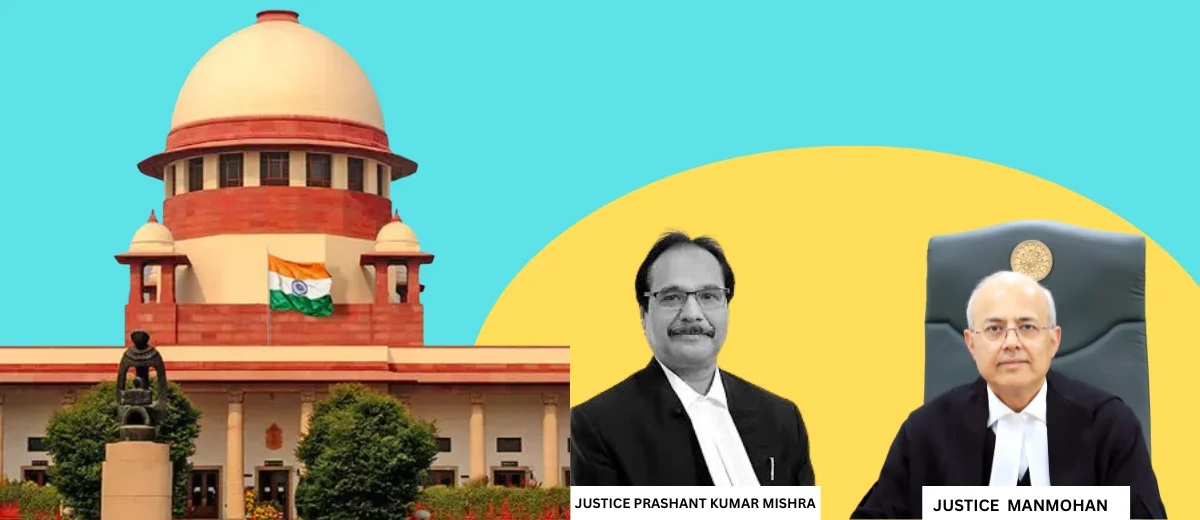
Case – Chinthada Anand vs State of Andhra Pradesh and Ors.
Petition Number – Criminal Appeal No.1580 of 2026 (Arising out of SLP (Crl.) No.9231/2025
Citation – 2026 INSC 283
Date of Judgement – 24.03.2026
Hon’able Judges/Corum– Justice Prashant Kumar Mishra and Justice Manmohan
BACKGROUND
Constitutional benefits cannot travel beyond constitutional identity. The Supreme Court, in this case, addressed a crucial issue concerning whether a person born into a ‘Scheduled Caste’ can retain the status after converting to another religion. The court reaffirmed that ‘Scheduled Caste’ status is not merely by birth but is constitutionally regulated and conversion to other religions like Christianity or Islam leads to loss of such status under law.
FACTS OF THE CASE
The appellant originally belonged to the Madiga community (a Scheduled Caste). He had been working as a Christian pastor for nearly a decade and conducting regular Sunday prayer meetings. He alleged that he was assaulted, abused with caste based slurs, and threatened by certain individuals due to his religious activities. Based on his complaint, an FIR was registered under provisions of Scheduled Caste and Scheduled Tribes (Prevention of Atrocities) Act,1989 and Indian Penal Code,1860. However, the accused approached the High Court seeking quashing of proceedings on the ground that the appellant having converted to Christianity, was no longer a member of a Scheduled caste and thus could not invoke the SC/ST Act . The High Court accepted this contention and quashed the proceedings. The appellant then approached the Supreme Court.
ISSUES INVOLVED
- Whether a person who has converted to Christianity can still claim Scheduled Caste (SC) status?
- Whether such a person can invoke protection under SC/ST (Prevention of Atrocities) Act, 1989?
- Whether the High Court was correct in quashing criminal proceedings ?
- Whether IPC offences were made out based on the available evidence?
ARGUMENTS OF THE PARTIES
The Appellant argued that caste is determined by birth and does not disappear upon conversion.
He contended that social discrimination continues even after conversion, and therefore, he should still be entitled to SC Status and protection under SC/ST Act. He further relied on a State Government Order stating that certain benefits may continue for converted individuals.
The Respondents argued that under the Constitution (Scheduled Castes) Order,1950, only persons professing Hinduism, Sikhism, or Buddhism can be considered as ‘Scheduled Caste’. Since the appellant was a Christian and Pastor, he no longer qualified. They contended that the SC/ST Act protection applies to only Hindus, Sikhs and Buddhists who are legally recognized as SC/ST members and thus proceedings are invalid.
JUDGEMENT AND ANALYSIS
The Supreme Court clearly held that conversion to Christianity or Islam results in loss of ‘Scheduled Caste’ status under Clause 3 of the Constitution (Scheduled Castes) Order, 1950. The court emphasized that only persons professing Hinduism, Sikhism, or Buddhism can be recognized as ‘Scheduled Castes’, and this condition is absolute. It clarified that once a person publicly professes another religion (such as Christianity), they cease to be a ‘Scheduled Caste’ in the eyes of law, regardless of birth. The Court denied the claim that caste persists despite conversion saying that constitutional recognition, and not social perception, determines SC status. It also believed that there are no statutory benefits such as protection under the SC/ST Act that can be availed of once such conversion has taken place. The Court also imposed very stringent requirements on reconversion such that they were required to demonstrate:
- Original caste;
- Genuine reconversion; and
- Acceptance by the community
The appellant was still a Pastor and professing Christian so could not invoke the SC status or protection under the SC/ST Act. The Court, after determining IPC charges, observed that there was incoherence in witness testimony, allegations were not adequately corroborated, and no prima facie case was established. Therefore, the Supreme Court confirmed the decision of the High Court and rejected the appeal.
CONCLUSION
The Court held that ‘Scheduled Caste’ status would cease to apply after conversion to Christianity or Islam, according to the Constitution (Scheduled Castes) Order, 1950. The Court reiterated that constitutional benefits are highly regulated and cannot be extended upon change of religious identity when one is born in another country. It strengthens the idea that entitlement is determined by legal identity and not social reality and that protections under the SC/ST Act can only be extended to those who are legally eligible to be considered as ‘Scheduled Castes’.




 > Mon - Sat, 9:00 AM – 7:30 PM