
Case Name: Shankar v State of Rajasthan
Petition Number: SPECIAL LEAVE PETITION (CRL.) NO. 13899 of 2025
Neutral Citation: 2026 INSC 315
Date of Judgement: 02.04.2026
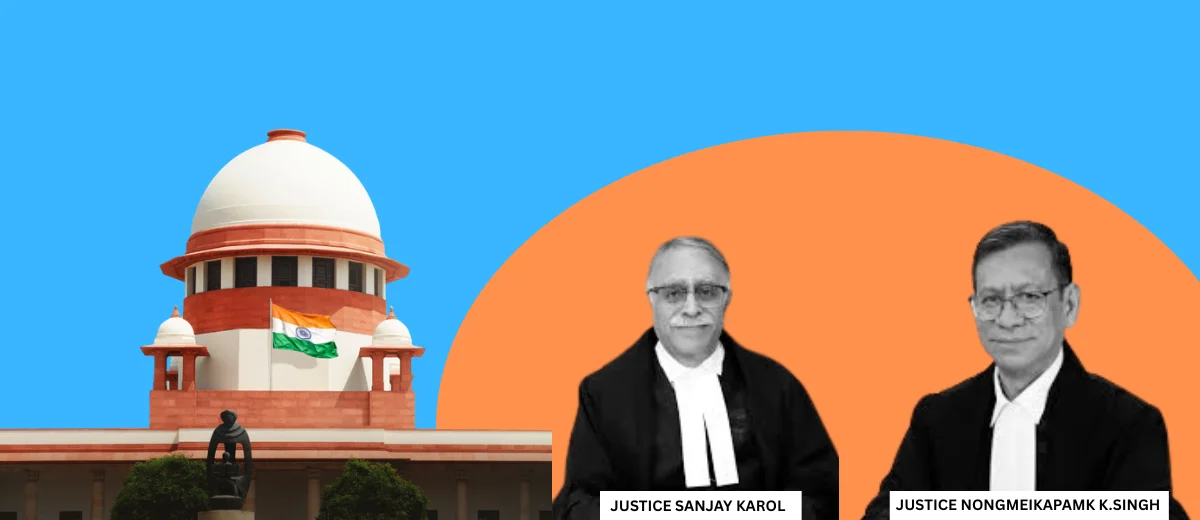
Coram: HON’BLE MR JUSTICE SANJAY KAROL & HON’BLE MR JUSTICE NONGMEIKAPAM KOTISWAR SINGH
INTRODUCTION
The appeal was filed by the accused, Shankar, challenging a judgment of the Division Bench of the High Court, which had confirmed the Trial Court’s decision convicting him of murder. The appellant was sentenced to life imprisonment for pouring kerosene on his wife and burning her to death. The Supreme Court examined the reliability of a dying declaration, the effect of hostile eyewitnesses, and the scope of interference in concurrent findings of conviction by lower courts.
FACTS
The appellant had a love marriage with the deceased about a month prior to her death on October 19, 2012. Within 20 days of the marriage, the relationship soured due to the appellant’s alleged excessive alcohol consumption and violent behaviour. The deceased had apparently gone to her parents’ when the appellant demanded she return to their rented room to cook for him.
When she complied and began preparing food, the appellant arrived in a drunken state, physically assaulted her, and locked the room from the inside. He then poured kerosene on her and set her on fire. Upon hearing her screams, he and a neighbouring tenant extinguished the fire. She was rushed to the hospital by her parents, where an Additional Chief Judicial Magistrate recorded her dying declaration. She succumbed to her burn injuries a few days later. The Trial Court convicted the appellant under Sections 302 and 342 of the IPC, which the High Court upheld.
ISSUE
- Whether the dying declaration recorded by the Magistrate was legally reliable, particularly given the appellant’s claim that the deceased was not in a fit mental condition to give a statement?
ARGUMENT OF THE PARTIES
The Appellant argued that the dying declaration was unreliable. He contended that the Magistrate had noted the victim’s mental condition was poor and had obtained the doctor’s certification on blank paper because the uneducated victim could not sign. The defence further alleged that the deceased was tutored by her parents to falsely implicate him. He further challenged the credibility of one of the doctors testifying for the prosecution, arguing he was only a ‘medical jurist’ and not a practising doctor.
The Respondent (State) supported the concurrent findings of the Trial Court and the High Court. The State maintained that the dying declaration was recorded strictly according to procedure, in a question-and-answer format, only after the duty doctor had examined the victim and certified her to be in a fit, conscious state of mind. The prosecution argued that the dying declaration was thoroughly corroborated by the medical evidence, which confirmed that the cause of death was septicaemia resulting from severe burn injuries.
JUDGEMENT AND ANALYSIS
The Hon’ble Supreme Court dismissed the appeal and upheld the appellant’s conviction and life sentence. The Court began by reiterating that its scope of interference in concurrent findings is highly restricted and permissible only if there is a manifest error in law or a gross misdirection in appreciating evidence.
Addressing the dying declaration, the Court emphasized that such statements enjoy a special position in law as exceptions to the hearsay rule, resting on the philosophical premise that a person facing imminent death is unlikely to lie. The Court thoroughly reviewed the Magistrate’s testimony and found no evidence supporting the appellant’s claim that the victim was of unsound mind. The duty doctor had properly examined the victim and certified her fitness before the Magistrate recorded the statement; the fact that this certification was on the reverse side of the paper did not diminish its legal sanctity.
The Court dismissed the allegations of the victim being “tutored” by her parents as a mere bald assertion with no evidentiary backing in cross-examination. The Court also rejected the attempt to discredit the ‘medical jurist’, noting his testimony perfectly aligned with the Medical Officer’s findings regarding the burn injuries.
CONCLUSION
The Supreme Court concluded that the prosecution had proved the appellant’s guilt beyond a reasonable doubt, affirming that a medically certified and procedurally sound dying declaration is sufficient to form the sole basis of a conviction.
The Court further supplemented its decision with a reflective postscript examining the wider societal dimensions of the offence. Despite decades of constitutional promises, legal reforms (like the Dowry Prohibition Act, Section 498A IPC, and the Domestic Violence Act), and welfare schemes, the Court observed that deep-rooted patriarchal control over women’s lives, bodies, and choices persists.
The Court observed that although India has made significant progress in terms of economic development, literacy, and women’s participation in education and employment, violence against women continues to persist. This is especially true in rural and semi-urban areas, where men still largely dominate decision-making and authority within the household. Highlighting the tragic paradox of macroeconomic progress coexisting with such brutal violence, the Court observed that the answer to why these patriarchal attitudes endure perhaps lies only with “We, the People of India.”





 > Mon - Sat, 9:00 AM – 7:30 PM