
Case Name: VIRINDER PAL SINGH V. PUNJAB AND SIND BANK & ORS.
Petition Number: CIVIL APPEAL NO. 3571 OF 2026 ARISING OUT OF SLP (C) No. 10742 OF 2026
Neutral Citation: 2026 INSC 266
Date of Judgement: 19.03.2026
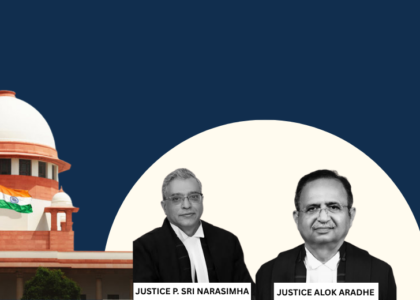
Coram: HON’BLE MR. JUSTICE PAMIDIGHANTAM SRI NARASIMHA AND HON’BLE MR. JUSTICE MANOJ MISRA
INTRODUCTION
In the present case, the appellant approached the Supreme Court aggrieved by an order of Division Bench of the High Court that allowed disciplinary proceedings to continue against him even after his retirement. Thus, the Supreme Court examined whether disciplinary proceedings initiated during the course of employment can continue post-retirement and penalties in the form of reduction of pay can be enforced by adjusting pensionary benefits.
FACTS AND PROCEDURAL HISTORY
The appellant, on the day of his retirement, was served a chargesheet alleging irregularities in disbursement of loans. The disciplinary proceedings continued against him and one of the charges, i.e. the appellant failed to ensure end use of the loan, was partly proved. Hence, punishment was initiated by reducing the scale of pay by three stages on a permanent basis. The appellant approached the Appellate Authority which dismissed the appeal. The appellant then filed a Writ Petition before the High Court, wherein the Single Bench of the High Court set aside the punishment order, allowing the bank to take action under Pension Regulations. The Bank aggrieved, appealed before the Division Bench of the High Court wherein it was held by the Bench that Regulation 20(3)(iii) of the Punjab and Sind Bank Officers’ Service Regulations permitted the continuance of disciplinary proceedings post completing the age of superannuation, and that disciplinary proceedings can continue against the appellant, based on the logical conclusion of the regulations. The appellant approached the Supreme Court aggrieved by the order of the Division Bench.
ISSUE
Whether the punishment by way of reduction in three stages of the scale of pay post-retirement of the appellant was permissible in law?
SUBMISSIONS OF THE PARTIES
The Appellant contended that after completing the age of superannuation, there did not exist a Master-Servant relationship between the Bank and the appellant and hence, the punishment could not be imposed. The Counsel for the appellant, relying on previous decisions, submitted that punishment of dismissal should be distinguished from reduction of pay as in the former, there is no liability to pay pension to the employee. The appellant further contended that Service Regulations apply only to employees in service. The other grounds which the appellant listed were: Concerned charges were not proved and not related to any specified misconduct.
The Respondent Bank contended that the general principle of barring disciplinary action after termination of the Master-Servant relationship after completing the age of superannuation holds an exception, i.e. if the Service Rules/Regulations permit the continuance of disciplinary proceedings post the age of superannuation, the proceedings can continue and be closed in its logical conclusion, quoting Regulation 20(3)(iii). The Respondent further added that the aforementioned regulation permits continuance of disciplinary proceedings even if it was initiated before superannuation and that the appellant never questioned the cash withdrawals of the borrower without supporting bills, which raises questions about the intended purpose. Moreover, according to the Respondent, only a small sum of Rs. 302 has been reduced from the pension of the Appellant, which does not render it a punishment disproportionate to the misconduct.
JUDGEMENT AND ANALYSIS
The Supreme Court noted that the appellant never raised objections against the Inquiry Officer on the Inquiry Report or that he was never given a due opportunity of hearing when asked to submit his comments. The Court explained the purpose of ensuring end-use loan disbursals: One, it ensures the loan is not used for purposes other than for the one sanctioned. Second, it ensures recovery. The Court emphasized that the absence of end use of the loan would amount to financial irregularity which would expose the Bank to financial risk. Pertinently, the Court stated that penal action on proof of a charge cannot be questioned just because the bank did not suffer financial loss.
The Court cautioned that whether by intention or by negligence, the dereliction in discharge of duties constitutes misconduct and thus concluded that the punishment was not disproportionate to conduct. Referring to its decisions in UCO Bank and Others v. Prabhakar Sadashiv Karvade (2018) 14 SCC 98 and Ramesh Chandra Sharma v. Punjab National Bank and Anr (2007) 9 SCC 15, the Court held that if the concerned Regulations permit continuance of proceedings initiated against an employee during service before retirement, they can be continued and brought to conclusion after retirement. The Court also considered the question of inflicting the punishment of dismissal on an employee who has already completed the age of superannuation, which it answered affirmatively meaning that if the ultimate punishment is dismissal, then there may be no difficulty in forfeiting the pension and other related retiral dues. Here, since the pension was reduced in three stages, it is calculated based on the last salary drawn.
However, while concluding, the Court cautioned that if the punishment imposed is partial reduction or adjustment of pension and not forfeiture of the entire pension, then it has to be considered individually whether it is implementable or not. Accordingly, the Court dismissed the appeal.
CONCLUSION
This judgement is thus an important precedent in discharge of duties for bank employees with regard to disbursement of loans, regardless of whether the bank suffered financial loss or not and with respect to retirement and pension reduction, imposing stricter liabilities on employees even after completing superannuation.


 > Mon - Sat, 9:00 AM – 7:30 PM