Case Name: PADAM MEHTA & ANR. V. THE STATE OF RAJASTHAN & ORS.
Petition Number: Civil Appeal @ SLP(C) No. 1425 Of 2025
Neutral Citation: 2026 INSC 476
Date of Judgment: 12.05.26
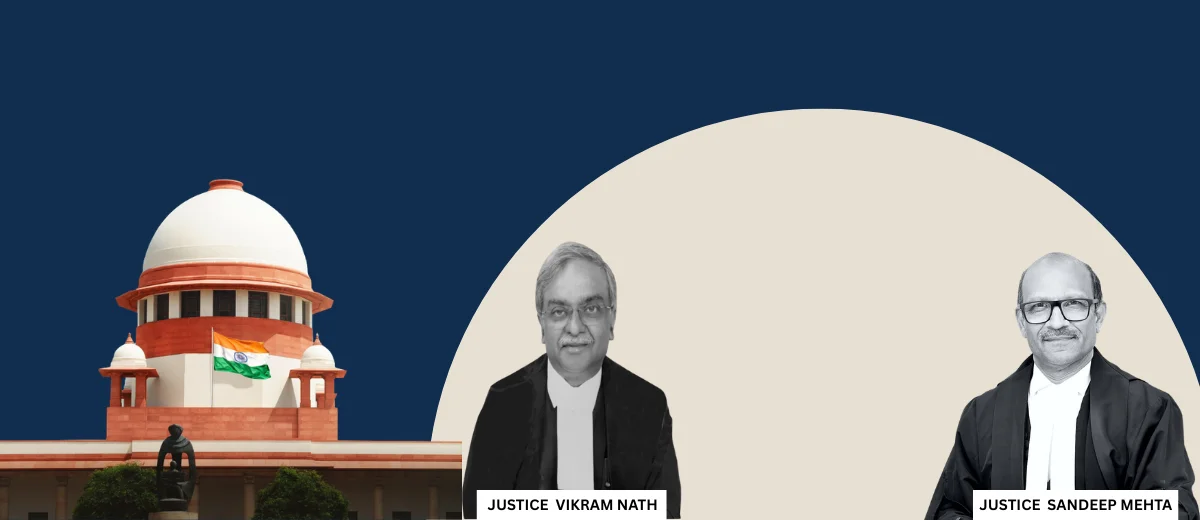
Coram: HON’BLE MR. JUSTICE VIKRAM NATH & HON’BLE MR. JUSTICE SANDEEP MEHTA
INTRODUCTION
The case addresses whether the State has a constitutional and statutory obligation to recognize and promote a regional language (Rajasthani) as a medium of instruction and as a subject in school curricula and teacher recruitment. The Supreme Court treated language as constitutionally significant because comprehension and meaningful participation depend on understanding one’s own language. The Court underscored that the right to receive education in a language one understands is an integral facet of the Freedom of Speech and Expression and the Right to Education.
FACTS AND PROCEDURAL HISTORY
The appellants filed a Public Interest Litigation (PIL) before the Rajasthan High Court seeking two primary directions to include Rajasthani language in the syllabus for the recruitment of teachers (Grade-III) under the Rajasthani Eligibility Examination for Teachers (REET), 2021 and to impart education to children in Rajasthani or the relevant local mother tongue. The Rajasthan High Court dismissed the PIL, holding that a writ of mandamus can only be issued if there is a failure to discharge a statutory duty or a breach of an enforceable legal right. The High Court found no such right for the Rajasthani language as it was not included in the Eighth Schedule of the Constitution. The appellants then moved the Supreme Court.
ISSUES
- Whether the State is obligated to provide primary education in the mother-tongue (Rajasthani) under the constitutional framework and the Right to Education Act (RTE Act) ?
- Whether the exclusion of a widely spoken language from the educational framework, while other minority languages are included, constitutes “hostile discrimination” under Art. 14 ?
- Whether the lack of inclusion in the Eighth Schedule is a valid ground for the State to refuse the recognition of a language for educational purposes.
SUBMISSIONS OF THE PARTIES
The appellants argued that Rajasthani speakers constitute a “linguistic minority” and entitled to facilities under Art. 350A. They submitted that the right to choose the medium of instruction is implicit in Art. 19(1)(a), especially when read with Art. 21A, because education must be intelligible and meaningful. They also pointed out a “hostile discrimination” because languages like Punjabi, Sindhi and Gujarati were included in school curricula while Rajasthani was excluded.
The respondents submitted that education and teacher recruitment are only conducted for languages formally recognized in the Eighth Schedule of the Constitution. Since Rajasthani language is not in the Eighth Schedule, no policy framework exists for its adoption. They argued that Art. 350A is only a directory and not mandatory, thus not creating an enforceable right. They further argued that the NEP 2020 is only an executive policy without statutory force and does not create legal obligations enforceable by writ.
JUDGMENT AND ANALYSIS
The Supreme Court set aside the order of the Rajasthan High Court and allowed the appeal. The Court structured its judicial reasoning and addressed each of the specific issues as follows:
Deciding the first issue, the Court held that the State bears a clear, active constitutional and statutory obligation to facilitate primary education in a child’s mother tongue. The Bench ruled that the mandate under Art. 21A is not merely to provide formal physical access to schooling, but to provide meaningful and qualitative education. If the medium of instruction is entirely alien or unintelligible to a child, the education ceases to be qualitative.
The Court cited State of U.P. v. Anand Kumar Yadav (2018) 13 SCC 560 and Devesh Sharma v. Union of India (2023) 18 SCC 339 to emphasize that the true legislative intent behind the RTE Act is to introduce a transformative, satisfactory and equitable quality to elementary education. Relying on the landmark Constitution Bench ruling in State of Karnataka v. Associated of English Medium Primary & Secondary Schools (2014) 9 SCC 485, the Court reiterated that Art. 19(1)(a) guarantees a child (and their parents) the freedom to receive primary education in their language of choice. Genuine comprehension is an intrinsic facet of the freedom of speech and expression.
The Court highlighted Section 29(2)(f) of the RTE Act, 2009, which explicitly dictates that the medium of instruction shall, “as far as practicable, be in the child’s mother tongue”. The Court noted that forcing a child into an unfamiliar linguistic environment creates academic trauma and anxiety, defeating the core purpose of the Act as upheld in Society for Unaided Private Schools of Rajasthan v. Union of India (2012) 6 SCC 1.
While dealing with the second issue, the Court found the State’s selective curriculum policy lacked a rational nexus with its educational objectives, thereby violating Art. 14. The Court observed that the State of Rajasthan officially recognizes and provides educational infrastructure for other minority regional languages such as Punjabi, Sindhi and Gujarati. However, it systematically excluded Rajasthani- the actual local mother tongue spoken by a vast majority of the population in the State. The Bench pointed out a stark internal contradiction in the State’s administration as Rajasthani is actively taught and accepted at the university level including at the University of Rajasthan, Jai Narain Vyas University and Maharaja Ganga Singh University. Denying its implementation at the primary school level while facilitating other languages constitutes an arbitrary and hostile classification under Art. 14.
The Court roundly rejected the State’s defense while addressing the third issue and ruled that the Eighth Schedule is not a “gatekeeper” or a prerequisite for educational policy. The Court clarified that non-inclusion in the Eighth Schedule does not strip a language of its pedagogical or constitutional value under Art. 350A (which mandates states to provide adequate facilities for instruction in the mother-tongue at the primary stage). The Bench reliance on English Medium Students Parents Assn. v. State of Karnataka & Ors. (1994) 1 SCC 550, which established that it is the natural endeavor and duty of every state government to preserve, promote and develop its dominant regional language. The Court noted that administrative or executive inaction cannot be used as an excuse to keep fundamental rights dormant, upholding in Para 47:
“Constitutional rights, once recognised, must be translated into tangible outcomes and cannot be permitted to languish as mere abstractions.”
CONCLUSION
The Supreme Court held that language is integral to meaningful education and constitutional participation and directed the State of Rajasthan to formulate a comprehensive policy to implement mother tongue-based education in line with NEP 2020. The Court also recognized Rajasthani as a regional language for educational purposes and introduced it as a subject in a phased manner.


 > Mon - Sat, 9:00 AM – 7:30 PM