
Case Name: RAM BALAK V. STATE OF UP
Petition Number: SLP(CRL) NO. 16332 OF 2025
Neutral Citation: 2026 INSC 511
Date of Judgment: 19.05.2026
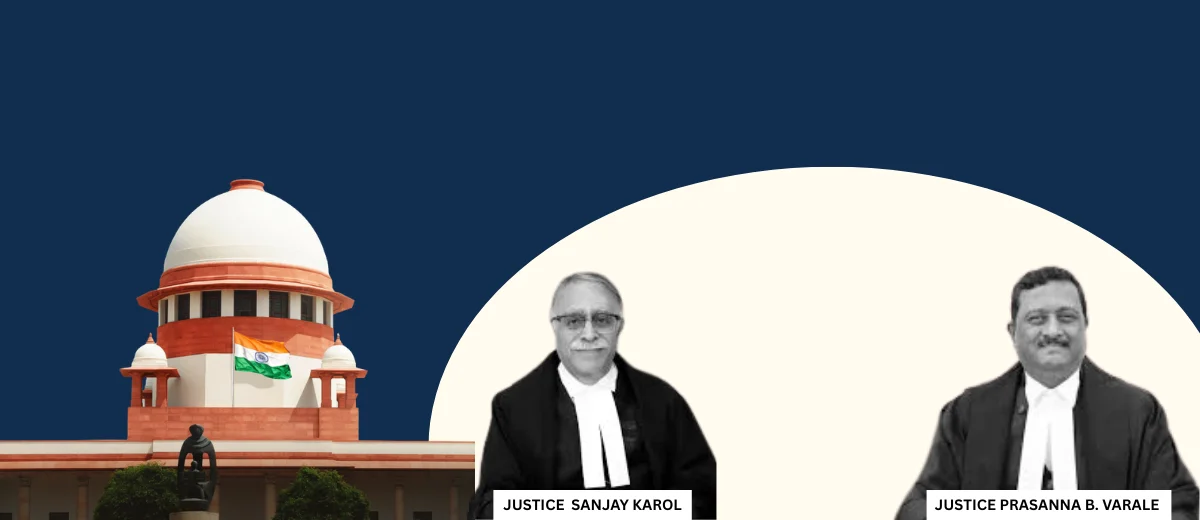
Coram: HON’BLE JUSTICE MR. SANJAY KAROL & HON’BLE MR. JUSTICE PRASANNA B VARALE
Relevant Provisions: Section 483 of the Bharatiya Nagarik Suraksha Sanhita, 2023, Sections 419, 420, 467, 468 and 471 of the Indian Penal Code.
INTRODUCTION
The primary question before the Supreme Court in this case was whether, while exercising jurisdiction under Section 483 of the Bharatiya Nagarik Suraksha Sanhita, 2023, a High Court can issue administrative directions concerning execution of summons and accountability of police authorities in bail proceedings. The Supreme Court examined the scope of bail powers, earlier High Court orders, and State compliance measures treating administrative directions as judicial mandates and held that Section 483 of the Bharatiya Nagarik Suraksha Sanhita, 2023, jurisdiction is confined to the question of grant, refusal, or conditions of bail and does not extend to issuing systemic administrative directions governing investigation, service of summons, or execution of coercive processes.
FACTS
The appeal arose from an order of the Allahabad High Court rejecting the appellant’s second bail application in a 2002 case involving offences under Sections 419, 420, 467, 468 and 471 of the IPC. While dismissing bail, the High Court also issued directions requiring trial courts and police authorities to ensure timely service of summons and execution of coercive processes, relying on earlier decisions such as Bhanwar Singh @ Karamvir v. State of UP [CRMBA 16871 of 2023] and Jitendra v. State of UP [CRMBA 9126 of 2023]. The High Court had previously, in related bail matters, called for affidavits from senior State officials and directed creation of accountability mechanisms for execution of court processes, which were later implemented through government orders.
Aggrieved, the accused approached the Supreme Court. The Supreme Court by an interim order granted bail to the appellant, while the matter was taken up further to determine whether such administrative and systemic directions could be issued by courts while exercising statutory bail jurisdiction under Section 483 BNSS, 2023.
ISSUE
Whether, while exercising bail jurisdiction under Section 483 BNSS, 2023, a High Court can issue systemic administrative directions mandating execution of summons and creating accountability mechanisms for police authorities?
JUDGMENT AND ANALYSIS
The Supreme Court held that while High Courts and Courts of Session possess wide discretion under Section 483 of the Bharatiya Nagarik Suraksha Sanhita, 2023, such jurisdiction is confined to the question of grant, refusal, or conditions of bail and does not extend to issuing systemic administrative directions governing investigation, service of summons, or execution of coercive processes. The Court emphasized that bail jurisdiction is statutory in nature and must operate within the four corners of the enabling provision.
It further relied on the State of U.P. v. Anirudh [(2026) SCC OnLine SC 40], reiterating that statutory powers of courts cannot be expanded by invoking constitutional status when acting within a defined statutory jurisdiction. The Court distinguished constitutional powers from statutory powers, holding that the latter are circumscribed by legislative intent and cannot be used to supervise executive functioning beyond the statute.
The Court therefore set aside the impugned directions issued by the High Court insofar as they mandated administrative reforms and accountability mechanisms, holding them to be beyond the scope of bail jurisdiction. However, it clarified that the State’s administrative measures already taken pursuant to such directions would not be invalidated and may continue in accordance with law. The Court also clarified that its decision did not affect the grant of bail in the appellant’s favour or the merits of the criminal proceedings pending trial. The appeal was accordingly allowed, with pending applications disposed of. All interim directions were confirmed subject to clarification on jurisdictional limits.
CONCLUSION
The Supreme Court reaffirmed that bail jurisdiction under Section 483 BNSS is strictly limited to the adjudication of bail and cannot be expanded into issuing administrative or systemic directions to the executive. It clarified the distinction between statutory and constitutional powers of courts and set aside High Court directions exceeding jurisdiction. However, it preserved State actions already taken and did not disturb the grant of bail, thereby maintaining procedural balance in criminal justice administration.




 > Mon - Sat, 9:00 AM – 7:30 PM