
Case Name: SHISHU PAL @ SHISH RAM & ORS. V. SURJEET & ORS.
Petition No.: Civil Appeal No 8456 OF 2026 (@Special Leave Petition (Civil) No. 33915 of 2025)
Neutral Citation: 2026 INSC 634
Date of Judgement: 11.06.2026
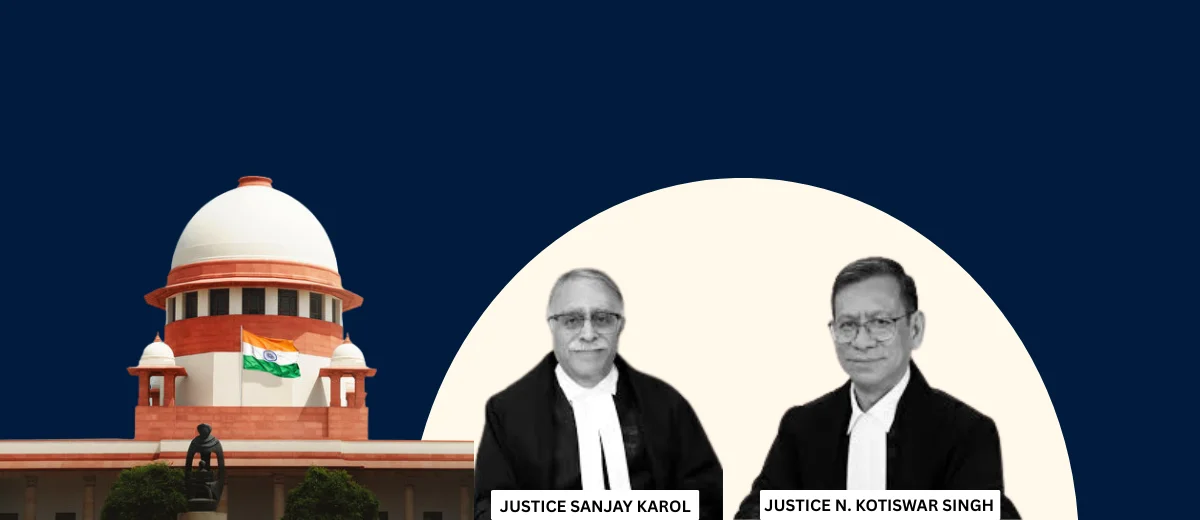
Coram: Hon’ble Justice Sanjay Karol & Hon’ble Justice Nongmeikapam Kotiswar Singh
Relevant Provisions: Sections 166, 168, 169 of the Motor Vehicles Act, 1988
BACKGROUND
In Shishu Pal @ Shish Ram & Ors. v. Surjeet & Ors., the Supreme Court revisited the principles governing compensation under the Motor Vehicles Act, 1988, in cases involving the death of a homemaker. The Court highlighted the longstanding undervaluation of unpaid domestic labour and recognised the substantial social and economic contribution of homemakers, describing them as “Nation Builders.” It further examined the consequences of protracted judicial delays in motor accident compensation proceedings, particularly under a welfare-oriented statute intended to provide prompt relief. The judgment advances the law on assessing compensation for homemakers while reaffirming the judiciary’s responsibility to ensure timely and effective adjudication of compensation claims.
FACTS
The case arose from a motor vehicle accident on 25th November 2001, in which a homemaker lost her life due to the rash and negligent driving of Respondent No. 1 while travelling from Sirsa to Fatehabad. Her legal heirs filed a Claim Petition before the Motor Accident Claims Tribunal, Sirsa, which awarded compensation of Rs. 2.42 lakh in 2003. Challenging the inadequacy of the award, the claimants appealed to the Punjab and Haryana High Court in 2004. Due to prolonged delays, including the destruction and reconstruction of court records, the appeal remained pending for nearly twenty years. In 2024, the High Court enhanced the compensation, prompting a further appeal before the Supreme Court.
ISSUE
The primary issue before the Court was regarding the method to be adopted in determining compensation under the Motor Vehicle Act 1988 in case of the death of a homemaker.
ARGUMENTS OF THE PARTIES
The appellants argued that the compensation awarded by the High Court was inadequate and failed to account for the full extent of the deceased homemaker’s contribution to the family. They contended that the prevailing practice of assigning a modest notional income to homemakers undervalues the economic significance of unpaid domestic work, caregiving, and household management. The respondents opposed any further enhancement, asserting that compensation must be determined in accordance with established principles governing motor accident claims. They maintained that the deceased’s alleged earnings from knitting and stitching could not be considered in the absence of supporting evidence and that compensation should be assessed on the basis of settled norms relating to notional income, multiplier application, and conventional heads of damages.
JUDGEMENT AND ANALYSIS
The Supreme Court held that compensation awarded for the death of a homemaker must meaningfully reflect the economic value of unpaid domestic labour and that prolonged judicial delays should not defeat the statutory objective of granting just and fair compensation under the Motor Vehicles Act, 1988. Recognising the indispensable role played by homemakers in sustaining families and contributing to the broader economy, the Court relied on empirical material, including the 2019 Time Use Survey, to emphasise the disproportionate burden of unpaid household work borne by women. It consequently described homemakers as “Nation Builders” whose contributions deserve meaningful legal and economic recognition.
In support of its reasoning, the Court relied on established precedents recognising the economic value of a homemaker’s contributions. In Lata Wadhwa v. State of Bihar (2001) 8 SCC 197, a three-judge Bench endorsed the multiplier method for determining compensation in cases involving the death of housewives and considered an amount of ₹3,000 per month adequate for deceased housewives within the age group of 34 to 59 years. Likewise, in Arun Kumar Agrawal v. National Insurance Co. Ltd. (2010) 9 SCC 218, the Court underscored that the term “services” should be construed expansively to encompass the care, guidance, attention, and support rendered by a wife and mother. The Court held that the deprivation of such invaluable yet unpaid services constitutes a compensable loss for the surviving family members.
A notable aspect of the judgment is the Court’s distinction between “loss of consortium” and “loss of domestic care.” While consortium, as recognised in Magma General Insurance Co. Ltd. v. Nanu Ram (2018) 18 SCC 130, compensates for the loss of love, affection, companionship, and emotional support arising from familial relationships, it does not account for the practical and economic loss caused by the absence of a homemaker. The Court, while discussing the aspect of computation for damages under non-pecuniary heads, categorized the same into three separate heads, the first being homemaker’s contribution towards the smooth functioning of the household, the second being the loss of maternal support for children and the third being the loss of spousal support. The Court then introduced a separate head of compensation called “loss of domestic care,” prescribing a composite amount of ₹30,000 per month where all three elements are present. This amount is to be revised cumulatively by 10% every three years and is intended to serve as a basic minimum monthly income in cases where the homemaker had no independently verifiable monetary earnings.
The Court also highlighted the systemic problem of judicial delay in motor accident compensation litigation. Noting that the claimants had pursued relief for nearly twenty-five years and that the appeal remained pending before the High Court for approximately two decades, it observed that such delays undermine the remedial purpose of the Motor Vehicles Act, 1988. In an unusual empirical exercise, the Court examined a large number of motor accident compensation appeals across various High Courts and analysed the time consumed at different stages of adjudication. The findings revealed that excessive delay had become a structural feature of compensation proceedings, significantly weakening the effectiveness of a welfare-oriented legislative framework designed to provide timely relief to victims and their families.
CONCLUSION
The Supreme Court has significantly advanced compensation jurisprudence by affirming that the unpaid domestic and caregiving labour of homemakers constitutes an economically valuable contribution that must be adequately recognised in motor accident claims. By introducing the head of “loss of domestic care,” the Court addressed a longstanding gap in the law and ensured a more realistic assessment of the loss suffered by dependents. The judgment further highlights the corrosive effect of prolonged judicial delays on access to justice and underscores the obligation of courts to secure timely relief under welfare-oriented legislation. As a result, the decision strengthens both the substantive and procedural dimensions of compensation law while promoting a more gender-sensitive and equitable understanding of domestic labour.




 > Mon - Sat, 9:00 AM – 7:30 PM