Case Name: DARUBAI & ANR. v. KAMALABAI & ORS.
Petition No.: Arising out of Special Leave Petition (Civil) No. 13232 of 2022
Neutral Citation: 2026 INSC 613
Date of Judgment: 01.06.2026
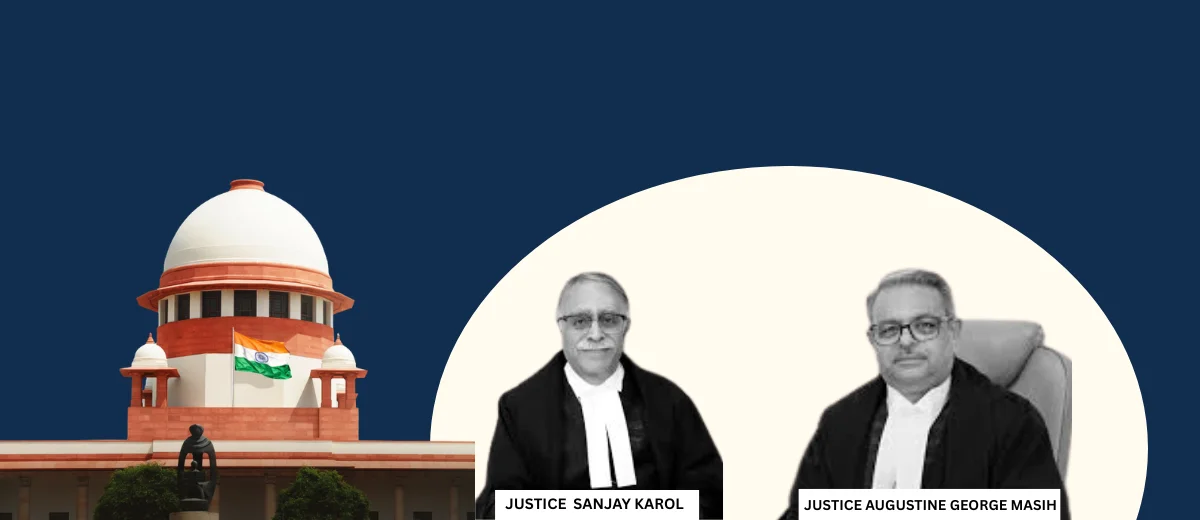
Coram: Hon’ble Mr. Justice Sanjay Karol & Hon’ble Mr. Justice Augustine George Masih
Relevant Statutes & Provisions: Section 8, Section 10, Section 19, Section 30 of Hindu Succession Act, 1956.
INTRODUCTION
This appeal arose from a judgment of the High Court of Judicature at Bombay, Aurangabad Bench, which had allowed a Second Appeal and restored a Civil Court decree in a suit for partition and separate possession. The dispute, pending for over half a century, was between a step-mother and the daughters of her deceased husband over his separate property. The central question was whether the step-mother could justify a sale of part of the property as ‘karta’ on the ground of legal necessity, which in turn depended on whether the heirs succeeded to the property as tenants-in-common or as joint tenants.
FACTS
Four plaintiffs, including the respondent herein, filed a suit for partition and separate possession claiming to be 4/5th owners of land and two houses at village Sapti, as daughters and successors-in-interest of late Dajiba, along with Darubai, Dajiba’s wife. The Civil Court decreed the suit by judgment dated 20.10.1995, rejecting Darubai’s defence that she had sold part of the property as ‘karta’, out of legal necessity, for the marriage of one of the plaintiffs, to one Dattatraya. The First Appellate Court, by judgment dated 09.03.1999, reversed this finding, holding that legal necessity was established along with Darubai’s right to manage the property, and interfered with the Civil Court’s judgment only insofar as the sale to Dattatraya was concerned. In the Second Appeal filed by plaintiff no. 4, the High Court, by judgment dated 31.03.2022, restored the judgment of the Civil Court. Darubai, the original defendant, challenged this judgment before the Supreme Court. The relationship between the parties and the character of the suit property as the separate property of Dajiba were not in dispute.
ISSUES
- Whether the defendant could avail the ground of legal necessity as ‘karta’ of the family to justify the sale of part of the suit property.
- Whether the parties to the dispute would succeed to the suit properties as tenants-in-common or as joint tenants, their rights flowing from Section 8 of the Hindu Succession Act, 1956.
ARGUMENTS OF THE PARTIES
The appellant contended that she had sold part of the suit property to Dattatraya as the karta of the family due to legal necessity, namely to meet the marriage expenses of one of the plaintiffs. She argued that the First Appellate Court rightly recognized both the existence of legal necessity and her authority to manage and alienate the property in that capacity. The respondents sought partition and separate possession, claiming that as Class I heirs of Dajiba, they were each entitled to their respective shares in the property. They disputed the appellant’s claim that she could alienate the property as karta.
JUDGEMENT AND ANALYSIS
The Court explained the distinction between joint tenancy and tenancy-in-common. In a joint tenancy, all co-owners together constitute ownership, governed by the rule of survivorship. When one joint tenant dies, his interest automatically accrues to the surviving co-owners, and not on his own progeny. In tenancy-in-common, each co-owner holds a distinct, identifiable, and notionally separate share, and on the death of a co-owner, that share devolves on his own heirs under the law of succession, with no place for survivorship. The Court traced this distinction through Jogeswar Narain Deo v. Ram Chund Dutt, (1896 SCC OnLine PC 5), where joint tenancy was held to be unknown to Hindu law except in coparcenary among members of an undivided family, and referred to Nawab Nisar Ali Khan v. Sardar Nawazish Ali Khan, (1939 SCC OnLine Lah 153), and Azizun Nisa v. Assistant Custodian, (1957 SCC OnLine All 83), on the nature of shares under each form of ownership.
On the character of property inherited under Section 8, the Court relied on CWT v. Chander Sen, [(1986) 3 SCC 567], which held that property devolving on a son under Section 8 is taken by him in his individual capacity and not as karta of his own Hindu Undivided Family, so that his own son acquires no birthright in it merely because it once belonged to the propositus. The Court also relied on Yudhishter v. Ashok Kumar, [(1987) 1 SCC 204], which reiterated that property inherited under Section 8 does not assume the character of coparcenary property, the inheritance being individual and statutory. The Court further relied on M. Arumugam v. Ammaniammal, [(2020) 11 SCC 103], which held that heirs inheriting under Sections 6 and 8 of the Act hold the property as tenants-in-common and not as joint tenants, and noted that Section 30, read with Section 19, indicates that such property is not to be treated as joint family property, even though it may be held jointly by the legal heirs as tenants-in-common until divided or otherwise dealt with.
On this basis, the Court held that in the context of Section 8, the question of karta-ship ordinarily does not arise merely because the property came from a paternal ancestor; the heirs succeed as tenants-in-common with definite and separate shares, and the property devolves by succession rather than survivorship. Applying this to the facts, the Court held that upon Dajiba’s death, Darubai and her four step-daughters became tenants-in-common with definite and separate shares of 1/5th each. Since each held a separate and identifiable share, the Court held there was no question of Darubai acting as karta to sell a part of the property on the ground of legal necessity; she only had the right to deal with her own 1/5th share.
CONCLUSION
The appeal was dismissed. The Court held that the heirs of late Dajiba, including Darubai, succeeded to his property as tenants-in-common with definite and separate 1/5th shares each, and not as joint tenants. Since Darubai held only her own separate share, she could not justify the sale of part of the property as ‘karta’ of the family on the ground of legal necessity. The High Court’s restoration of the Civil Court’s decree was upheld. There was no order as to costs.



 > Mon - Sat, 9:00 AM – 7:30 PM