Case Name: BAKSISH AHMAD v. UNION OF INDIA & ANR.
Petition No.: Civil Appeal Nos…….of 2026 [Arising out of SLP (Civil) Nos. 855-856 of 2026]
Neutral Citation: 2026 INSC 630
Date of Judgement: 09.06.2026
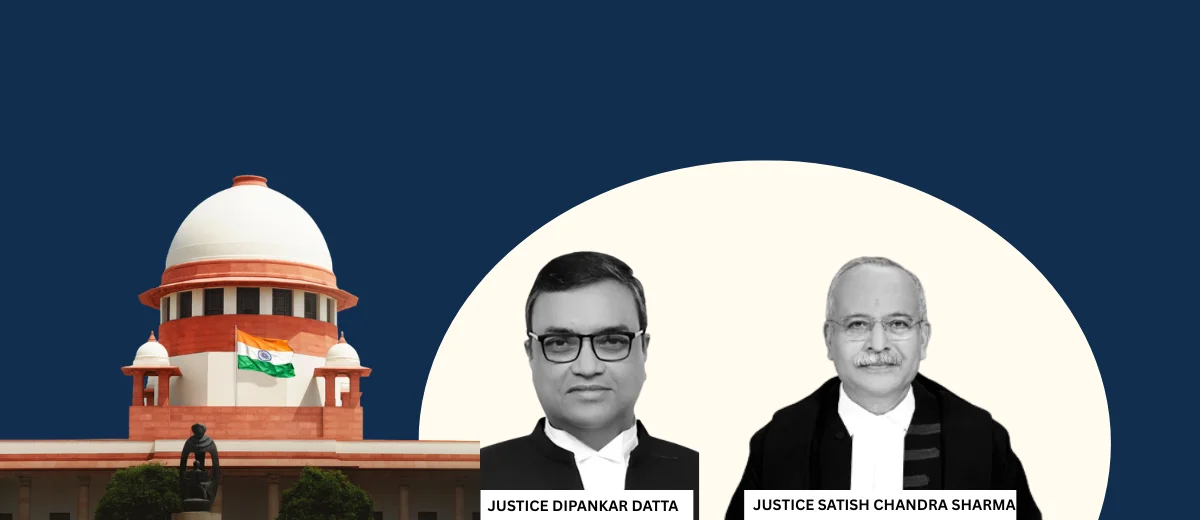
Coram: Hon’ble Mr. Justice Dipankar Datta & Hon’ble Mr. Justice Satish Chandra Sharma
Relevant Statutes & Provisions: Article 226(1) and 226(2), Constitution of India; Rule 7, Rule 22, Rule 177, Border Security Force Rules, 1969; Rule 21, Central Civil Services (Conduct) Rules, 1964.
INTRODUCTION
This appeal arose from the dismissal of a writ petition filed before the Delhi High Court by a constable of the BSF who was dismissed from service on account of contracting a second marriage during the subsistence of his first marriage and without obtaining permission from the authority. The central question before the Supreme Court was whether the Delhi High Court had territorial jurisdiction to entertain the writ petition under Article 226 of the Constitution of India, and whether that Court correctly applied the doctrine of forum non conveniens to decline jurisdiction.
FACTS
The appellant was enrolled as a member of the BSF. While he was serving, a missing person report concerning a woman was filed, the appellant was suspected to be involved in her abduction. Meanwhile the appellant’s wife also lodged a complaint alleging that the appellant had contracted a second marriage with the said lady. A Staff Court of Inquiry (SCoI) was ordered. The SCoI found that the appellant, without divorcing his first wife, had contracted a second marriage with the lady who was herself already married, without getting an approval from authorities.
The appellant was served with a show cause notice, he failed to respond to the same within fifteen days. Thus he was dismissed from service without pensionary benefits. The appellant filed a statutory petition, seeking reinstatement. The petition was placed before the Inspector General, BSF, Jammu. The IG condoned the delay in filing but rejected the petition on merits. The appellant then filed a writ petition before the Delhi High Court under Article 226 of the Constitution. The Division Bench dismissed it on grounds of forum non conveniens, holding that the cause of action had arisen either in West Bengal or in Jammu & Kashmir, not within Delhi. The review petition was also dismissed.
ISSUE
Whether the Delhi High Court was right in refusing to entertain, try and adjudicate the writ petition of the appellant on the ground of forum non conveniens.
ARGUMENTS OF THE PARTIES
The appellants contended that the Delhi High Court did have territorial jurisdiction under clause (1) of Article 226, which confers jurisdiction upon a High Court where the authority against whom a writ is sought is situated within its territorial limits. They argued that, since the Union of India and the Director General, BSF, were both located in Delhi; the Delhi High Court was competent to adjudicate the matter. The respondents submitted that the impugned judgment required no interference, Delhi High Court had correctly found that no part of the cause of action arose within its territorial limits. It was further argued that the Delhi High Court could not be regarded as the forum conveniens merely because the situs of the offices of the respondents were in Delhi. On the contrary, the most appropriate forum is the High Court at Calcutta within whose territorial jurisdiction the integral and essential part of the cause of action had arisen.
JUDGEMENT AND ANALYSIS
The Court first examined Abrar Ali v. CISF (Civil Appeal No. 6020 of 2012) and agreed with the outcome of that decision. Upon closer examination, however, the Court observed that the Delhi High Court in Abrar Ali had actually considered and consciously rejected jurisdiction despite being aware of the CISF’s presence in Delhi. The Court therefore acknowledged that the characterisation in Abrar Ali that the High Court had “overlooked” that the CISF headquarters was located in Delhi. Article 226(1) was not entirely accurate.
Nonetheless, the Court held that the ultimate conclusion in Abrar Ali remained sound. The reason behind this conclusion was that in Shri Ranjeet Mal v. General Manager, Northern Railway, Baroda House, New Delhi (1977) 1 SCC 484, Supreme court held that liability for enforcement of an order quashing an order of dismissal from service of a railway servant will lie with the Union of India. Reading this principle alongside Sections 4 and 5 of the BSF Act, the Court held that since the Union of India and the Director General, BSF, maintain their offices in New Delhi, highlighting that there is a presumption that official acts have been regularly performed, it was held that the Delhi High Court was competent to try and entertain the writ petition of the appellant.
To reconcile the apparent conflict between its previous judgments, the Court categorically laid down the following: where any member of the Central Armed Police Forces, including the BSF, is aggrieved by an administrative order of termination of service, the Delhi High Court has territorial jurisdiction under clause (1) of Article 226, by virtue of the situs of the offices of the Union of India and the Director General, BSF, regardless of where the cause of action arose.
Referring to Arif Azim Co. Ltd. v. Micromax Informatics FZE, (2025) 9 SCC 750, the Court explained that doctrine of forum non conveniens applies only where multiple fora are available to a litigant for seeking the same remedy; and, when such multiple fora are available, the forum which has been approached is entitled in law to examine whether any other forum is more convenient and/or better suited to consider and decide the claim that has been raised by the aggrieved litigant. It permits a court with valid jurisdiction to decline its exercise where a clearly more appropriate forum exists.
CONCLUSION
The appeal was allowed and the impugned order of the Division Bench of the Delhi High Court was set aside. The appellant’s writ petition was revived before the Delhi High Court for consideration on merits. Further, the Court concluded that where the question of pursuing a constitutional remedy is involved and invocation of writ jurisdiction is traceable to clause (1) of Article 226, the doctrine of forum non conveniens may rarely apply.


 > Mon - Sat, 9:00 AM – 7:30 PM