
DATE: 19/03/2026
Case: Subramani v. State of Karnataka
Petition Number: Criminal Appeal No. 2432 of 2010
Citation: 2026 INSC 249
Date of Judgement: March 17, 2026
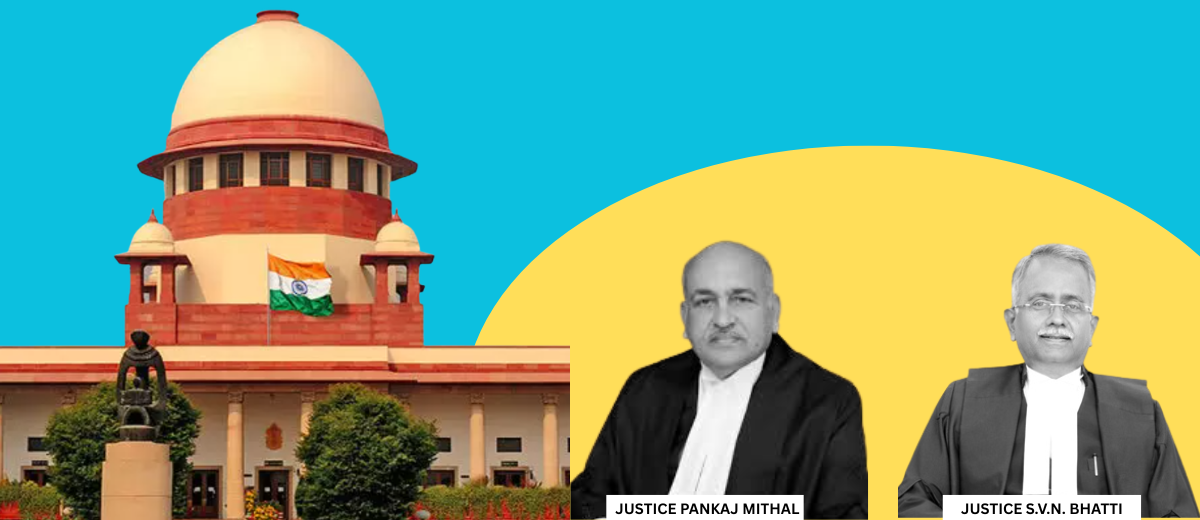
Hon’ble Judge/ Corum: Hon’ble Justice Pankaj Mithal and Hon’ble Justice S.V.N. Bhatti
Introduction
Justice Pankaj Mithal and Justice S.V.N Bhatti, on March 17, 2026, brought justice to a 26-year-old inhumane act of cruelty performed by a husband on his wife over the demand for money by upholding the Karnataka High Court’s decision to reverse the acquittal of the accused, and sentencing him to life imprisonment under Section 302 of the Indian Penal Code (IPC) and 2 years of simple imprisonment under 498A of IPC.
The bench observed that the dying declaration given by the deceased shall override discrepancies in the investigating officer’s statement, once approved by the doctor certifying that the deceased was in a fit state of mind.
Factual Matrix
The accused and the deceased were married for 17 years before the incident on July 20, 2000, occurred. They had 4 children, with their eldest being 16 years of age at the time of the incident. The accused, with time, became abusive towards the deceased and kept on raising demands for money, which the father of the deceased fulfilled.
On July 20, 2000, the accused came to the house and started berating the deceased for sending her father to counsel and advising him instead of bringing the money he had demanded while sending her to her paternal home. The couple began quarrelling, and the accused brought a bottle of kerosene, poured it on her and set her on fire.
She was brought to the Victoria Hospital, Bangalore, around midnight on July 20th and died three days later on July 24, 2000, due to severe burns and injuries received by her.
Procedural History
An FIR was filed under Section 302 and Section 498A of the IPC by the father of the deceased. The Trial Court acquitted the accused primarily on factual discrepancies and the statement of the investigating officer, where he stated that the deceased was heavily sedated and not conscious. The dying declaration was thus considered unreliable.
On appeal to the High Court, the judgment and order of the Trial Court were reversed, and the acquittal was set aside. The accused was sentenced to two years of simple imprisonment, along with ₹ 2,000/- as a fine, and, in default of payment, to a further three months of simple imprisonment under Section 498A. He was also convicted under Section 302 IPC for killing the deceased and was sentenced to life imprisonment and a fine of Rs. 10,000/-, and in default, to undergo a further one month of simple imprisonment.
Judgement Analysis
On observing the Witness Testimonies, evidence provided, and most essentially, both the attending doctors’ certification that the deceased, despite suffering from serious injuries, was in a conscious state of mind and in a fit position to make a statement, and, therefore, permission was granted to the police to record her statement. The discrepancies highlighted by the accused were individually addressed by the bench and held to be of no merit.
Conclusion
The appeal was dismissed and declared devoid of merit, and the opinion made was that the High Court was perfectly justified in the facts and circumstances of the case that the accused is guilty of the commission of offences both under Section 302 and 498A of IPC, and has rightly been convicted and sentenced to the imprisonment awarded.