
Case Name: PRAMOD KUMAR NAVRATNA VS. STATE OF CHHATTISGARH & OTHERS
Petition Number: Criminal Appeal No. ___ of 2026 arising out of SLP (Crl.) No. 4452 of 2025
Citation: 2026 INSC 124
Date of Judgement: 05.02.2026
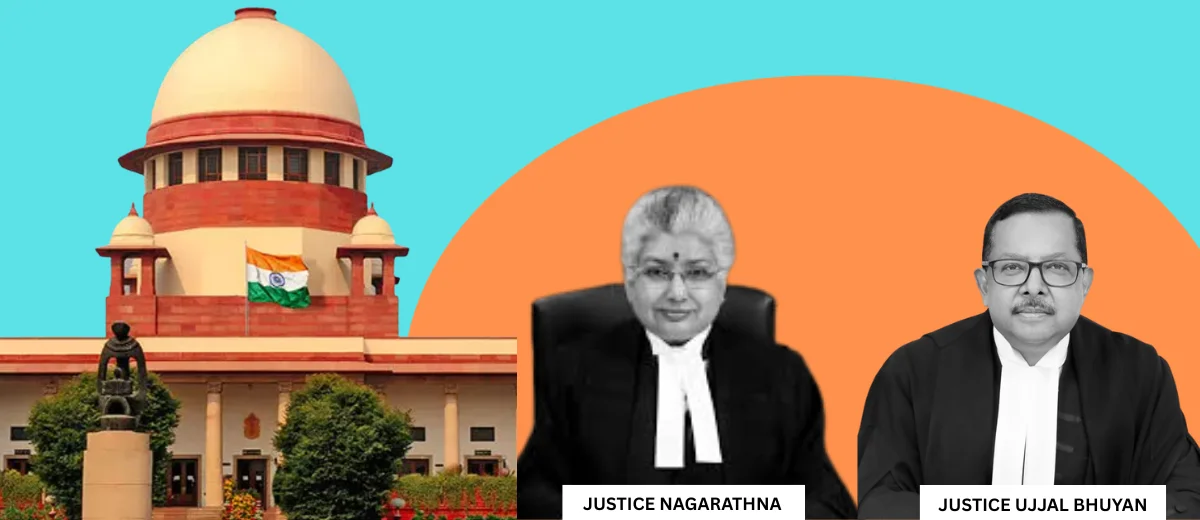
Hon’ble Judges/Coram: JUSTICE B.V. NAGARATHNA & JUSTICE UJJAL BHUYAN
Background of the Case:
The present appeal arose from an order of the Chhattisgarh High Court dated 03.03.2025, whereby the High Court refused to quash an FIR registered against the appellant under Section 376(2)(n) of IPC. The appellant approached the Supreme Court challenging the order as it resulted in continuation of criminal proceedings against him, culminating in a chargesheet and commencement of sessions trial.
Facts of the Case:
The complainant-respondent No. 3 is a 33-year-old married woman and an advocate by profession. Divorce proceedings initiated by her husband were pending at the time of the alleged offence. In September 2022, she came into contact with the appellant, who is also an advocate, at a social event. They both developed a mutual liking for each other and hence, stayed in contact. The complainant accused the appellant of inducing her into sexual relations on a false promise of marriage. She stated that he applied vermilion on her head as a sign of commitment, repeatedly engaged in sexual intercourse with her, forced her to consume abortion pills when she became pregnant, and later refused to marry her.
On 06.02.2025, an FIR was registered under Section 376(2)(n) of IPC. On the same day, the appellant filed a complaint alleging harassment and blackmail by the complainant. The High Court granted him anticipatory bail but refused to quash the FIR, stating that issues of consent and false promise required further investigation. Thereafter, a chargesheet was filed and after the commencement of proceedings before the Sessions Court, the appellant approached the Supreme Court.
Issues of the Case:
- Whether a consensual relationship between adults could constitute rape on the ground of a false promise of marriage?
- Whether the ingredients of Section 376(2)(n) IPC were met?
Arguments of the Parties:
The appellant argued that the complainant was a married woman at the time of the alleged offence. Since her divorce was not finalised, she was legally incapable of marrying him. Being a practising advocate, she was aware of the same. It was submitted that the relationship between the parties was consensual and continued for a considerable period. No evidence demonstrated that the alleged promise of marriage was false from the very beginning. According to the appellant, the FIR was an attempt to misuse the legal process and convert a failed relationship into a criminal case.
The State and the complainant argued that the complainant’s consent was obtained under a misconception of fact. This promise of marriage induced the complainant into sexual relations. Since a chargesheet had already been filed, it was submitted that the matter involved disputed questions of fact and it should go to trial.
Judgement and Analysis:
The Court stated that every breach of promise to marry is not rape. There was no evidence which indicated that the promise was false from the very beginning and was made solely to get into sexual relations.
The complainant’s divorce was not finalised at the time. Therefore, any promise of marriage was legally unenforceable. The Court placed significant emphasis on the complainant’s profession and legal awareness. She could not be treated as a gullible victim unaware of legal consequences.
Section 376(2)(n) applies to repeated acts of sexual assault, not repeated consensual intercourse. The provision targets aggravated sexual violence, not prolonged consensual relationships. Hence, the Supreme Court allowed the appeal, set aside the High Court’s order, and quashed the FIR, chargesheet, and all other criminal proceedings against the appellant.
Conclusion:
A consensual relationship between adults, even if based on a promise of marriage, does not amount to rape unless it is shown that the promise was false from the very beginning and was made solely to obtain consent. The Court expressed concern over the growing tendency to criminalise failed relationships, as such misuse trivialises the gravity of rape.