DATE: 30/03/2026
Case: DISTRICT MAGISTRATE AND DISTRICT ELECTION OFFICER AND COLLECTOR, GWALIOR, M.P. v. NATIONAL INSURANCE COMPANY LIMITED & ORS.
Petition Number: Special Leave Petition (Civil) No.22910 of 2025
Citation: 2026 INSC 279
Date of Judgement: 23.03.2026
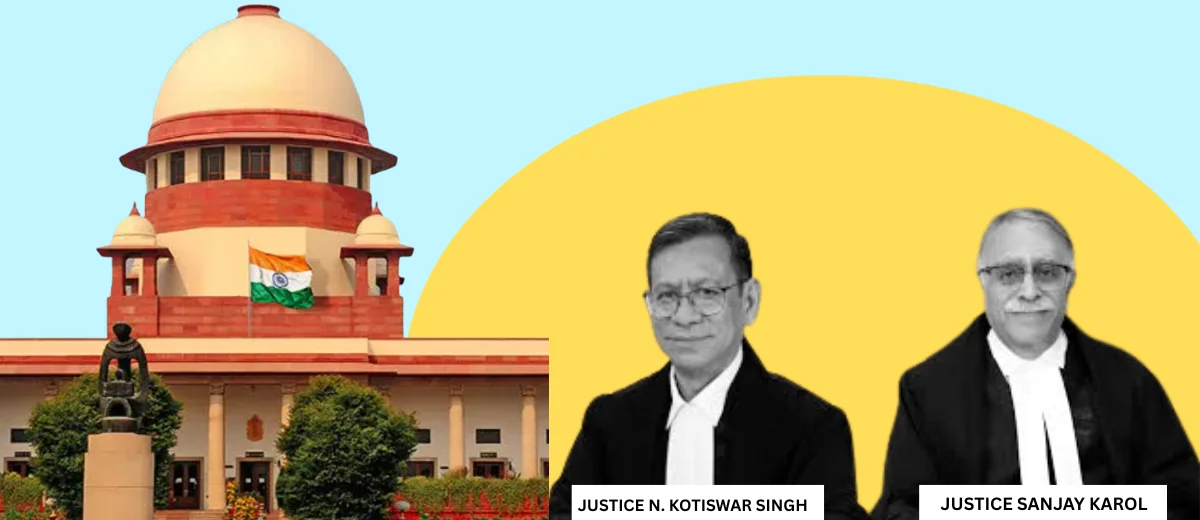
Hon’ble Judge/ Corum: Hon’ble Justice Sanjay Karol and Hon’ble Justice Nongmeikapam Kotiswar Singh
Introduction
On March 23, 2026, Hon’ble Justice Sanjay Karol and Hon’ble Justice Nongmeikapam Kotiswar Singh answered the question of liability arising out of an incident wherein a school bus requisitioned by the government authorities got into an accident with a motorcycle, killing the rider.
Factual Matrix & Procedural History
The present case arises out of the accident that happened on January 23, 2010, wherein a school bus dashed into a motorcycle, killing the rider of the latter. The bus, although under the ownership of Kidzee Corner School, Gwalior, had been, undisputedly, requisitioned under the orders of the appellant for Gram Panchayat Elections.
The appellants in the present case were held liable by the Fifth Additional Motor Accident Claims Tribunal, Gwalior, awarding compensation to the tune of Rs 5,13,500 along with 6% interest from the date of filing of the petition.
Aggrieved by this award, two miscellaneous appeals were filed before the High Court of Madhya Pradesh, one by the Insurance Company and another by the legal representatives of the deceased, who took objection to the conservative estimation of the deceased’s income and, as such, prayed for the enhancement of the compensation so awarded.
By the impugned judgment dated January 8, 2024, both the miscellaneous appeals were allowed, and the liability fastened upon the Insurance Company was shifted onto the appellants herein. Further, the appeal by the legal representatives was allowed by enhancing the compensation to Rs. 27,01,556/-.
Issues Framed
The only issue framed was:
- Whether the High Court’s finding that the appellant, a functionary of the State, would be liable to meet the award and not the Respondent – Insurance Company, was in accordance with law or not?
Submissions of the Parties
The appellants, by way of appeal, urged that the High Court’s determination was erroneous since at the relevant point in time the offending vehicle was under the coverage of an insurance policy, and so liability to be fastened otherwise would be wrong. Further, it was contended that when the bus was being used for a public purpose and in the course thereof, if the liability is fastened upon public authorities, it would send a wrong message since the authorities do not have either ownership of the vehicle or any insurable interest therein.
The respondents argued that it would send a bad message to civic authorities who requisition such vehicles for public purposes if it were held that the liability for any accident that happens while the vehicle is requisitioned should be fastened on the Insurance Company, and that the authority, in the guise of mere possession, would be left unaccountable.
Judgment Analysis
The Hon’ble Bench relied on various precedents, such as National Insurance Co. Ltd. v. Deepa Devi (2008) 1 SCC 414 and Purnya Kala Devi v. State of Assam (2014) 14 SCC 142, and held that when a public authority requisitions a privately owned vehicle for public purposes, the nature of possession and control changes entirely. The owner is divested of custody and decision- making power, and the vehicle is placed at the disposal of the State for governmental functions. During this period, the owner neither directs its use nor derives any benefit from it. If an untoward incident occurs, responsibility would properly rest with the requisitioning authority and not with the insurer engaged by the owner for ordinary, private or commercial use, as the case may be.
Further, it was held that requiring the insurer to answer for consequences arising from a use neither authorised nor controlled by the insured would be unfair. Importantly, when statutory power is exercised to requisition private property in the public interest, that power carries with it an obligation to answer for the consequences flowing from such compelled use.
Another consideration made by the Hon’ble Bench was that Section 160 of the Representation of the Peoples Act, 1950 grants power to the State to requisition premises and vehicles. The provision, however, does not expressly authorise the requisition of manpower such as a driver. Once the vehicle is requisitioned and deployed for election duty, its control and use passes on to the State authorities for the duration of that period. It is a reasonable conclusion that by accepting and utilising the services of the driver, the Authorities implicitly recognised such a driver’s competence, capacity and ability to operate the vehicle.
In other words, while the vehicle could have been requisitioned from the School, the driver could have been a staff member of the authorities/institutions listed under Section 159(2) of the Act. However, that was not the case. Observing this different perspective, the liability would rest with the requisitioning authority, and thereby with the State.
Conclusion
Thus, the Hon’ble Supreme Court firmly resolved the lingering ambiguity regarding accountability when private property is requisitioned for state service. The Bench concluded that the act of requisitioning created a temporary but total shift in the possession and control over the vehicle, effectively placing the State in the shoes of the owner. By taking control of the school bus for election duties, the authorities had assumed the inherent risks associated with its operation on public roads. The Court reasoned that it would have been fundamentally unjust to penalise a private insurance provider for an accident occurring during a period when the insured party had no power to direct or halt the vehicle’s movement