Case Title: –META PLATFORMS INC. & WHATSAPP LLC Vs COMPETITION COMMISSION OF INDIA AND OTHERS
Citation:-C.A. No. 301–302 of 2026 & C.A. No. 366–367 of 2026
Date:-(Orders under consideration – February 2026)
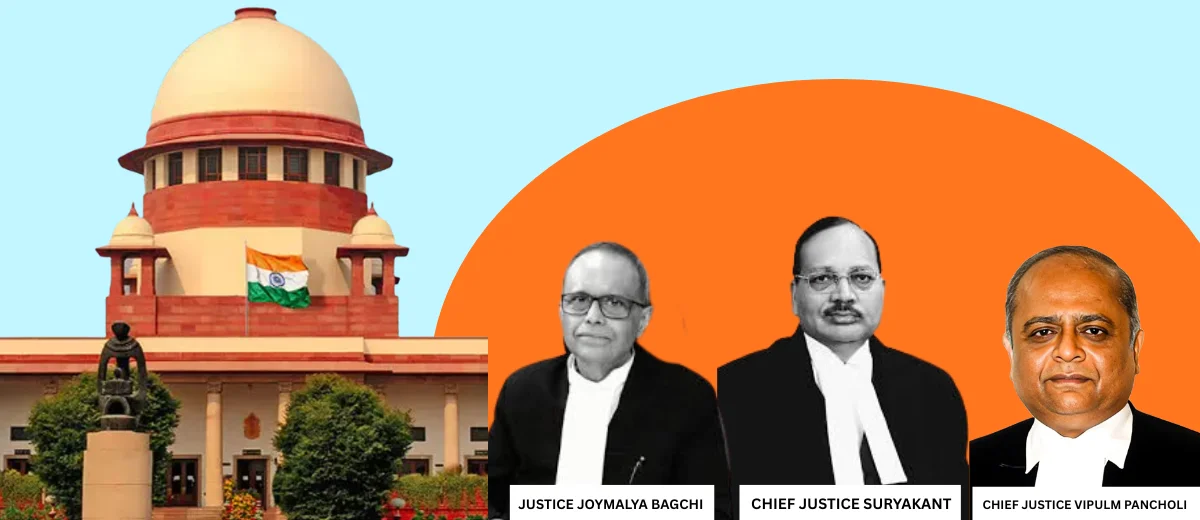
Hon’ble Supreme Court Bench:-
Chief Justice of India Surya Kant, Justice Joymalya Bagchi & Justice Vipul Pancholi
The Hon’ble Supreme Court of India is presently seized of appeals filed by Meta Platforms Inc. and WhatsApp LLC challenging the judgment of the National Company Law Appellate Tribunal (NCLAT), which upheld a monetary penalty of ₹213.14 crore imposed by the Competition Commission of India (CCI) in relation to WhatsApp’s 2021 Privacy Policy. The case raises significant questions at the intersection of competition law, data protection, consumer choice, and constitutional privacy in digital markets dominated by network effects.
A cross-appeal has also been filed by the Competition Commission of India challenging the NCLAT’s decision insofar as it permitted limited data sharing for advertising purposes after holding that there was no abuse of dominance by WhatsApp in leveraging its position into Meta’s advertising ecosystem.
Background of the Case:
The dispute originates from an order passed by the Competition Commission of India in November 2024, examining WhatsApp’s 2021 update to its privacy policy. The CCI found that WhatsApp, which enjoys a dominant position in India’s OTT messaging services market, imposed a “take-it-or-leave-it” framework upon users. Continued access to WhatsApp’s core messaging services was made conditional on users’ consent to expanded data sharing with other Meta group entities.
The CCI held that such conduct amounted to an abuse of dominant position under Section 4 of the Competition Act, 2002. Accordingly, a penalty of ₹213.14 crore was imposed, along with remedial directions aimed at restoring consumer choice, including prohibiting coercive data sharing, mandating clear opt-in and opt-out mechanisms, and requiring transparency regarding the purpose and extent of data sharing.
Meta Platforms and WhatsApp challenged the CCI’s order before the NCLAT. In November 2025, the NCLAT upheld the monetary penalty but set aside the five-year restriction on advertising-related data sharing and reversed the finding that WhatsApp had unlawfully leveraged its dominance into Meta’s advertising ecosystem. Aggrieved by the partial relief granted to WhatsApp, the CCI preferred a cross-appeal before the Supreme Court.
Arguments by the Parties:
Senior Advocates appearing for Meta Platforms and WhatsApp contended that users had consented to the privacy policy and were provided with an “opt-out” option. It was argued that WhatsApp messages remain end-to-end encrypted and that neither WhatsApp nor Meta has access to the content of user communications.
On the other hand, the CCI and the Union of India argued that consent obtained in a monopolistic market cannot be regarded as free or meaningful. They contended that WhatsApp’s dominance deprived users of any real choice, particularly in a country marked by digital illiteracy and economic vulnerability. It was further argued that personal data is commercially exploited and monetised, conferring competitive advantages upon Meta in online advertising markets.
Court’s Observations and Legal Reasoning:
The Hon’ble Supreme Court made strong prima facie observations questioning the validity of “consent” obtained by a dominant digital platform. The Chief Justice observed that an opt-out mechanism is illusory when users are effectively compelled to accept the policy or exit the platform entirely.
Justice Bagchi highlighted that the Digital Personal Data Protection Act, 2023, primarily addresses privacy concerns but does not sufficiently account for the economic value of personal data and its commercial exploitation, unlike certain European regulatory regimes. The Bench expressed concern over how behavioural data is analysed, monetised, and leveraged to reinforce dominance in advertising markets.
The Court also questioned whether complex and technical privacy policies could be reasonably understood by ordinary users, emphasising that policies must be framed from the perspective of the common consumer.
Conclusion:
While the appeals remain pending adjudication, the Supreme Court’s observations underscore a judicial shift towards recognising personal data as both a constitutional and economic asset. The case marks a critical moment in India’s digital jurisprudence, highlighting the need to balance innovation and profitability with consumer autonomy, competition law principles, and constitutional protections. The final outcome is likely to have far-reaching implications for data governance, competition regulation, and the accountability of dominant digital platforms in India.


 > Mon - Sat, 9:00 AM – 7:30 PM