Case: MRITUNJAY TIWARI VS. UNION OF INDIA AND ANR.
Petition Number: WP (C) Nos. 101/2026, 108/2026 & 109/2026.
Date of Order: 29.01.2026
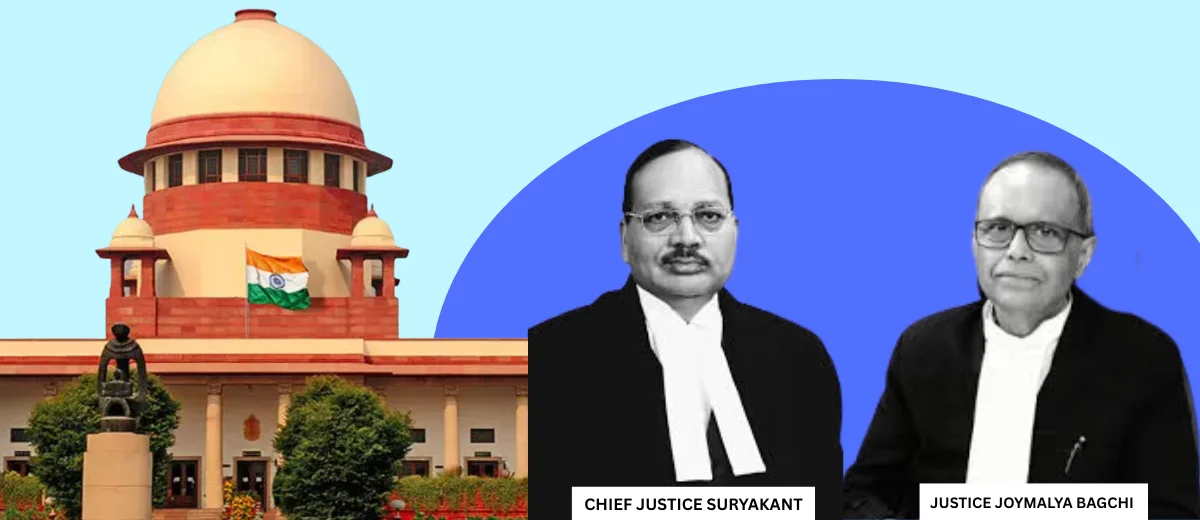
Coram: HON’BLE THE CHIEF JUSTICE & HON’BLE MR. JUSTICE JOYMALYA BAGCHI
Introduction:
On 29 January 2026, the Supreme Court passed an interim order halting the operation of the UGC Regulations, 2026. The Regulations, notified on 13 January 2026, aimed to strengthen protections against caste-based discrimination in higher educational institutions.
However, they triggered immediate controversy for allegedly being “unfair” to the general-category students. On being approached regarding the same, the Apex Court revived the 2012 UGC Equity Regulations by exercising powers under Article 142 of the Constitution.
Background of the Case:
The 2026 Regulations trace their origin to Abeda Salim Tadvi v. Union of India, a writ petition filed in 2019, by the parents of two students who allegedly committed suicide after facing caste-based discrimination in higher educational institutions.
In that case, the failure to implement the UGC Regulations, 2012, was challenged. A Bench led by Justice Surya Kant directed the UGC to come up with new regulations addressing caste discrimination, student suicides, and institutional accountability. Abiding by these directions, the UGC formulated the 2026 Regulations.
Facts of the Case:
The present writ petitions were filed by general category students, advocates, and others who argued that the new regulations were not in accordance with the provisions of Article 14. The outrage was primarily about Clause 3(c) of the 2026 Regulations, which defines “caste-based discrimination” as discrimination only against members of Scheduled Castes, Scheduled Tribes, and Other Backward Classes.
Issues Before the Court:
- Whether Clause 3(c) of the 2026 Regulations is arbitrary, exclusionary, and violative of Article 14?
- Whether the definition of caste-based discrimination, when read alongside the broader definition of “discrimination” under Clause 3(e), creates inconsistency and confusion?
- Whether the omission of “ragging” as a form of discrimination constitutes a regressive legislative decision?
- Whether permitting “segregation” in the allocation of hostels, classrooms, mentorship groups under Clause 7(d) violates the principles of equality and fraternity under Articles 14 and 15 of the Constitution?
- Whether the Regulations adequately protect extremely backward classes within SC/ST/OBC categories?
- Whether the 2026 UGC Regulations suffer from any other constitutional or legal defects which require the intervention of the Supreme Court?
Arguments by the Parties:
Petitioners:
The petitioners argued that Clause 3(c) is “completely exclusive” and violative of the Article 14. It is also inconsistent with the Clause 3(e) of the same regulations which defines “discrimination” broadly and includes religion, race, caste, gender, place of birth, and disability. According to them, Clause 3(c) wrongly presumes that caste-based discrimination is experienced only by reserved categories.
There would be a substantial risk of false complaints and criminal consequences which could potentially destroy a student’s career and life. The petitioners stressed that no internal safeguard or filtering mechanism exists in the regulations to prevent such misuse. It was also pointed out that ragging was completely omitted is entirely absent from the 2026 framework.
Respondents:
Senior Advocate Indira Jaisingh argued that the regulations must be read along with the directions issued by the Court in the earlier proceedings and interpreted accordingly. Their objective was to create an inclusive academic environment and protect historically marginalised students. Clause 3(c) and Clause 3(e) must be read harmoniously. She also pointed out that ragging is already covered under the 2009 regulatory regime. She argued that a blanket stay was unnecessary and unwarranted.
Court’s Opinion and Analysis:
The Court expressed prima facie doubts about Clause 3(c). In particular, the judges questioned why there was a separate definition of “caste-based discrimination” when another clause already gave a wide definition of discrimination covering caste, religion, gender, and other grounds. This could lead to confusion and misuse of the law.
Justice Bagchi observed that excluding ragging and permitting segregation could reduce the protective scope of the regulations and undermine the ideals of Article 15 and fraternity. The Court concluded that the regulations suffer from ambiguities and the possibility of misuse cannot be ruled out at this stage. Serious constitutional questions arise which require the intervention of a larger Bench.
At last, a notice was issued to the UOI and the UGC. It was decided that all the matters are to be heard along with the Abeda Salim Tadvi case before a three-Judge Bench. The Court put a stay on the 2026 Regulations and stated that the UGC Regulations, 2012 shall continue to be in force for the time being. The Court strictly asked the parties to not turn this whole matter into a political debate.
Conclusion:
The intention behind these Regulations was understood by the Hon’ble Court, but intention alone is not enough. The law must be fair, unambiguous, and constitutionally consistent. The 2026 UGC Regulations were due to the potential misuse of the same. the Court highlighted that social justice measures must align with constitutional provisions of equality and fraternity and also stated that the issues require scrutiny by a larger Bench. To prevent a regulatory vacuum, 2012 UGC Regulations will be in force for the time being as per the court’s instructions.


 > Mon - Sat, 9:00 AM – 7:30 PM