Case Name: RAJENDRA SINGH BORA VERSUS UNION OF INDIA & ORS.
Petition Number: Arising out of Special Leave Petition (C) No.29304 of 2018
Neutral Citation: 2026 INSC 404
Date of Judgement: 22.04.2026
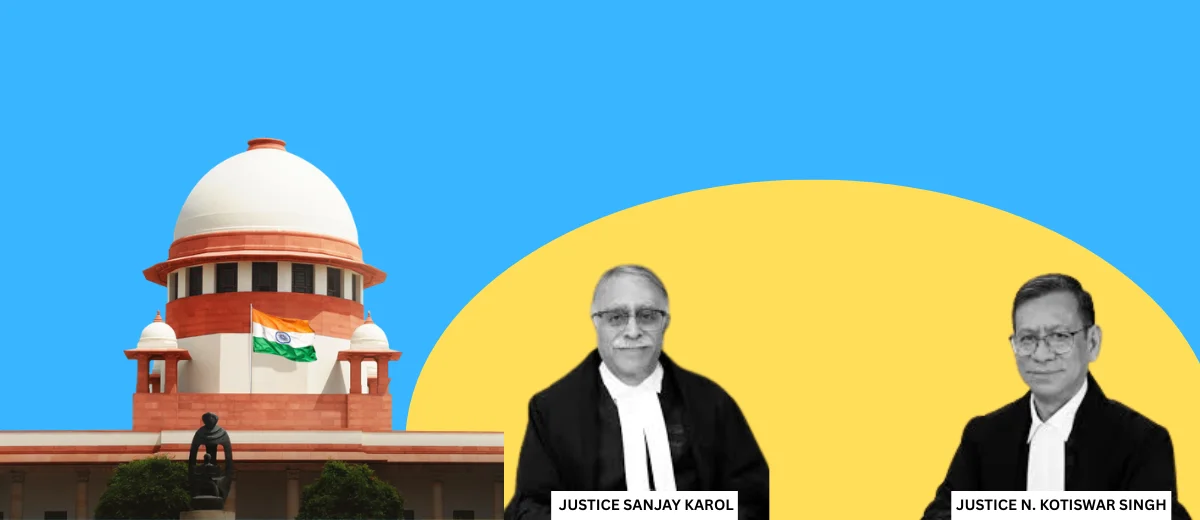
Coram: HON’BLE MR JUSTICE SANJAY KAROL & HON’BLE MR JUSTICE NONGMEIKAPAM KOTISWAR SINGH
INTRODUCTION
The present appeal was filed by an employee challenging the judgment of the Allahabad High Court, which had dismissed his plea seeking a change of cadre from the State of Uttar Pradesh (UP) to the State of Uttarakhand. The Supreme Court addressed the nuances of state cadre allocation following state reorganization, the legal distinction between a ‘transfer’ and a ‘change of cadre’, and the severe impact of administrative apathy on an employee’s fundamental service rights.
FACTS
The appellant cleared the Combined Lower Subordinate Service Examination in 1995. He opted for the post of Sub-Deputy Inspector of Schools, indicating a preference for the “hill area” of Uttar Pradesh (which later became the State of Uttarakhand). Despite his merit, he was denied appointment because he submitted his B.Ed. marksheet during the interview rather than with the initial application form.
He successfully challenged this rejection, and the High Court allowed his writ petition in 2004, terming the State’s approach as “hyper-technical.” The State’s appeal was dismissed in 2009. The appellant was finally appointed in 2011. However, he was posted in Kashi Ram Nagar, Uttar Pradesh, and not in his preferred “hill cadre.” In 2012, he made multiple representations requesting reallocation to the hill cadre, citing his original option, his domicile, and the severe cognitive disability of his son. The State ignored these requests. The Allahabad High Court ultimately dismissed his subsequent writ petition in 2018, ruling that once an employee was allotted to the UP Service, a “transfer” to Uttarakhand could not arise.
ISSUE
- Whether the appellant was legally entitled to be reallocated to the Uttarakhand State Cadre based on his original preference, domicile, and the prevailing Medical Hardship exceptions under DoPT Guidelines?
- Whether the High Court erred in conflating a request for “change of cadre” with a routine “transfer”?
ARGUMENTS OF THE PARTIES
The Appellant argued that he was legally entitled to the Uttarakhand cadre as he originally opted for the ‘hill area’ posting prior to the state’s reorganization, is a domicile of present-day Uttarakhand, and has a cognitively disabled son, fulfilling multiple criteria for cadre reallocation under the DoPT guidelines. The Respondent and the High Court’s reasoning adopted the stance that once the appellant was allotted to the Uttar Pradesh Service, the question of a “transfer” to Uttarakhand simply did not arise, treating the request as a routine administrative transfer rather than a structural state reallocation.
JUDGEMENT AND ANALYSIS
The Hon’ble Supreme Court strongly disagreed with the High Court’s determination and allowed the appeal based on a three-pronged legal and factual analysis. The Court clarified a fundamental legal distinction: a “transfer” is merely a change in posting within the same cadre/service for administrative convenience, having no impact on substantive status. A “change in cadre,” by contrast, is an exceptional, structural shift from one state’s service to another that alters the regulatory framework of the employee. The difference, therefore, is clear and substantive. A transfer is a matter of administrative convenience within the same service, whereas a change in cadre entails a reconfiguration of the employee’s service identity itself. The High Court legally erred by treating the appellant’s request for cadre reallocation as a simple transfer request.
The Court noted that under the Department of Personnel and Training (DoPT) guidelines, state cadre allocation upon reorganization is based on option, domicile, and reverse seniority. The appellant had requested the “hill cadre” from the very beginning and was a domicile of present-day Uttarakhand. If the State had not unlawfully delayed his initial appointment, he would have naturally been absorbed into the Uttarakhand cadre upon reorganization. The DoPT guidelines provide specific exceptions to the standard allocation policy, allowing allocation based on an employee’s option in cases of medical hardship (including “mental illness” of a family member). Since the appellant’s son is cognitively challenged with little or no scope for improvement in his condition, his case squarely fell under this humanitarian exception, legally entitling him to his preferred cadre.
CONCLUSION
The Supreme Court granted the requested relief and heavily penalized the State for extreme administrative apathy, noting the appellant was forced to fight for his rights from 1997 to 2026. The Court set aside the impugned High Court judgment and directed the Chief Secretary of UP to forthwith facilitate the appellant’s reallocation to the State of Uttarakhand while protecting his seniority and benefits. Appalled by the decades-long delay and the fact that the appellant was kept away from his disabled family member, the Court imposed costs of Rs. 1,00,000/- on the State of Uttar Pradesh, to be paid directly into the appellant’s bank account within four weeks. The Court also requested the Chief Justice of the High Court to identify and expedite similar long-pending service disputes to prevent such injustices.


 > Mon - Sat, 9:00 AM – 7:30 PM