
Case Name: ADALAT YADAV ETC. V. THE STATE OF BIHAR
Petition Number: CRIMINAL APPEAL NOS. 1788-1789 OF 2019
Neutral Citation: 2026 INSC 403
Date of Judgement: 22.04.2026
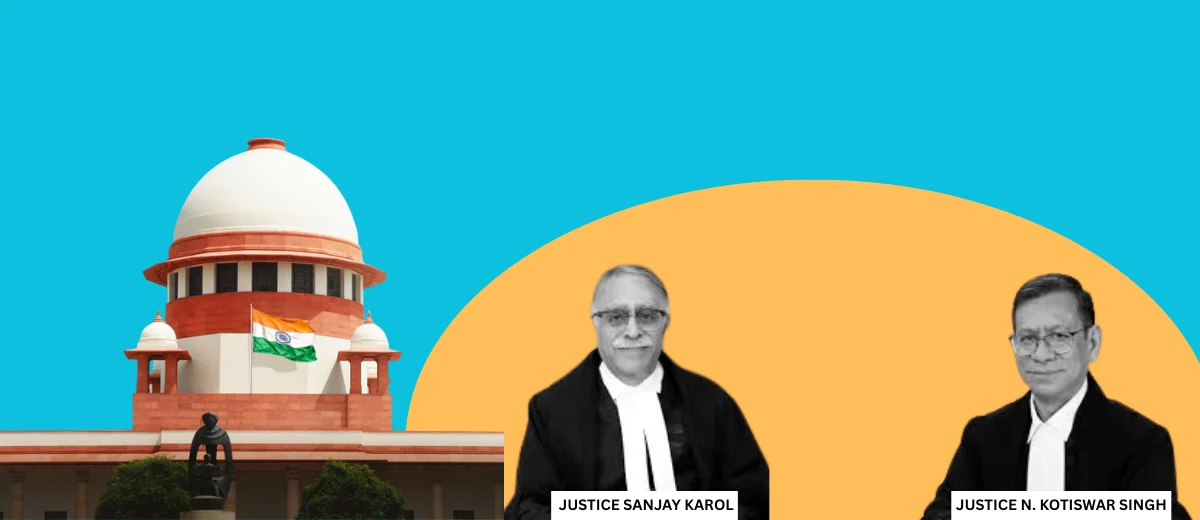
Coram: HON’BLE MR. JUSTICE SANJAY KAROL AND HON’BLE MR. JUSTICE NONGMEIKAPAM KOTISWAR SINGH
INTRODUCTION
The present case involved two appellant-convicts, a father-son duo convicted of murder, attempted murder and Arms Act violations. The Supreme Court examined whether conviction could rest on the testimony of a single injured witness in the absence of independent witnesses, delay in filing FIR and discrepancies in evidence.
FACTS AND PROCEDURAL HISTORY
The murder occurred in 2008 in Bihar. While the deceased and his brother, PW5, who is the complainant in the case were returning from Court and reached the grocery store, the father (A-1) and his son (A-2) surrounded them and hurled abuses at them and stated that despite warnings to not testify against another man who was an Accused in the High Court, the deceased refused to heed this warning. Subsequently, the Appellant Convict A-1 fired his pistol, shot the deceased’s head who fell on the spot and died. The other convict, A-2 also fired at other people accompanying the deceased, including PW5 who was injured in his leg. The Patna High Court, while affirming the conviction, held that the testimonies of witnesses PWs 1-4 were not wholly reliable. The Appellants approached the Supreme Court.
ISSUE
Whether the conviction of the Appellants on the basis of sole testimony of injured witness PW5 in the absence of testimonies of independent witnesses and conflict in Medical Evidence was beyond reasonable doubt?
SUBMISSIONS OF THE PARTIES
The learned counsel for the Appellants submitted that the delay in FIR resulted in a tainted version and not the original version as while the incident occurred between 5-6 P.M., the FIR was lodged at 10:30 P.M. Secondly, the place of occurrence stands disproved as although the FIR stated the crime scene to be the grocery shop, the Investigating Officer testified that there was no grocery shop in the crime scene. Thirdly, the medical evidence and witness testimony stand conflicted. While PW7 deposed that the deceased was shot in the head, PW9, the doctor testified that the postmortem showed the exit wound was on the upper nose. The Counsel argued that the Officer-in-Charge of the Police Station who received the written report and other important witnesses from the police were not examined during trial, causing prejudice to the appellant-convicts. The Counsel further added that the findings of the High Court conclude the testimonies of PWs 1-4 as unreliable and concluded that all of these make the prosecution’s case not beyond reasonable doubt.
The learned Counsel for the Complainant contended that the prosecution’s case stands entirely proved and none of the grounds were sufficient to cast doubt on the conviction. It was argued that the High Court, despite rejecting the testimonies of PWs 1-4 upheld the conviction on the sole testimony of PW5, as PW5 was an injured witness of high evidentiary value. As for the crime scene, it was argued that the prosecution witnesses were using different reference points to describe the same area. Gunshot injury was corroborated by the medical report and therefore, stood undisputed.
JUDGEMENT AND ANALYSIS
The Supreme Court held that the value of evidence is based on quality, not quantity, affirming that ‘Evidence is to be weighed not counted.’ Conviction is possible as long as the testimony is of sterling quality. Quoting the decision in Amar Singh v. State (NCT of Delhi) (2020) 19 SCC 165, the Court noted that under Section 134 of the Indian Evidence Act, there is no legal impediment to convict on the sole testimony of a single witness, as long as the testimony is reliable; It is the quality of the testimony that is material to the case.
The Court quoted Rai Sandeep v. State (NCT of Delhi) (2012) 8 SCC 21 and Naresh v. State of Haryana (2023) 10 SCC 134 and other decisions to explain what qualifies as a sterling witness. When a witness is of sterling quality, it should be such that it instills confidence in the court and can be accepted at face value. What is relevant is the consistency of the initial statement of the witness and one made before the Court without any prevarications. With regard to Delay in FIR, the Court emphasised that mere delay in itself cannot be a ground to doubt the prosecution’s case if a satisfactory explanation is given by the prosecution. The Court acknowledged through the decisions that there may be various genuine causes for lodging FIR including temperament to move to the police, unconversantness, transportation issues and physical impairment.
The Court thus held that there was no fault with the impugned judgement of the High Court, relying on a single witness to affirm conviction. With regard to the medical evidence, the Court observed that the testimonies of both PW5 and PW7 although in different terms, point to the shot on the deceased’s head and reiterated that eyewitness testimony is superior to medical evidence. The absence of independent witnesses thus does not quash the prosecution’s case.
CONCLUSION
The Supreme Court concluded that since the single witness withstood the cross examination, the testimony is undisputed and placed on a higher pedestal. The Court affirmed the conviction of the High Court and accordingly dismissed the appeal.



 > Mon - Sat, 9:00 AM – 7:30 PM