Court Would Be Reluctant To Entertain A Writ Petition In View Of An Alternative Remedy: Kerala High Court

Case Name: M/s. RCC-ACC (JV) v. Board of Major Port Authority for Port of Cochin & Anr.

Petition Number: WA NO. 834 OF 2026

Neutral Citation: 2026:KER:30416

Date of Judgement: 06.04.2026

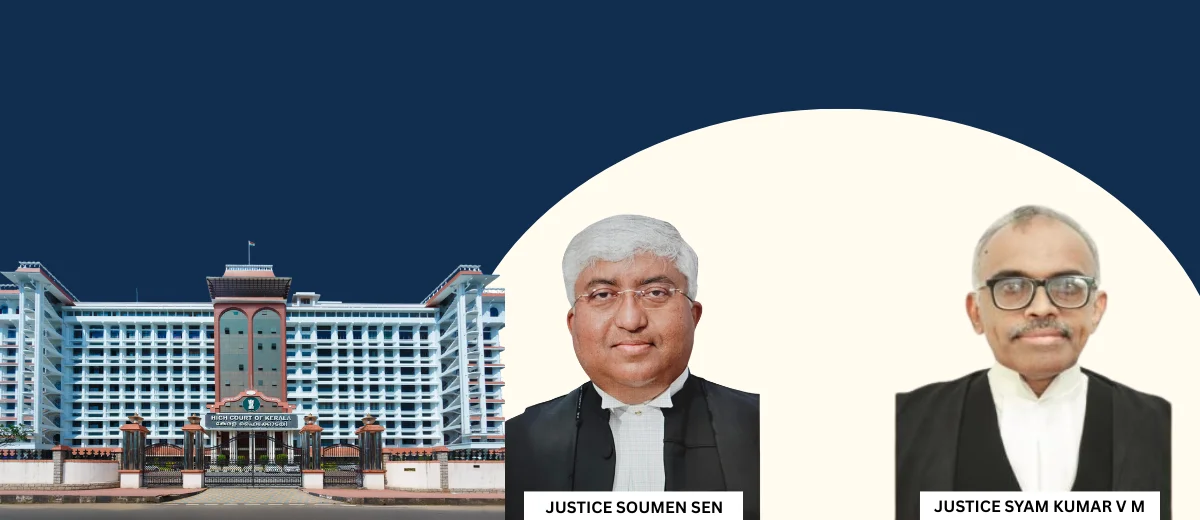
Coram: Honourable Chief Justice Soumen Sen and Justice Syam Kumar V.M.

INTRODUCTION

This writ appeal was filed by a contractor, M/s. RCC-ACC (JV), against the judgment dated 11.03.2026 in WP(C) No. 47578 of 2025 of the High Court of Kerala. The appellant was assigned the work of constructing international and domestic cruise terminals and other allied facilities at the Mormugao Port Authority under an EPC contract, Tender No. T15-T-1946/2021-C.

FACTS

A show-cause notice dated 21.11.2025 was issued by the Cochin Port Authority, alleging that the contract is liable to be terminated for wrongful delay or suspension of work, slow progress, or inferior workmanship. The appellant replied on 01.12.2025, raising grounds including non-availability of valid CRZ approval and indemnity, and stating that arbitration proceedings were already underway concerning major variations in scope.

The Cochin Authority terminated the contract on 10.12.2025 on several grounds. It was alleged that there was non-compliance with the Supplementary Agreement executed on 13.08.2025, along with a lack of progress and non-completion of the work within the stipulated timelines, and other related works had not been carried out to its satisfaction. Accordingly, these actions were deemed a breach of contract. 

During pendency, the appellant invoked the arbitration clause before the Commercial Court, Ernakulam, under Section 9 of the Arbitration and Conciliation Act, 1996, seeking status quo. The application was withdrawn because, by the time the matter came up, the termination order had already been issued.

ISSUES 

  1. Whether the writ petition was maintainable/entertainable in view of the existence of an arbitration clause and alternative remedy under the Arbitration Act.

  2. Whether the termination order was illegal because it relied on grounds not mentioned in the show cause notice.

  3. Whether disputed questions of fact could be decided in a writ petition.

ARGUMENTS OF THE PARTIES

Petitioner’s Argument: The petitioner argued that although an application had earlier been filed before the Commercial Court, it was later withdrawn after the contract was terminated. It was further contended that the existence of an arbitration clause does not bar the invocation of the writ jurisdiction under Article 226. The petitioner also submitted that the termination order was ex facie illegal, as several grounds relied upon in the termination letter, such as non-compliance with the supplementary agreement dated 13.08.2025, suspension of work on 30.11.2025, and defects in painting and steel structure works, were not mentioned in the show cause notice. Therefore, the petitioner was denied an opportunity to respond to those allegations before the termination order was passed. The petitioner also expressed apprehension that the termination and threatened blacklisting might detrimentally impact future contracts. 

Respondent’s Argument: The respondent contended that the contract was validly terminated due to repeated breaches and continuous non-performance by the contractor. It was argued that despite the issuance of a show cause notice dated 21.11.2025, the petitioner failed to make satisfactory progress in the work and eventually stopped work at the site. The respondent further maintained that the explanations provided for the delay were unsatisfactory and that no proper action plan was submitted for the timely completion of the project. It was also argued that the petitioner had violated the terms of the Supplementary Agreement and failed to carry out rectification works to the satisfaction of the Authority. Additionally, the respondent relied on the arbitration clause in the contract and contended that the dispute was contractual in nature, for which the petitioner should seek a remedy through arbitration rather than under Article 226 of the Constitution. 

JUDGEMENT AND ANALYSIS 

The Court first addressed the issue of maintainability, preferring the term “entertainability” rather than “maintainability,” as the scope of power under Article 226 is not circumscribed by any statute. The Court remarked, if parties have agreed to a specific forum, it would be extremely reluctant to entertain a writ petition in view of the existence of an alternative remedy. The remedy sought in the writ petition cannot be contended to be unavailable in a proceeding under Section 9 of the Act, which is a Code in itself. The remedy claimed can be conveniently granted by a court deciding an application under Section 9 or even by the Arbitrator under Section 17. Only in cases where there is an absence of an efficacious remedy may the court grant interim relief.

As far as Issue Two is concerned the Court noted that on an apparent reading of the show cause notice and the letter of termination, there may be some fresh materials not mentioned in the show cause notice. The same could have been a ground for the proceedings initiated before the Commercial Court and would have resulted in a finding favourable to the petitioner. If the petitioner had proceeded to work without the required CRZ permission, they may have exposed themselves to legal action, which could have been a reasonable excuse for not commencing the work. If termination is wrongful, the Arbitrator can always grant damages.

the petitioner apprehended that termination may detrimentally impact any future contract or threatened blacklisting. However, the learned Single Judge had already directed the respondent authorities to follow the due procedure of law regarding blacklisting. Regarding blacklisting, it has to follow the law laid down in Erusian Equipment and Chemicals Ltd. vs. State of West Bengal (1975) 1 SCC 70 and subsequent decisions, including UMC Technologies Pvt. Ltd. vs. Food Corporation of India and another (2021) 2 SCC 551, Although this relief could also have been sought under Section 9, the Court granted such relief having regard to the fact that the learned Single Judge had also cautioned the authority to follow the rule of law before any final decision.

With respect to Issue three, the Court observed that in A.P. Electrical Equipment Corporation v. Tahsildar and others 2025 SCC OnLine SC 447, there was no arbitration clause and nothing to show that the petitioner had initiated a proceeding by filing an application under Section 9. It is a trite law that the mere existence of disputed questions of fact would not stand in the way of a writ court, provided such disputed questions can be tried and decided by the writ court. However, having regard to the fact that there are efficacious alternative remedies where such issues can be more conveniently dealt with, the writ court, in appropriate situations, declines to exercise a discretionary remedy.

The existence of the scope of work under the amended contract, as urged by the appellant, is required to be adjudicated before an appropriate forum and cannot be conveniently decided in a writ proceeding. When parties themselves agreed to a forum for the resolution of a dispute and the agreement subsists, the writ court would not ordinarily invoke writ jurisdiction.

The Court rejected the submission that the Section 9 application became infructuous by reason of the issuance of the termination letter, as the petitioner remained open to amending the reliefs sought in that proceeding.

CONCLUSION

The writ appeal was disposed of by the Court by clarifying that the disposal of the writ appeal shall not prevent the petitioner to take steps under the Act and to seek appropriate reliefs in the said proceeding. The Court further clarified that any observation adverse to the petitioner for not entertaining the petition shall not stand in the way in a proceeding that may be initiated under the Act, and in the event the said proceedings are initiated, the appropriate forum shall decide the said matter strictly in accordance with law and without being uninfluenced by any observations made in this regard.

Leave a Reply

You may also like these