

Case Name: STATE OF ODISHA V. SREEPATI RANJAN DASH
Petition No.: Civil Appeal NO.13121 OF 2025
Neutral Citation: 2026 INSC 505
Date of Judgement: 18th May 2026
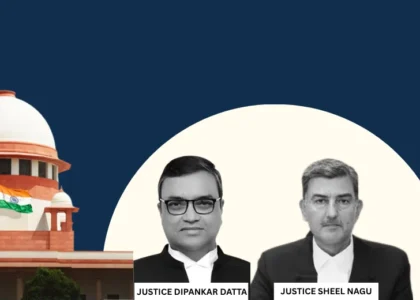
Coram: Honourable Mr Justice Dipankar Datta & Honourable Mr Justice Augustine George Masih
Relevant Provisions: Article 309 of the Constitution of India; Article 162 of the Constitution of India; Odisha Transport Service (Method of Recruitment and Conditions of Service) Rules, 2021; Executive Instructions dated 17 November 1981.
INTRODUCTION
In the present matter, the Supreme Court affirmed that a government employee has no vested right to seek promotion under the rules existing at the time when vacancies arose. The Court held that the State possesses the authority to restructure cadres and alter recruitment methods through statutory rules framed under Article 309 of the Constitution, even if vacancies had existed under the earlier regime.
FACTS
The Commerce and Transport Department of the Government of Odisha had issued executive instructions in 1981 for recruitment to the post of Assistant Regional Transport Officer. These instructions permitted the promotion of eligible Grade-I Assistants (Senior Assistants) with five years’ service to the ARTO post on the basis of merit and suitability.
The respondents were appointed as Junior Assistants and promoted to Senior Assistants. Subsequently, the Odisha Government undertook the restructuring of the transport cadre following the abolition of inter-state border check gates. The post of ARTO was upgraded from Group C to Group B and brought into the Odisha Transport Service cadre. Thereafter, the Odisha Ministerial Services cadre was restructured, and the post of Senior Assistant was redesignated as Assistant Section Officer (ASO). The respondents continued in service as ASOs.
In 2021, the respondent sought promotion to the post of ARTO under the 1981 executive instructions. The Transport Commissioner recommended convening a DPC (Departmental Promotion Committee) to fill vacant ARTO posts. However, the Government rejected the proposal. The respondents approached the Orissa High Court challenging the rejection orders.
During the pendency of these proceedings, the Odisha Transport Service (Method of Recruitment and Conditions of Service) Rules, 2021, were framed under Article 309 of the Constitution. The 2021 Rules provided that appointments to the post of ARTO would be made through a competitive examination conducted by the OPSC. The Single Judge allowed the writ petitions and directed the State to convene a DPC and consider the respondents for promotion under the 1981 executive instructions.
Aggrieved, the State approached the Supreme Court.
ISSUES
1. Whether government employees acquire a vested right to promotion under the rules existing at the time vacancies arise, particularly when the State subsequently restructures the cadre and introduces new statutory recruitment rules.
- Whether the executive instructions of 1981 continued to govern appointments after enforcement of the Odisha Transport Service Rules, 2021, and whether the High Court was justified in directing the convening of a DPC under the earlier regime.
- Whether the post of ARTO constituted a promotional post or a selection post, and what legal consequences flowed from such classification.
ARGUMENTS OF THE PARTIES
The State of Odisha argued that, following the 2017 cadre restructuring, the appointing authority for the post of ARTO became the Government of Odisha, not the Transport Commissioner. Consequently, the earlier executive instructions ceased to have practical applicability. The State contended that the respondents possessed no vested or enforceable right to promotion merely because vacancies had existed prior to the introduction of the 2021 Rules. It was further argued that the post of ARTO was not part of the promotional hierarchy but was a selection post. Under the 2021 Rules, the post was required to be filled through a competitive examination conducted by the OPSC, thereby superseding all earlier executive instructions.
The respondents, on the other hand, argued that they had become eligible for promotion while the 1981 executive instructions were still in force. They contended that the executive instructions had the force of law under Article 162 of the Constitution, in the absence of formal recruitment rules. The respondents further submitted that the mere redesignation of their post from Senior Assistant to Assistant Section Officer did not alter their entitlement to promotion. They also argued that the State could not arbitrarily refuse to fill vacancies and that the decision in State of H.P. v. Raj Kumar would not apply retrospectively.
JUDGEMENT AND ANALYSIS
Addressing the first issue of whether vacancies must necessarily be filled under the rules existing when the vacancies arose, the Supreme Court answered in the negative and held that there is no universal rule requiring vacancies to be filled under the rules prevailing on the date the vacancies arose.
The Court placed substantial reliance upon State of H.P. v. Raj Kumar (2023) 3 SCC 773. The Court reproduced para 85 of Raj Kumar and reiterated that the statement in Rangaiah that vacancies arising prior to the amendment of rules must be governed by old rules “does not reflect the correct proposition of law.”
The Court observed that an employee has merely the right to be considered for promotion in accordance with the rules prevailing on the date of consideration, not under repealed or superseded rules. It emphasised that the Government may consciously decide not to fill vacancies under old rules when cadre restructuring or policy changes are introduced. Therefore, the Court held that the Government’s decision not to fill ARTO vacancies under the earlier executive instructions and instead fill them under the 2021 Rules was legally valid.
Regarding the second issue, the Court rejected the respondents’ claim of vested right or legitimate expectation. Relying upon Haryana SEB v. Gulshan Lal (2009) 12 SCC 231, the Court reiterated that an employee has neither a vested right nor a legitimate expectation to be promoted. At best, the employee possesses a limited right to consideration of candidature.
The Court further held that when the Government, acting as the appointing authority, decides not to fill vacancies through promotion due to cadre restructuring and a change in recruitment policy, courts cannot compel the State to proceed with such appointments. On this issue, the Supreme Court stated that the respondents could not insist upon promotion merely because they had become eligible while the earlier executive instructions were in force.
When deciding whether the 2021 Rules superseded the 1981 Executive Instructions, the Supreme Court held that the Odisha Transport Service Rules, 2021, framed under Article 309 superseded the earlier executive instructions. Executive instructions themselves were only a temporary arrangement pending finalisation of cadre rules. Once the 2021 Rules were enacted, the executive instructions’ object and purpose were fulfilled.
The Court disagreed with the High Court’s interpretation that the process relating to convening the DPC stood protected by the saving clause contained in the 2021 Rules. According to the Supreme Court, neither any appointment had been made, nor any DPC constituted prior to the enforcement of the Rules. Therefore, there existed no completed act capable of being saved from supersession. The Court, therefore, reaffirmed that statutory rules framed under Article 309 prevail over executive instructions issued under Article 162 in case of inconsistency.
On the final issue, the Supreme Court held that the post of ARTO was a selection post and not a regular promotional post. The Court emphasised the distinction between promotion posts and selection posts. In the case of selection posts, the manner and method of selection are matters of governmental policy.
Relying upon Sant Ram Sharma v. State of Rajasthan AIR 1967 SC 1910, the Court observed that promotion to selection posts depends primarily upon merit and suitability rather than seniority alone. Consequently, no automatic right to appointment or promotion can arise. The Court further held that the Government was fully competent to alter the method of selection and introduce direct recruitment through competitive examination conducted by the OPSC, unless such a policy was shown to be arbitrary. Since no arbitrariness was established, the respondents could not claim entitlement to the post.
CONCLUSION
The Supreme Court allowed the appeals filed by the State of Odisha and set aside the judgments of the Orissa High Court. The Court held that the respondents possessed no vested right to promotion under the earlier executive instructions merely because vacancies had arisen during their operation. The judgment establishes that service rights are governed by the rules prevailing at the time of consideration and not at the time vacancies arise.



 > Mon - Sat, 9:00 AM – 7:30 PM