
Case Name: HARISH RANA V. UNION OF INDIA & ORS.
Petition Number: MISCELLANEOUS APPLICATION IN SPECIAL LEAVE PETITION (CIVIL) NO. 18225 OF 2024
Neutral Citation: 2026 INSC 222
Date of Judgement: 11.03.2026
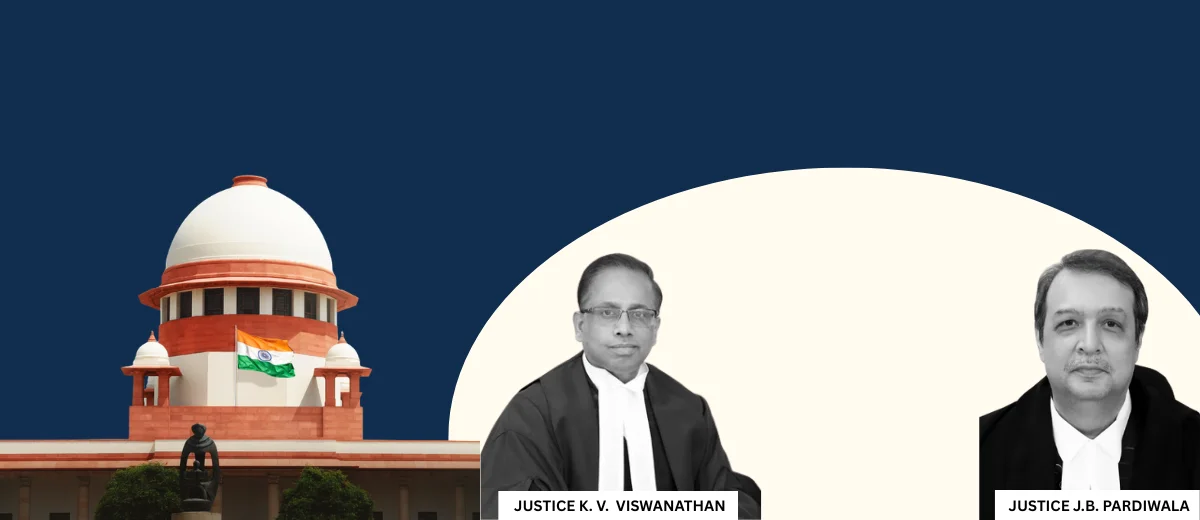
Coram: HON’BLE MS. JUSTICE K. V. VISWANATHAN AND HON’BLE MR. JUSTICE J.B. PARDIWALA
INTRODUCTION
The above case is a landmark judgement wherein the Supreme Court allowed the first ever Passive Euthanasia in India to a man who was in a persistent vegetative state for 13 years, reaffirming the Right to Die with Dignity under Article 21 after the Common Cause Judgement in 2018. The impugned judgement elaborates the circumstances and factors to be considered to allow a person to undergo Euthanasia, i.e. to accept life by preferring to die.
FACTS AND PROCEDURAL HISTORY
The Appellant, Harish Rana, aged 32 years was 20 years old in 2013 when he fell from the fourth floor of his accommodation and sustained a diffuse axonal injury. Despite being admitted in the hospital for a week and administered treatment, he was far from recovery and bedridden. After his discharge, he required frequent hospital admissions for treating head injuries, seizures, pneumonia and bedsores at AIIMS. Due to a medical history of several seizures, since 2016, he had been administered anti-seizure drugs to prevent them. Thereafter, his medical reports indicated that his body exhibited no movement, no awareness of the environment and no interaction. He was no longer deriving benefits from any of the treatments, according to his parents and that he was in a permanent, mechanical state with his neurological conditions remaining absolutely static. In 2014 and 2016, he was issued Disability Certificates concluding that he was permanently disabled and that he was in a Permanent Vegetative State. The parents of the Appellant had approached the High Court in 2024 praying to constitute a Medical Board to evaluate whether the Life-Sustaining tube should be withdrawn. However, the High Court dismissed the petition, on the ground that Harish was “not being kept alive mechanically” and was “able to sustain himself without extra external aid.” In 2025, the Court constituted two Medical Boards and directed to submit a report recording their opinion on the medical status of the Appellant. The Doctors of both the boards concluded that there was no hope of recovery for the Appellant and continuing the treatment wouldn’t be in the best interest of the Appellant.
ISSUES
- What essentially constitutes ‘Best Interest’ of the patient?
- Whether Passive Euthanasia should be conducted in the best interest of the patient?
SUBMISSIONS OF THE PARTIES
The Counsel for the Appellant argued that in Common Cause v. Union of India (2018) 5 SCC 1, there was no contemplation for adjudication by constitutional courts in such matters. It was further submitted that the Appellant could not invoke Article 226 of the Constitution of India and approach the High Court as a last resort because to do so, there must be a disagreement between the Primary Medical Board and the Secondary Medical Board which didn’t exist in their case. Moreover, there was no other mechanism to trigger the process for the Appellant and hence, they were left with no other option. The Counsel contended that the High Court committed error as the 2018 Common Cause Judgement extended to patients in Permanent Vegetative State and not just terminally ill patients with reference to Aruna Shanbaug v. Union of India AIR 2011 Supreme Court 1290 as well as the Appellant continued his nutrition using tubes. The Counsel submitted that this curtails the freedom of the Appellant as he continues to be in an undignified state and prayed for medical intervention to remove artificial prolonging of life.
The Counsel for Union of India submitted in consensus with the Appellant, that the lawful withdrawal of artificial treatment sustaining life does not amount to causing death. It was further submitted that after deliberations with the Appellant’s family and perusal of the Medical Boards’ Reports, it is clear that the Applicant is in a Permanent Vegetative State and that he deserves a dignified, humane and kind passing away.
JUDGEMENT AND ANALYSIS
In this comprehensive judgement, the Division Bench began by discussing the principles laid down in the 2018 Common Cause Judgement, answering the relevant question: “Whether, When and on what legal basis can medical treatment be withdrawn or withheld?”
In Common Cause v. Union of India (2018), the Court held that
(i) Right to Die with Dignity is inherent under Article 21 of the Constitution;
(ii) Both Passive Euthanasia and Advance Medical Directive (AMD) are permitted under the framework of Article 21.
Furthermore, the 2018 Judgement laid down guidelines on the execution of ADM to decide whether the medical treatment of an incompetent patient must be terminated or not.
Causing Death and Allowing Death: Distinguishing Active Euthanasia and Passive Euthanasia
It has been clarified by the Court vide its previous decisions that only Passive Euthanasia is permitted in India. The Court referred to Paragraph 178 in the 2018 Common Cause Judgement, which reads: “…passive euthanasia fundamentally connotes absence of any overt act either by the patient or by the doctors…In active euthanasia, a specific overt act is done to end the patient’s life whereas in passive euthanasia, something is not done which is necessary for preserving a patient’s life….”
Active Euthanasia means physician-assisted suicide by way of lethal injection whereas Passive Euthanasia means removing the patient from life-sustaining treatment. Para 49 explains that in Passive Euthanasia, there is no medical intervention from the doctor while on the other hand, Active Euthanasia involves injecting a lethal medication which kills the patient. The former is a premature extinction of life while the latter does not delay life beyond its natural end point.
Right to Die with Dignity under Article 21
Dignity is recognised as the core element of life as recognized under Article 21. Life is not merely an animal existence and that Dignity is the underlying force of all fundamental rights that confer an individual a dignified existence. Right to life is an inviolable fundamental right and putting an end to it is inherently an act against that person’s dignity. The Court referring to Gian Kaur v. State of Punjab (1996) 2 SCC 648, opined that the fundamental right to life under Article 21 is not merely a guarantee of biological survival but a right to live with dignity and includes a right to have a dignified process of death. The Court in Para 22 of the decision, observed that Article 21 is a provision guaranteeing protection of life and personal liberty and by no stretch of imagination can “extinction of life” be read to be included in “protection of life.” Justice Dipak Misra, in the 2018 Common Cause judgment, observed that the withdrawal or withholding of life-sustaining treatment from a patient in a Persistent Vegetative State (PVS) would neither constitute suicide nor amount to abetment thereof, but would merely facilitate the natural process of death which had already commenced.
Best Interest of the Patient
The Court clarified that a holistic assessment of all circumstances, be it medical or non-medical, should be conducted including the patient’s wishes, feelings, beliefs, values, and any other factor which would likely influence the patient’s decision, or which the patient themselves would have taken into account, if they had the capacity to decide. It involves a deep consideration of the patient’s life, their relationship with family and the value that the family life has for the patient. There is no strait-jacketed formula to determine the best interest and requires consideration of all circumstances, ultimately answering the question of whether it is in the patient’s best interests that life should be prolonged by the continuance of the particular medical treatment. A doctor’s duty to continue treatment to a patient obliges only until such treatment is capable of conferring some therapeutic benefit upon the patient. It is not mandated after it is clear that the treatment only prolongs biological existence and the patient does not reap any actual benefit.
The Court held that continuing the medical treatment for the Appellant merely artificially prolonged his existence but did not add any meaningful purpose to his life, only adding agony and giving an undignified life. The Court cautioned that the first step towards initiating Euthanasia was obtaining written consent of the patient’s next of kin/next friend/guardian.
CONCLUSION
The Court therefore concluded that continued prolonged treatment is no longer beneficial for the patient and opined it to be stopped. It issued directions to AIIMS to take the necessary steps to withdraw the undergoing medical treatment.
In Para 332, the Court remarked, “This decision is not about choosing death, but is rather one of not artificially prolonging life. It is the decision to withdraw life-sustaining treatment when that treatment no longer heals, restores, or meaningfully improves life. It is allowing nature to take its course when medicine can only delay the inevitable because survival is not always the same as living.”


 > Mon - Sat, 9:00 AM – 7:30 PM