
Case Name: Anand Narayan Shukla v Jagat Dhari
Petition No.: Civil Appeal No. 7355 OF 2026
Neutral Citation: 2026 INSC 463
Date of Judgement: 8th May 2026
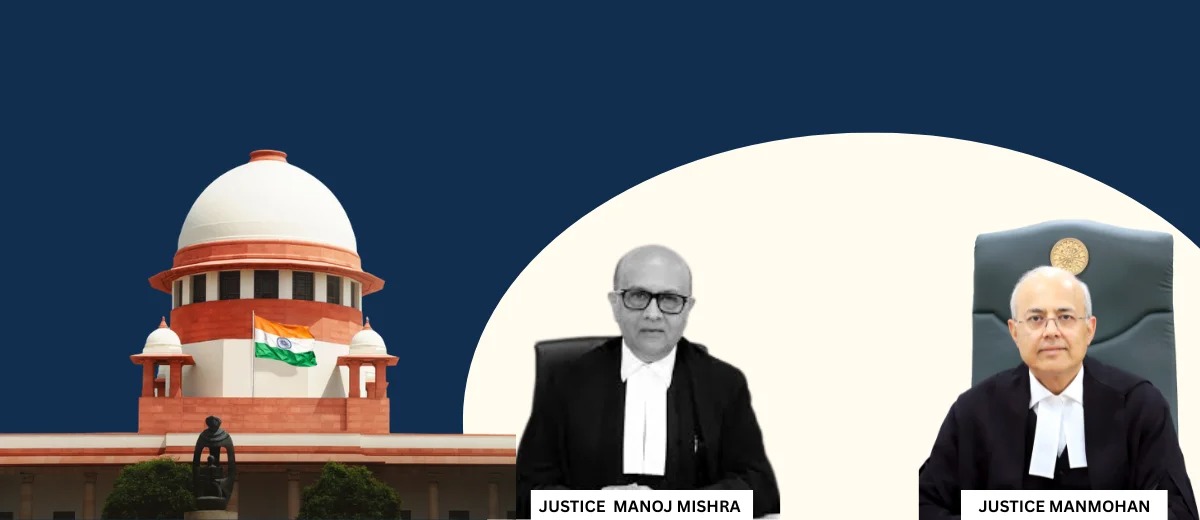
Coram: Honourable Mr Justice Manoj Mishra & Honourable Mr Justice Manmohan
Relevant Provisions: Section 28 of the Specific Relief Act, 1963; Order XX Rule 12A CPC; Section 37 CPC; Article 227 of the Constitution of India
INTRODUCTION
The Supreme Court, in the present case, clarified the scope and operation of Section 28 of the Specific Relief Act, 1963 (SRA), in relation to decrees for specific performance. The Court held that a decree for specific performance does not automatically stand rescinded merely because the decree-holder fails to deposit the balance of the sale consideration within the period stipulated in the decree. Decrees for specific performance are in the nature of preliminary decrees; therefore, the court that passes such a decree retains jurisdiction to either rescind the contract or extend the time for payment.
The judgment is significant as it comprehensively summarises the governing legal principles relating to rescission of contracts, extension of time for deposit, and the equitable jurisdiction exercised by courts under Section 28 of the Specific Relief Act. The Court held that rescission is discretionary and not automatic, and that courts must consider the conduct of the parties, the surrounding circumstances, and whether the judgment-debtor can be adequately compensated for the delay before rescinding a decree for specific performance.
FACTS
The dispute arose from an agreement for sale under which the respondent agreed to sell approximately 3.75 acres of land to the appellant. An advance amount was paid at the time the agreement was executed. The appellant instituted a suit seeking specific performance of the agreement. The Trial Court directed the appellant-plaintiff to pay or deposit the balance price within one month. Upon such payment, the respondent-defendant was required to execute and register the sale deed in favour of the appellant.
Pursuant to the decree, the appellant issued a legal notice calling upon the respondent to execute the sale deed upon receipt of the balance amount. However, the respondent neither accepted the amount nor executed the sale deed. Meanwhile, the respondent preferred a first appeal challenging the decree for specific performance.
Since no stay was granted in the appeal proceedings, the appellant initiated execution proceedings, stating in the application that he was ready and willing to deposit the balance consideration before the court. The execution proceedings thereafter witnessed repeated adjournments, with the execution court repeatedly directing payment to the judgment-debtor. Further delays occurred owing to procedural complications and the COVID-19 pandemic lockdown.
Eventually, the appellant deposited the balance sale consideration before the execution court. Thereafter, the respondent filed an application under Section 28 of the Specific Relief Act seeking rescission of the contract on the ground that the amount had not been deposited within the time stipulated in the decree. The execution court allowed the application and dismissed the execution proceedings. The High Court affirmed this view in exercise of jurisdiction under Article 227 of the Constitution. Aggrieved thereby, the appellant approached the Supreme Court.
ISSUES
1. Whether the decree of specific performance passed by the trial court merged in the order of the appellate court, even though the appellate court dismissed the appeal for non-prosecution?
2. Whether the respondent’s application under Section 28 of the 1963 Act was maintainable after the Court had granted permission to make a deposit of the balance amount and, pursuant thereto, the amount was also deposited?
3. Whether the rescission of the contract and consequential dismissal of the execution application was vitiated by a pedantic approach of the court(s) below, as they failed to consider the facts and circumstances of the case, as also whether the decree could be saved by compensating the judgment-debtor for the delay in deposit of the balance sale consideration?
ARGUMENTS OF THE PARTIES
The appellant contended that he had issued a notice within the stipulated period, expressing his readiness and willingness to perform his obligations under the decree. It was argued that the respondent himself was unwilling to accept payment. The appellant further submitted that the execution court itself repeatedly adjourned the matter and did not consistently direct the deposit of the amount in court. It was further argued that Section 28 of the SRA confers discretionary powers upon courts not merely to rescind contracts but also to extend the time for payment or deposit. It was submitted that the courts below had adopted a hyper-technical approach by mechanically rescinding the decree without examining whether extension of time could have been granted upon suitable compensatory terms.
The respondent, on the other hand, argued that, despite repeated opportunities and directions, the appellant failed to deposit the balance of the sale consideration within the stipulated period. It was contended that mere filing of an appeal against the decree did not operate as a stay, and therefore the appellant could not justify prolonged non-compliance with the decree. The respondent further submitted that equitable relief could not be granted to a decree-holder who had negligently failed to comply with the terms of the decree.
JUDICIAL REASONING
The Supreme Court undertook an extensive examination of Section 28 of the Specific Relief Act and the jurisprudence governing decrees for specific performance. The Court stated that a decree for specific performance is in the nature of a preliminary decree, and therefore, the court passing such a decree does not become functus officio after the pronouncement of judgment. Rather, the court retains continuing supervisory jurisdiction over the decree until the sale deed is executed.
The Court emphasised that the language employed in Section 28, particularly the phrase “may, by order, rescind”, clearly demonstrates that rescission is discretionary and not automatic. Consequently, failure to deposit the balance consideration within the stipulated period does not automatically terminate the decree or rescind the contract.
The judgment summarised the principles relating to Section 28 of the Specific Relief Act as follows (Para 33) :
- A decree for specific performance of a contract is in the nature of a preliminary decree, and therefore, till the deed is executed pursuant to the decree, the Court that passed the decree is vested with the jurisdiction to either rescind the contract / the decree for non-payment/non-deposit within the stipulated period or extend the period for making such payment/ deposit.
- Neither is there automatic rescission of the contract/decreed for non-payment/non-deposit within the period stipulated by the decree, nor is there automatic extension of time by making such a deposit if the stipulated period for payment/deposit has expired. However, where the decree stipulates that on failure to pay / deposit within the specified period, the decree shall stand rescinded or the suit shall stand dismissed, the decree is rendered inexecutable on failure to pay/ deposit.
- Prayer to extend the time for making a deposit in compliance with the conditions stipulated in the decree may be made prior to, or even after, the expiry of the period stipulated therefor.
- There is no prescribed form for making a prayer to extend the time to make such a payment or deposit. Such a prayer may be made, even orally, when the Court seeks to address an application for rescission of the contract/decree or when the decree is put for execution, provided the execution court is the one that passed the decree. However, if the decree is passed by the appellate court, such a prayer/application may be made before the court of first instance, having regard to the provisions of Section 37 of the CPC.
- As specific performance of a contract is an equitable relief, while considering the prayer for rescission of the contract/decree, or for extension of time to make a deposit in compliance with the decree, the Court must be guided by principles of equity. Therefore, to balance the equities, the Court would have to consider the attending facts and circumstances of the case, the conduct of the parties and whether, by putting the decree holder to such additional terms and conditions, the judgment debtor could be adequately compensated for the delay.
- The test is whether, from the conduct of the decree holder, it could be logically inferred that he had no intention to complete his part of the contract. If it appears so, and there appears an element of willful negligence on the part of the decree holder in complying with the terms of the decree, the Court may invoke its power under Section 28 and rescind the contract.
- Under Order XX Rule 12 A of CPC, when a decree for specific performance of a contract for the sale, or lease of immovable property, orders that the purchase-money or other sum is to be paid by the purchaser or lessee, the Court must specify the period within which the payment shall be made. If no time limit is set, compliance must be within a reasonable period. As to what would be a reasonable period would depend on the facts of the case.
Applying these principles to the present case, the Supreme Court found that the execution court and the High Court had failed to consider several material circumstances. The Court noted that the decree itself did not stipulate automatic rescission upon default. Further, the execution court itself repeatedly adjourned the proceedings and initially directed payment to the judgment-debtor instead of a deposit before the court.
With respect to Issue 1, the Supreme Court rejected the contention that the decree for specific performance had lost its enforceability merely because the respondent’s first appeal was dismissed for non-prosecution. The Court held that the doctrine of merger would still apply, and consequently, the decree of the Trial Court merged with the appellate order. However, the Court clarified that such a merger did not divest the court of jurisdiction under Section 28 of the Specific Relief Act.
With respect to Issue 2, the Court held that the respondent’s application under Section 28 of the Specific Relief Act remained maintainable even after the appellant had eventually deposited the balance sale consideration pursuant to permission granted by the execution court. However, the Court clarified that such maintainability did not imply that rescission must necessarily follow. Therefore, even where there is a delay in deposit, the court must determine whether the circumstances justify rescission or whether extension of time should instead be granted upon appropriate terms.
With respect to Issue 3, the Supreme Court held that the execution court and the High Court had adopted an unduly technical and pedantic approach in rescinding the contract solely because the balance consideration was not deposited within the stipulated period of one month. The Court observed that the decree itself did not provide that the decree would automatically stand rescinded upon default. Further, the appellant’s conduct demonstrated continuous readiness and willingness to perform the contract, as evidenced by the issuance of the notice, the institution of execution proceedings, and the eventual deposit of the amount. The Court also noted that the execution proceedings themselves were repeatedly adjourned, the execution court initially directed payment to the judgment-debtor rather than deposit in court, and that substantial delay occurred during the COVID-19 pandemic.
The Bench observed that neither the execution court nor the High Court considered whether the equities of the case warranted an extension of time, subject to compensatory conditions, and mechanically concluded that the decree had become inexecutable solely because the amount was not deposited within one month. The Supreme Court therefore held that the courts below had failed to exercise jurisdiction in accordance with settled legal principles governing Section 28 of the Specific Relief Act.
CONCLUSION
The Supreme Court allowed the appeal and set aside the orders passed by the execution court and the High Court, rescinding the contract and dismissing the execution proceedings. The Court restored the execution application, along with all pending applications relating to rescission and the extension of time for fresh consideration, in accordance with the principles laid down in the judgment.



 > Mon - Sat, 9:00 AM – 7:30 PM