
Case Name: MD. ARIZ HASNAIN @ ARIZ HASNAIN V. STATE OF JHARKHAND
Petition Number: SLP (CRL) NO.S. 11860 OF 2025
Neutral Citation: 2026 INSC 456
Date of Judgment: 30.04.2026
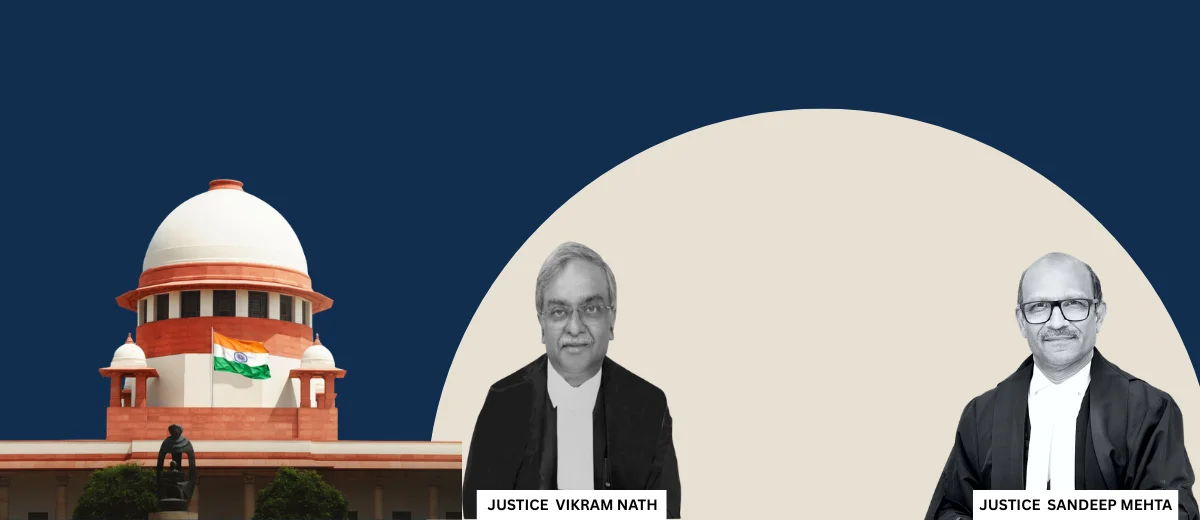
Coram: HON’BLE MR. JUSTICE VIKRAM NATH & HON’BLE MR. JUSTICE SANDEEP MEHTA
Relevant Provisions: Section 167(2) of the Code of Criminal Procedure, Sections 18,20, 38 and 39 of the Unlawful Activities (Prevention) Act, 1967 and Sections 124A, 153A, and 120B of the Indian Penal Code.
INTRODUCTION
The court in this case reiterated that extension of time for filing chargesheet is not merely a mechanical exercise, it requires an application of mind and mandates that the accused be heard before any decision is made. It held that if the same is not done, then the extension itself becomes illegal, and any right to default bail which may have crystallised at extension, will become indefensible.
FACTS
The appeal in this case arose from a judgment of the High Court of Jharkhand dismissing the appellant’s challenge to an order extending the time for filing the chargesheet under the Unlawful Activities (Prevention) Act, 1967. The appellant was accused for committing offences under the IPC and UAPA. He claimed that he had been illegally detained on 4 November 2023, prior to the registration of the FIR on 7 November 2023, and was formally remanded to judicial custody thereafter. Since the statutory 90-day period under Section 167(2) CrPC was to expire on 5 February 2024, the Investigating Officer sought an extension on 2 February 2024, which the Special Judge granted without informing or hearing the appellant. Unaware of this order, the appellant applied for default bail on 8 February 2024. His plea was rejected after the extension order was disclosed to him on 20 February 2024. The appellant challenged the legality of the extension, contending that mandatory safeguards under Section 43-D(2) UAPA were violated and that the Public Prosecutor had not independently applied his mind. During pendency of the proceedings, the chargesheet was filed on 2 May 2024, leading the High Court to dismiss the petition as infructuous.
ISSUE
Whether the extension of time for filing the chargesheet under Section 43-D(2)(b) of the Unlawful Activities (Prevention) Act, 1967, granted without notice to and hearing of the accused, is illegal and consequently entitles the accused to default bail under Section 167(2) CrPC?
ARGUMENTS OF THE PARTIES
The appellant argued that the extension order was illegal as he was neither produced nor notified of the application. The order lacked reasons, reflected no judicial application of mind, and was passed mechanically. Consequently, the extension was invalid, conferring upon him an indefeasible right to default bail under Section 167(2) CrPC.
On the other hand, the State contended that the extension of time was lawfully granted in accordance with statutory requirements. Since the chargesheet was filed within the extended period, the appellant’s claim to default bail did not survive. The respondent maintained that the trial court and High Court rightly upheld the validity of proceedings.
JUDGMENT AND ANALYSIS
The Court relied extensively on Jigar v. State of Gujarat to hold that production of the accused and intimation regarding the prosecution’s application for extension of time are mandatory requirements before extending the period for investigation beyond 90 days. The Court emphasized that such extension directly deprives the accused of the indefeasible right to default bail under Section 167(2) CrPC and therefore must satisfy the constitutional mandate of fairness under Article 21.
The Court observed that the appellant was neither produced physically or virtually nor informed about the application dated 2 February 2024 seeking extension of time. Further, the Special Judge mechanically granted extension merely on the prosecution’s assertion that investigation was pending, without recording cogent reasons or independently examining the necessity for continued detention. Similar perfunctory reasoning was repeated in subsequent extension orders.
It held that the extension orders reflected complete non-application of mind and violated mandatory procedural safeguards, the Court declared the first extension order illegal and arbitrary. Since the chargesheet was filed after expiry of the statutory 90-day period and the appellant had already applied for default bail before filing of the chargesheet, the Court held that his right to default bail had crystallized and become indefeasible.
CONCLUSION
The judgment reinforced that extension of time for investigation under the Unlawful Activities (Prevention) Act, 1967 cannot be granted mechanically or behind the accused’s back. It affirmed that notice, hearing, and judicial application of mind were indispensable safeguards, and that in their absence the accused’s indefeasible right to default bail under Section 167(2) CrPC will get crystallised.




 > Mon - Sat, 9:00 AM – 7:30 PM