
Case Name: INDIAN RAILWAYS V. WEST BENGAL STATE ELECTRICITY DISTRIBUTION COMPANY LIMITED & ORS.
Petition Number: Civil Appeal No. 4652 of 2024
Neutral Citation: 2026 INSC 464
Date of Judgment: 08.05.26
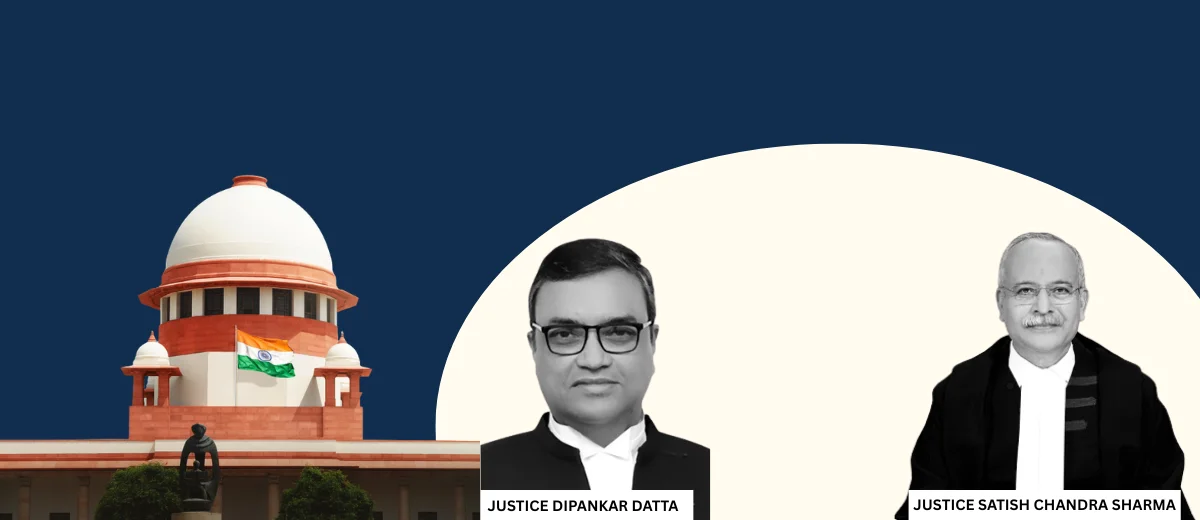
Coram: HON’BLE MR. J. DIPANKAR DATTA & HON’BLE MR. J. SATISH CHANDRA SHARMA
INTRODUCTION
The Supreme Court of India addressed a batch of statutory appeals filed by the Indian Railways under Section 125 of the Electricity Act, 2003. The primary challenge was against a common judgment dated 12.02.2024 of the Appellate Tribunal for Electricity (APTEL) which denied the Railways’ claim to be a “deemed distribution licensee” (DDL) under the Electricity Act, 2003 and mandated the payment of surcharges for availing open access.
FACTS AND PROCEDURAL HISTORY
Indian Railways, seeking to procure 100 MW of power from Gujarat for its traction substations in Maharashtra via “open access”, sought a declaration from the Central Electricity Regulatory Commission (CERC) that it is a DDL. While the CERC initially ruled in favor of the Railways in 2015, declaring them a deemed distribution licensee under Section 14 of the Electricity Act, various state-level regulatory commissions (SERCs) and distribution companies (DISCOMS) contested this. In February 2024, APTEL reversed the CERC order, holding that Railways is not a distribution licensee and is liable to pay surcharges as a consumer. The Railways then appealed this APTEL decision to the Supreme Court.
ISSUES
- Whether the activities provided under Section 11(g) and (h) of the Railways Act pass muster of “distribution” of electricity and whether such activities are a necessary pre-requisite to qualify as a DDL under the Act?
- Whether the Indian Railways, being an entity of the Central Government, falls within the ambit of “Appropriate Government” under Section 14 of the Act?
- Whether the Indian Railways, even if held to be a DDL under the Act, is exempt from the obligation to pay Cross-Subsidy Surcharge or additional surcharge for the grant of non-discriminatory open access as per Section 42 of the Act?
- Whether a proposed legislation may be relied upon as an aid to statutory interpretation for addressing gaps in the existing framework, and to give effect to the parliamentary intent to remedy defects thereunder?
SUBMISSIONS OF THE PARTIES
Appellant (Indian Railways): The appellant argued that Section 11 of the Railways Act gives them absolute and non-obstante authority to maintain “distribution installations” which overrides the Electricity Act. It claimed that being an entity of the Central Government, it is the “Appropriate Government” and thus automatically a DDL.
Respondents (DISCOMs): They contended that the Railways only consumes electricity for its internal operations, which does not constitute “distribution” as defined under the Electricity Act (which requires supplying electricity to third-party consumers). They argued that the Railways Act only allows them to build infrastructure for their own working, not to act as a public utility.
JUDGMENT AND ANALYSIS
The Supreme Court conducted a detailed analysis of the interplay between the Electricity Act, 2003 and the Railways Act, 1989. The Court’s findings on the four framed issues are as follows:
While addressing the first issue, the Court rejected the Appellant’s contention that the power to maintain “distribution installations” under Section 11 of the Railways Act is equivalent to being a “distribution licensee.” Following Sesa Sterlite Ltd. v. Orissa Electricity Regulatory Commission (2014) 8 SCC 444, the Court held that “distribution” necessitates a system that connects to third-party consumers for sale or supply. Since the Railways operates a closed, internal network for its own consumption (traction/signaling) and does not supply electricity to third-party consumers, it fails to satisfy the definition of a distribution licensee under Section 2(17) and 2(19) of the Electricity Act.
On the second issue, while the Court conceded that the Railways operates as a functionary under the Central Government, it clarified that being an instrumentality of the State under Article 12 of the Constitution does not automatically confer the status of an “Appropriate Government” for the purposes of the Electricity Act. Citing Steel Authority of India Ltd. v. National Union Waterfront Workers (2001) 7 SCC 1, the Court applied a “functional test,” concluding that the classification of “railways” in Section 2(5)(a)(ii) is a reference to subject-matter rather than an automatic conferment of governmental status on the entity itself.
While dealing with the third issue, the Court observed that even if the Railways were assumed to be a DDL, it would not be exempt from surcharges. Under Section 2(15), a “consumer” is anyone who is supplied with electricity for their own use. The Court held that since the Railways is the end-user of the power it procures via open access, it is a “consumer.” Relying again on the principles in Sesa Sterlite, the Court explained that CSS is a “compensatory charge.” It is designed to compensate the local DISCOM for the loss of a high-value consumer whose exit affects the DISCOM’s ability to subsidize weaker sections of society. The Court ruled that no consumer (government or private) can claim a privileged treatment to avoid this social-redistributive cost.
Lastly, on the fourth issue of this case, the Railways pointed to the Draft Electricity (Amendment) Bill, 2025, which proposed to exempt them from CSS, as evidence of parliamentary intent. The Court held that while legislative history is a valid tool (referencing Kalpana Mehta v. Union of India (2018) 7 SCC 1), a proposed bill that has not been passed cannot override the existing statute. The Court observed that since previous attempts (like the 2014 Amendment Bill) to grant Railways this specific status were rejected or lapsed, it indicated that Parliament has consistently chosen not to grant the Railways the exemption they currently seek.
CONCLUSION
The Supreme Court dismissed all appeals and concluded that Indian Railways is a consumer of electricity and not a deemed distribution licensee for the purpose of avoiding surcharges. Consequently, it is liable to pay Cross-Subsidy Surcharge and Additional Surcharge as calculated by the respective distributive companies for availing open access. The Court directed the respondents to compute these outstanding amounts for payment by the Railways.


 > Mon - Sat, 9:00 AM – 7:30 PM