
Case Name: New India Assurance Company Limited v. Dolly Satish Gandhi & Anr.
Petition No.: Special Leave Petition (Civil) Nos. 18267 of 2025
Neutral Citation: 2026 INSC 498
Date of Judgement: 15th May 2026
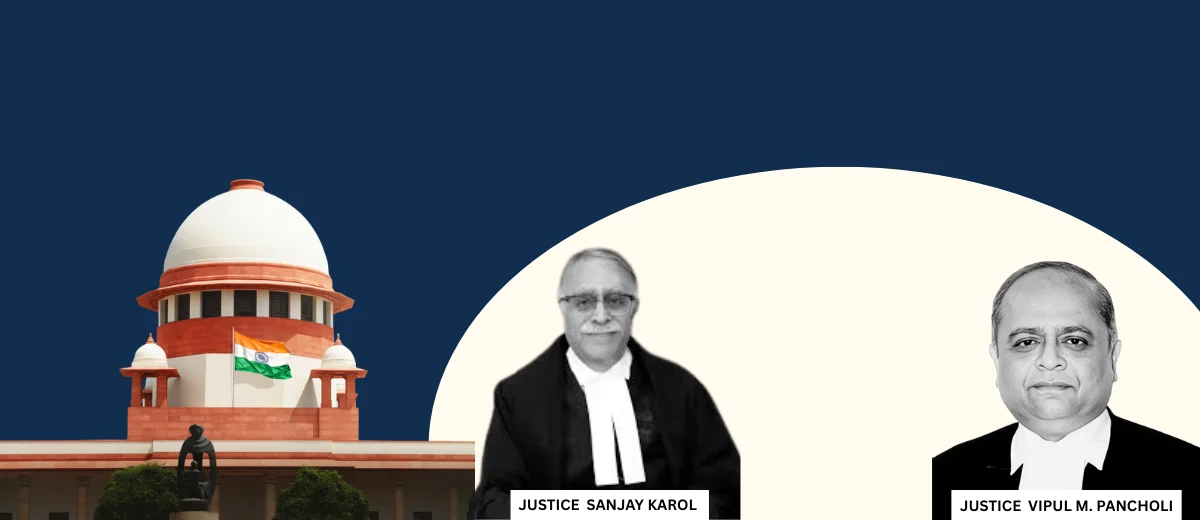
Coram: Honourable Mr Justice Sanjay Karol & Honourable Mr Justice Vipul M. Pancholi
Relevant Provisions: Sections 146, 147, 166, 167 and 168 of the Motor Vehicles Act, 1988
INTRODUCTION
The Supreme Court in the present case addressed whether amounts received under a Mediclaim or medical insurance policy can be deducted from compensation awarded under the Motor Vehicles Act, 1988. The Court held that Mediclaim benefits are contractual in nature and arise from premiums paid by the insured, whereas compensation under the Motor Vehicles Act is a statutory entitlement flowing from an accident caused by negligence. Consequently, the amount received under a Mediclaim policy cannot be deducted from compensation awarded by the Motor Accident Claims Tribunal even if compensation is granted under the head of medical expenses. The Court further emphasised the distinction between statutory and contractual entitlements and clarified the scope of the principle against “double benefit” in motor accident compensation jurisprudence.
FACTS
Claims were made before the Motor Accident Claims Tribunal seeking compensation under various heads, including medical expenses, loss of income, transportation, and special diet. Simultaneously, the injured claimant had also received reimbursement of medical expenses under a Mediclaim policy. The insurer argued that once medical expenses had already been reimbursed under the Mediclaim policy, granting compensation again under the same head would amount to duplication of benefits and unjust enrichment.
The appeal arose from a judgment of a three-Judge Bench of the Bombay High Court, which held that the amount received by a claimant under his or her own Mediclaim policy cannot be deducted in determining the compensation payable by the Motor Accident Claims Tribunal. The Supreme Court also noticed that several High Courts across the country had taken conflicting positions on this issue, thereby creating judicial inconsistency and uncertainty.
ISSUES
1. Whether amounts received under a Mediclaim or medical insurance policy are liable to be deducted from compensation awarded under the Motor Vehicles Act, 1988, particularly under the head of medical expenses.
- Whether allowing both statutory compensation and Mediclaim reimbursement would amount to impermissible “double benefit” or unjust enrichment.
ARGUMENTS OF THE PARTIES
The appellant-insurer, New India Assurance Company Limited, argued that once medical expenses had already been reimbursed under a Mediclaim policy, the claimant’s loss under that specific head stood neutralised. Therefore, awarding the same amount again under the Motor Vehicles Act would exceed the principle of restitution and result in the duplication of benefits. The insurer relied heavily on the principle of “just compensation” and argued that compensation under the Act should not become a source of profit or unjust enrichment. The appellant further argued that Sections 146 and 147 of the Motor Vehicles Act contemplate indemnification only for actual loss. Once the claimant had already been reimbursed through Mediclaim, there was no surviving liability under the head of medical expenses.
The respondents, on the other hand, argued that compensation under the Motor Vehicles Act is a statutory entitlement arising from negligence and bodily injury, whereas Mediclaim benefits arise from a private contract based upon payment of premiums. Since the two operate in separate legal spheres, neither can diminish the other. They submitted that Mediclaim benefits are independent contractual entitlements and therefore cannot be treated as gains arising from the same source. The respondents further argued that the Motor Vehicles Act is a beneficial legislation intended to provide just and fair compensation to accident victims. Deducting Mediclaim benefits would unfairly benefit the wrongdoer or the insurer of the offending vehicle while depriving the claimant of the benefits earned through payment of premiums over several years.
JUDGEMENT AND ANALYSIS
The Supreme Court answered this issue in the negative and held that Mediclaim or medical insurance amounts are not deductible from compensation awarded under the Motor Vehicles Act. The Court observed that the principle against “double benefit” applies only where two payments compensate the claimant for the same loss arising from the same source and within the same legal sphere.
The Court explained that the true test is to examine the “source and nature” of the benefit received. If the benefit is independent in character, it cannot be deducted merely because it accrues after the accident. The Court distinguished between statutory benefits and contractual benefits, holding that statutory benefits flow from legislative mandate, whereas contractual benefits arise from mutual agreement between parties.
The Court extensively relied upon Helen C. Rebello v. Maharashtra SRTC (1999) 1 SCC 90, and reiterated that amounts receivable independently of the accident cannot be deducted from compensation under the Motor Vehicles Act. Referring to Helen Rebello, the Court observed that “the principle of loss and gain has to be on the same plane within the same sphere.”
The Court further analysed the nature of Mediclaim policies and observed that such policies are purchased by individuals as financial safeguards against unforeseen medical contingencies and escalating healthcare costs. The Bench reasoned that denying claimants the benefit of both Mediclaim reimbursement and statutory compensation would effectively deprive them of the fruits of premiums paid over the years.
The Court held that accepting the insurer’s argument would confer an unintended advantage upon the insurer of the offending vehicle because the wrongdoer’s insurer would escape liability merely because the claimant had prudently purchased insurance coverage. The Court categorically observed that merely because the two payments appear similar, they cannot automatically be treated as “double benefit.”
Therefore, the Court conclusively held that compensation under the Motor Vehicles Act is a statutory and beneficial entitlement standing on a “higher pedestal”, whereas Mediclaim reimbursement is a contractual benefit arising from premiums paid by the insured. Consequently, both operate independently, and one cannot be deduced from the other.
CONCLUSION
The Supreme Court dismissed the appeal filed by New India Assurance Company Limited and held that amounts received under Mediclaim or medical insurance policies are not deductible from compensation awarded under the Motor Vehicles Act, even where compensation includes medical expenses. The Court clarified that Mediclaim benefits arise from a contractual arrangement supported by payment of premiums, whereas compensation under the Motor Vehicles Act is a statutory entitlement flowing from a motor accident and guided by the principle of just compensation.



 > Mon - Sat, 9:00 AM – 7:30 PM