
Case Name: Munna Moyuddin Shaikh Versus State of Gujarat
Petition Number: CRIMINAL APPEAL NO.2686 OF 2026 (Arising out of SLP (Crl.) Diary No. 35717 of 2025)
Neutral Citation: 2026 INSC 558
Date of Judgment: 26.05.2026
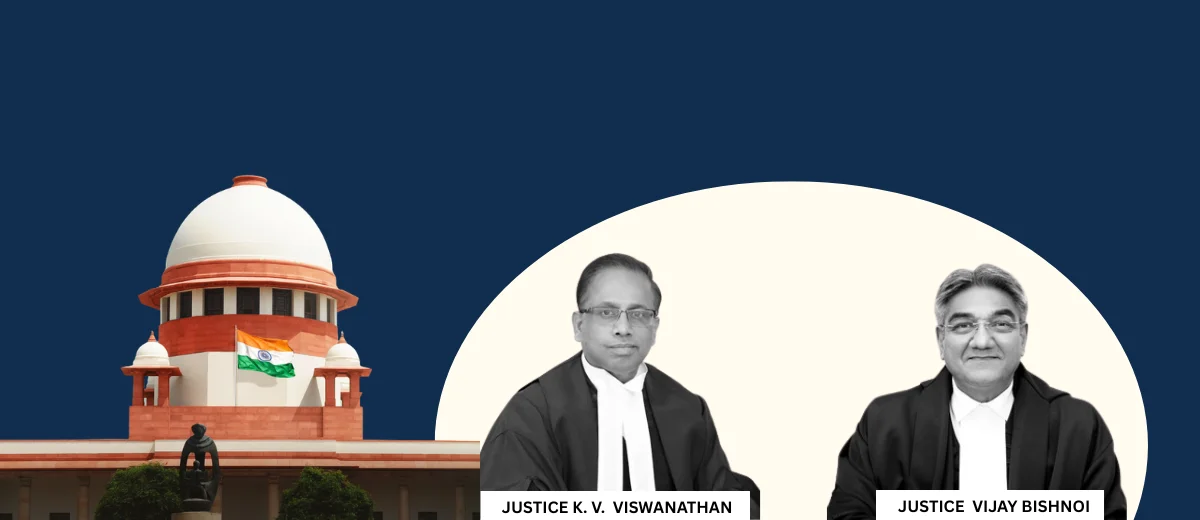
Coram: Justice K.V. Viswanathan and Justice Vijay Bishnoi
INTRODUCTION
This is a criminal appeal arising out of an SLP challenging the Gujarat High Court’s judgment dated 18.03.2002, which had confirmed the appellant’s conviction for murder and sentenced him to life imprisonment along with a fine of ₹25,000. The core question before the Supreme Court was whether the sentence of life imprisonment could be modified to the period already undergone (23 years, 6 months).
FACTS
The case dates back to 1998, when the appellant Munna Moyuddin Shaikh, then about 21 years old, allegedly stabbed the deceased with a knife on the torso and abdomen, causing his death. He was one of four accused put on trial, but the only one convicted. Three eyewitnesses supported the prosecution’s case, which was further backed by medical evidence and the recovery of the knife at the appellant’s instance. The Trial Court convicted him under Section 302 of the IPC and sentenced him to life imprisonment, with a fine of ₹25,000. The Gujarat High Court confirmed this in 2002. By the time the matter reached the Supreme Court, the appellant had already spent about 23 years, 6 months and 3 days in prison.
ISSUE
Whether a sentence of life imprisonment could be modified to that of a fixed term, and also as to whether such a modification would amount to enhancement of the sentence?
ARGUMENTS OF THE PARTIES
The appellant did not contest the conviction but focused entirely on the sentence. It was argued that the appellant had already undergone approximately 23 years, 6 months and 3 days of imprisonment without remission, and therefore the sentence of life imprisonment ought to be converted to the period already undergone. The appellant relied on the judgment in Shiva Kumar alias Shiva alias Shivamurthy v. State of Karnataka (2023) 9 SCC 817, arguing that even in cases where capital punishment is not imposed or proposed, constitutional courts have the power to impose a modified or fixed term sentence, provided it is not less than 14 years. The respondent, with fairness, brought to the Court’s notice the judgment in Birbal Choudhary alias Mukhiya Jee v. State of Bihar (2018) 12 SCC 440, which clarified that modifying a life sentence to a fixed term is not an enhancement of sentence, and therefore no notice under Section 401 CrPC was required.
JUDGMENT AND ANALYSIS
The Supreme Court upheld the conviction of the appellant under Section 302 IPC and Section 135 of the Bombay Police Act without any interference, as it found no reason to disturb the concurrent findings of both the Trial Court and the High Court. On the question of sentence, the Court drew upon a series of precedents to arrive at its conclusion. The Constitution Bench judgment in Union of India v. V. Sriharan (2016) 7 SCC 1 laid the foundation, holding that life imprisonment means imprisonment for the rest of the convict’s natural life, subject only to the right to claim remission under Articles 72 and 161 of the Constitution.
The same judgment also clarified that the power to impose a modified or fixed-term punishment can be exercised only by the High Court or the Supreme Court, not by any inferior court. Building on this, the Court in Shiva Kumar v. State of Karnataka(supra) further clarified that even in cases where the death penalty is not in question, constitutional courts can modify a life sentence to a fixed term, provided the term is not less than 14 years, as mandated by Section 433-A CrPC. The judgment in Birbal Choudhary v. State of Bihar(supra) additionally settled that such modification is not an enhancement of sentence and therefore no notice under Section 401 CrPC is required.
Applying these principles, the Court noted that the appellant had already served about 23 years, 6 months and 3 days, which is well above the minimum threshold of 14 years. The Court also took into consideration that the incident occurred in 1998 when the appellant was only about 21 years old. Accordingly, while maintaining the conviction, the sentence of life imprisonment was modified to the period already undergone, and the appellant was directed to be set at liberty forthwith.
CONCLUSION
The Supreme Court partly allowed the appeal. While the conviction of the appellant under Section 302 IPC and Section 135 of the Bombay Police Act was maintained, the sentence of life imprisonment was modified to the period already undergone, i.e. 23 years, 6 months and 3 days. The Court directed that the appellant be set at liberty forthwith, if not required in any other case.





 > Mon - Sat, 9:00 AM – 7:30 PM