
Case Name: SONAL TALPADA v. VEERBHAN SINGH
Petition No.: Civil Appeal No. of 2026 (Arising out of SLP (C) No. 10422 of 2025)
Neutral Citation: 2026 INSC 620
Date of Judgement: 02.06.2026
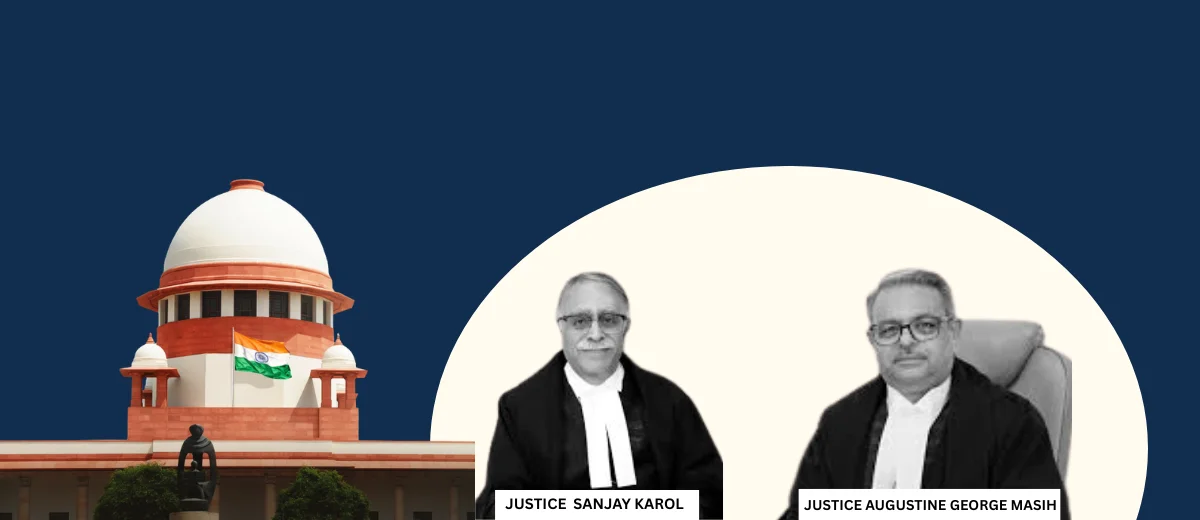
Coram: Hon’ble Mr. Justice Sanjay Karol & Hon’ble Mr. Justice Augustine George Masih
Relevant Statutes & Provisions: Section 13(1)(ia), Section 13(1)(ib), Hindu Marriage Act, 1955; Article 142(1), Constitution of India.
INTRODUCTION
This appeal arose from a judgment of the High Court of Rajasthan at Jaipur, which set aside a Family Court order dismissing the divorce petition filed by the respondent-husband against the appellant-wife. The Family Court had earlier held that the husband failed to prove cruelty. The Supreme Court was called upon to examine whether the husband had established cruelty within the meaning of Section 13(1)(ia) of the Hindu Marriage Act, 1955, and whether the marriage had broken down irretrievably so as to warrant dissolution.
FACTS
The marriage between the parties took place on 05.12.2007 in Gujarat. At the time of marriage, the appellant-wife was a gynaecologist in government service in Gujarat, while the respondent-husband was a government doctor in Rajasthan. The appellant-wife lived with the husband for only two to three months during their two-year matrimonial period. Citing cruelty, the husband filed a divorce petition under Section 13(1)(ia) of the HMA. The Family Court dismissed the petition on 21.08.2018, holding that cruelty had not been proved.
The High Court reversed this finding and granted divorce, citing an incident where the wife allegedly insulted the husband near the Taj Mahal, denial of sexual relations, desertion due to prolonged absence, and fifteen years of separation. The appellant-wife approached the Supreme Court against this decision. During the pendency of the appeal, the parties were referred to mediation, which proved unsuccessful.
ISSUES
- Whether the respondent-husband was subjected to cruelty within the meaning of Section 13(1)(ia) of the Hindu Marriage Act, 1955.
- Whether the marriage between the parties had broken down irretrievably so as to justify its dissolution.
ARGUMENTS OF THE PARTIES
The appellant-wife submitted that she never abandoned the matrimonial relationship and remained ready and willing to live with the husband, who could not take advantage of his own wrong. It was argued that desertion and irretrievable breakdown had not been pleaded in the divorce petition, that she had left her government job in Gujarat to save the marriage upon her father-in-law’s assurance regarding a nursing home in Bharatpur, and that no evidence of cruelty had been produced by the husband.
The respondent-husband argued that the wife made no genuine effort to preserve the marriage, that the parties had cohabited for barely two to three months over eighteen years, and that she had repeatedly denied him sexual relations, amounting to cruelty and desertion. It was further contended that the absence of mutual trust and incompatible lifestyles had led to an irretrievable breakdown, with no possibility of reconciliation.
JUDGEMENT AND ANALYSIS
At the outset, the court relied on Samar Ghosh v. Jaya Ghosh [(2007) 4 SCC 511] and reiterated that, unilateral decision of refusal to have intercourse without reasonable cause amounts to mental cruelty and that where there has been a long period of continuous separation, it may be concluded that the matrimonial bond is beyond repair. On the allegation concerning the Taj Mahal incident, the Court agreed with the Family Court’s assessment that no cruelty was established, since the husband himself admitted the monument was closed that day. However, on the evidence regarding cohabitation, the Court noted that even during their brief period of living together, the wife slept separately, kept her room locked, and did not respond when the husband knocked, a fact she did not dispute., and upheld the High Court’s grant of divorce on this ground.
On desertion, the Court observed that although this ground had not been formally pleaded, matrimonial disputes are not confined to rigid legal labels, and the overall conduct of parties must be examined. The Court emphasised that conjugal rights and duties are reciprocal, and prolonged withdrawal from the obligations of marriage has legal consequences when evaluating cruelty. Citing Nayan Bhowmick v. Aparna Chakraborty (2025 INSC 1436) the Court held that it is not for courts to adjudicate whose approach to married life was correct, but that mutual refusal to accommodate each other over a long period amounts to cruelty to both parties. The Court held that continued separation during the pendency of litigation may also be considered by an Appellate Court in assessing whether mental cruelty has been established, since an appeal is a continuation of the suit.
Independently of the finding on cruelty, the Court invoked its power under Article 142(1) of the Constitution to dissolve the marriage on the ground of irretrievable breakdown. Relying on Vikas Kanaujia v. Sarita [(2025) 3 SCC 748] and the Constitution Bench decision in Shilpa Sailesh v. Varun Sreenivasan [2024 INSC 1033], the Court reiterated that this discretion must be exercised with care, only where the marriage is shown to be totally unworkable and emotionally dead. The Court noted several relevant factors: the parties had lived together for only two to three months over eighteen years; they had been separated for over fifteen years; mediation had failed; there were no children from the marriage; and both parties were financially independent professionals. The Court found no evidence supporting the wife’s claim that she had left her job in Gujarat to live with the husband, noting that she continued to work there. The Court held that continued pendency of matrimonial litigation serves only to prolong a dead relationship and causes psychological harm to both parties.
CONCLUSION
In exercise of its power under Article 142(1) of the Constitution, the Court dissolved the marriage on the ground of irretrievable breakdown, given the prolonged separation of over fifteen years, the failure of mediation, and the absence of any realistic possibility of reconciliation. No order was made as to costs.



 > Mon - Sat, 9:00 AM – 7:30 PM