
Case name: SHAURYA SUNIL KUMAR SINGH V CENTRAL BUREAU OF INVESTIGATION
Petition No: Special Leave Petition (Crl.) NO. 4333 OF 2026
Citation: 2026 INSC 666
Date of Judgment: 01.07.2026
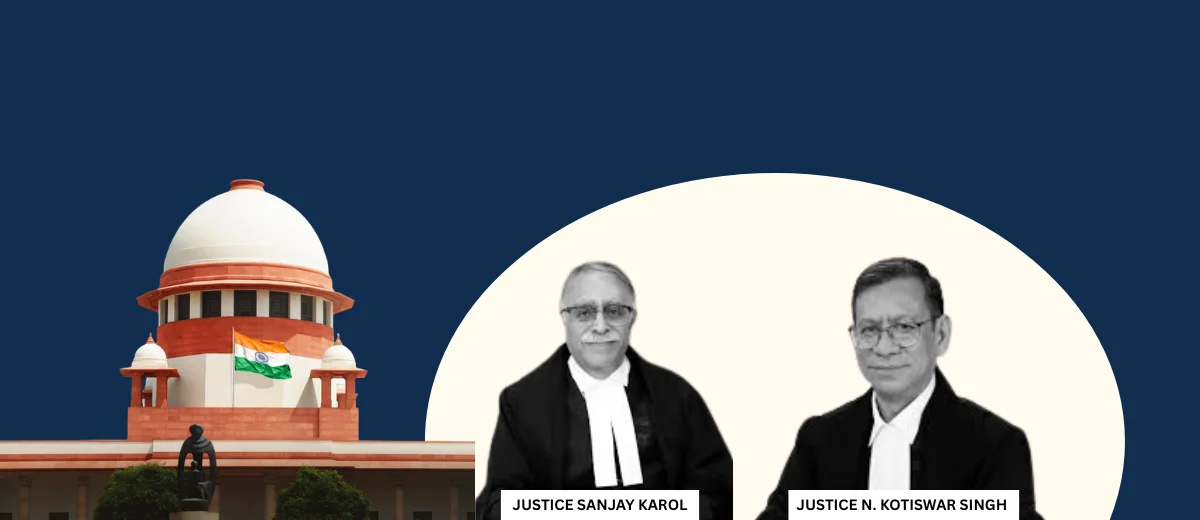
Coram: Hon’ble Justice Sanjay Karol and Hon’ble Justice Nonmeikapam Kotiswar Singh
Relevant Statutes and Provisions: Section 187(3) BNSS, Section 193 BNSS, Section 230 BNSS, Sections 61(2), 318, 319, 336, 340 of BNS, S7 of Prevention of Corruption Act, Section 66, 66D of Information Technology Act
INTRODUCTION
The judgment focused on holding that a simple non-filing of additional copies of a chargesheet under S193(8) of BNSS is a mere irregularity that does not entitle an accused to default bail. The Division Bench emphasized that the right to default bail is strictly conditional upon the pendency of an investigation; once the charge-sheet is filed in its proper form, the question of default bail does not arise.
FACTS
CBI registered an FIR against SP Cargo and Courier Services Pvt Ltd, its operator and unknown bank officials for operating fake mule accounts using forged KYC documents to extort money through cyber frauds like digital arrests and phishing attacks. The appellant was arrested for allegedly providing logistical support to Palande by transporting cheque books, ATM cards. Although CBI timely filed its chargesheets, the appellant sought default bail arguing that prosecution failed to submit additional copies of the chargesheet for the accused as mandated. After his pleas were dismissed by both Special Judge and the Bombay High Court, the Supreme court dismissed the appeal ruling that the right to default bail ceases once a proper chargesheet is filed within the stipulated time period.
ISSUE
Whether the filing of a charge-sheet without additional copies as required by Section 193(8) of the BNSS would entitle the appellant for the benefit of default bail?
JUDGEMENT AND ANALYSIS
At the outset, the court extracted the statutory provisions concerning default bail in the BNSS and corresponding section of CrPC. On the conjoint reading of these sections, they came to the conclusion that S167(2) of the CrPC and S187(3) of BNSS are substantially identical and differ only in phraseology, when it comes to filing a chargesheet an addition has been under S193(8) BNSS whereby the investigating officer is required to file additional copies of the report for supply to the accused and for supply of these documents, a timeline had been instituted of 14 days from date of production under S230 of BNSS.
The court emphasized that right to default bail is an indefeasible right that flows from Article 21 of the Constitution as supported by Saravanan v. State (2020) 9 SCC 101 and Fakhrey Alam v. State of Uttar Pradesh (2021) 20 SCC 636. It stated that the grant of default bail to an accused is not a release from custody on merits but on failure of the investigating agency to file the chargesheet within a period of sixty or ninety days, as prescribed. The court observed that the relief of default bail is limited to non-filing of the chargesheet itself and once it is filed in its proper form, the question of default bail does not arise. It has placed reliance on CBI v. Kapil Wadhawan (2024) 3 SCC 734 wherein it is said that even in the scenario that all documents relied upon by the prosecution are not filed with the chargesheet, the same would not invalidate the chargesheet itself.
Furthermore, the reasoning is in line with the exposition of the court in Central Bureau of Investigation v. R.S. Pai (2002) 5 SCC 82 where the court focused that while construing S173(5) of the CrPC which required supporting documents and witness statements to be supplied to the Magistrate along with chargesheet and this section is to be directory in nature. In the above case, the court is of the view that the present appellant is not entitled to the relief of default bail. It is borne from the record that the chargesheet was filed within the prescribed statutory time before the magistrate, thus it is in compliance with 193(3) BNSS. Consequently, the right to default bail became extinguished and the appellant ought to have applied for regular bail. The court also submits that where appellant gives his prayer for regular bail, his application is to be considered on its own merits, in accordance with law, independent of this appeal. Thus, the Court dismissed the appeal.
CONCLUSION
The Supreme Court concluded that the right to default bail is an indefeasible right under Article 21 of the Constitution that only arises if the investigating agency fails to file a chargesheet within the prescribed time period. Once it is filed, the right to default bail extinguishes. S193(8) of BNSS which requires additional copies of the police report is directory rather than mandatory, therefore a mere technical omission does not entitle the accused to statutory release.


 > Mon - Sat, 9:00 AM – 7:30 PM