
Case Name: NATIONAL LEGAL SERVICES AUTHORITY VS UNION OF INDIA & ORS.
Petition No.: WRIT PETITION (CRIMINAL) NO(S). 162 OF 2025
Neutral Citation: 2026 INSC 713
Date of Judgement: 16.07.2026
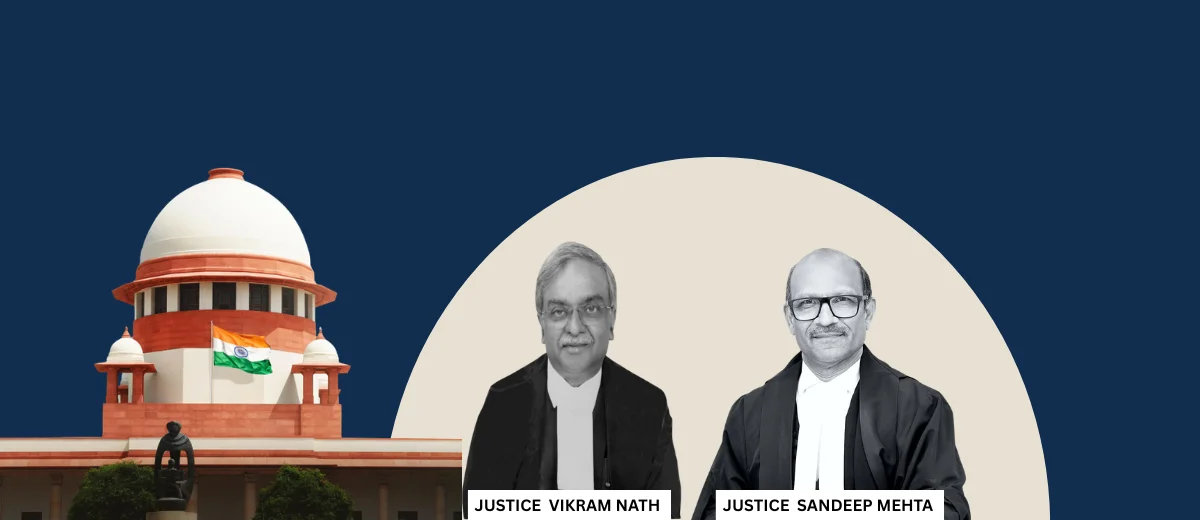
Coram: Hon’ble Mr. Justice Vikram Nath and Hon’ble Mr. Justice Sandeep Mehta
Relevant Statutes & Provisions: Article 14, Article 21, Article 32, Article 142, Article 51(c) of Constitution of India, Section 4(d) of the Legal Services Authorities Act, 1987
INTRODUCTION
The Hon’ble Supreme Court has held that the right to live with dignity and the right to health guaranteed under Article 21 of the Constitution of India are not suspended upon conviction. Recognizing the vulnerability of elderly and terminally ill prisoners within overcrowded and medically ill-equipped prisons, the Court issued structural directives under Articles 32 and 142 of the Constitution. The Court mandated all States and Union Territories to formulate uniform policies for compassionate, premature release and to integrate the entire application tracking process with the National e-Prisons Portal.
FACTS
The National Legal Services Authority (NALSA) filed a writ petition under Article 32 of the Constitution raising concerns about the continued imprisonment of elderly convicts above 70 years of age and terminally ill prisoners. To assess the situation, NALSA conducted a nationwide special campaign involving physical verification and medical record screening, identifying a vulnerable group of inmates across the country. The petition specifically highlighted 11 terminally ill convicts and 84 convicts above 70 years from 17 States and 1 Union Territory who had not approached the Supreme Court through appeals. Despite the seriousness of the issue, only the States of Bihar and Himachal Pradesh filed counter-affidavits, while the remaining States failed to respond.
ISSUES
- Whether the existing legal frameworks, remission policies and executive advisories governing incarceration are being meaningfully implemented in practice.
- Whether there exists a need for a principled and uniform mechanism to ensure that advanced age and terminal illness are recognised not as exceptional contingencies, but as constitutionally relevant considerations in the administration of criminal justice.
ARGUMENTS OF THE PARTY
NALSA argued that it had the necessary locus standi under Section 4(d) of the Legal Services Authorities Act, 1987, to file the petition. It contended that the continued incarceration of elderly and terminally ill prisoners violates Article 21, which guarantees the right to health, dignity, and humane living conditions. NALSA further urged the Court to adopt an objective definition of “terminal illness” based on international standards and highlighted its revised Standard Operating Procedure for Under Trial Review Committees (UTRCs) to address the needs of such vulnerable prisoners.
The State of Bihar submitted that steps had already been taken for the premature release of several identified prisoners, with some having been released and others receiving assistance through legal services mechanisms. The State of Himachal Pradesh informed the Court that it had no terminally ill prisoners but had 17 elderly inmates, including one undergoing regular dialysis. The State also indicated that it had no objection to the grant of bail to eligible prisoners, subject to the satisfaction of the competent courts.
JUDGMENT AND ANALYSIS
Regarding the core constitutional question, the Court held that the manner in which a constitutional democracy treats its most vulnerable individuals within its institutional framework is the clearest reflection of its commitment to the rule of law. Citing precedents like Dr. P. Varavara Rao v. NIA 2022 SCC OnLine SC 1004 and Rasik Chandra Mondal v. State of West Bengal Writ Petition (Criminal) No. 313 of 2020, the Court affirmed that when incarceration results in avoidable physical suffering and denial of end-of-life care, it ceases to be a lawful restriction and degrades into retributive suffering divorced from proportionality. It further assessed the Law Commission of India’s 268th Report and international benchmarks including the Nelson Mandela Rules to establish that advanced age and terminal illness are constitutionally relevant factors.
Addressing the institutional distribution of powers, the Court acknowledged that the subject of “prisons and persons detained therein” falls under List II of the Seventh Schedule, making it the primary legislative domain of the States. Under separation of powers, the Court noted it cannot assume the role of the legislature. However, it firmly held that constitutional restraint cannot be equated with constitutional abdication. Where executive inaction results in systemic violations of Article 21, the judiciary is duty bound to intervene. To eliminate ground-level execution gaps, the Court exercised its plenary jurisdiction under Articles 32 and 142 to issue mandatory, uniform structural directives.
The Supreme Court issued a series of directions to the States and UTs to ensure timely consideration of elderly and terminally ill prisoners for premature release. The Court directed to formulate and notify, within three months, a comprehensive policy in consultation with the respective State Legal Services Authorities. Such a policy must adopt the definition of “terminal illness” contained in the UNODC Handbook (2009), a condition where there is no reasonable medical possibility that the patient’s condition will not continue to deteriorate and ultimately result in death. The Court further mandated the constitution of independent Medical Boards at the Divisional and State levels for objective medical assessment and periodic certification of prisoners. The policy is also required to be integrated with the functioning of UTRCs for regular review of eligible cases in accordance with the framework proposed by NALSA.
To ensure transparency and eliminate procedural delays, the entire process from digital registration and medical evaluation to final recommendations and recording of reasons must be tracked through the e-Prisons Portal with automated alerts. The Court also directed the Ministries of Law and Justice, Home Affairs, and Electronics and Information Technology to provide the necessary digital infrastructure, software support, and capacity-building assistance to the States. Finally, the Union Government and all States and Union Territories were directed to file compliance affidavits before the Court within six months.
CONCLUSION
The Supreme Court allowed the writ petition to the extent of issuing systemic reforms, emphasizing that punishment must remain anchored in humanity, proportionality, and the possibility of reform. While individual releases are to be processed via the newly directed mechanisms or Trial Courts, the judgment effectively transitions compassionate release from an ad-hoc executive general amnesty to a structured, digitally monitored, and legally enforceable right under Article 21. The Registry was directed to implead the remaining non-party States and UTs, and the matter was listed for January 19, 2027, strictly for monitoring compliance affidavits.




 > Mon - Sat, 9:00 AM – 7:30 PM