
Case Name: RAHUL v. STATE OF UTTAR PRADESH AND ANOTHER
Petition No.: Crl.A. @ SLP (C) No.2939/2026
Neutral Citation: 2026 INSC 825
Date of Judgement: 11.08.2026
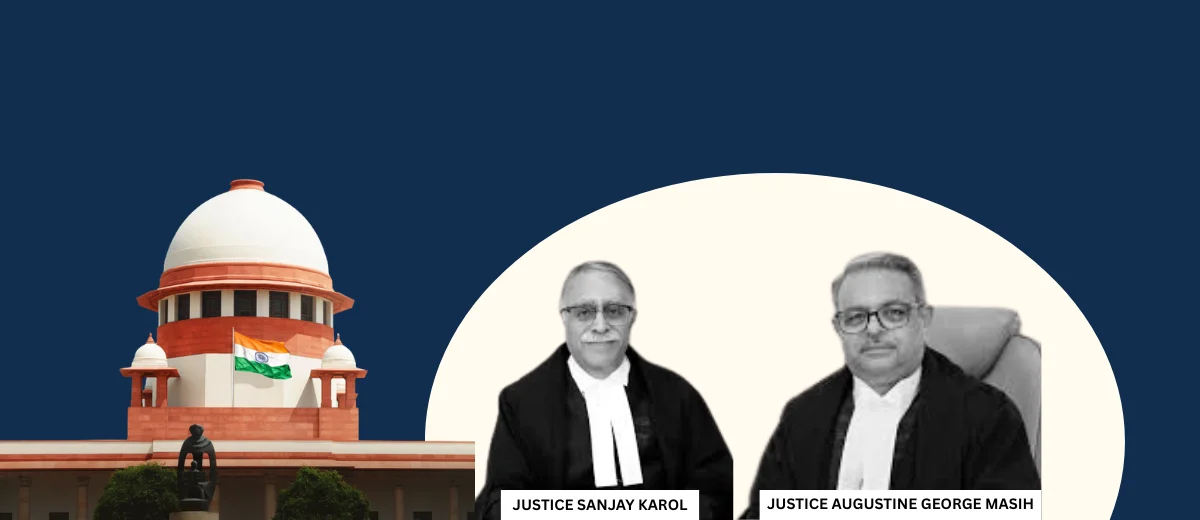
Coram: Hon’ble Mr. Justice Sanjay Karol and Hon’ble Mr. Justice Augustine George Masih
Relevant Statutes & Provisions: Section 498-A, Section 304-B IPC, Section 302 read with Section 34 of the Indian Penal Code, 1860; Section 3 and Section 4 of the Dowry Prohibition Act, 1961; Article 14 and Article 21 of the Constitution; Section 11 and Section 103 of the Indian Evidence Act, 1872
The case concerns the quashing of criminal proceedings against an accused who relied on official service records to establish his absence from the place of occurrence. The Supreme Court examined whether such unimpeachable evidence could be considered at the pre-trial stage under Section 482 Cr.PC. The Court also considered the acquittal of co-accused on the same allegations and evidence. It reaffirmed that courts must prevent proceedings that amount to a manifest abuse of process. The judgment ultimately applied the four-step test to determine whether quashing of proceedings would serve the ends of justice.
FACTS
Marriage between the appellant and daughter of the Respondent No. 2, was solemnised on 21.04.2014. Respondent No. 2 lodged First Information Report (F.I.R) on 13.06.2016 alleging that the appellant and his family members had subjected Anshul to cruelty and harassment for dowry, particularly for a Tata Safari motor car, and on non-fulfilment of this demand, the deceased was subjected to death hanging on 13.06.2016. Panchayatnama recorded the room and main entrance door of the house locked from inside. The Post-Mortem Report recorded the cause of death as asphyxia due to antemortem hanging with a single ligature mark and no other ante-mortem injury, strongly indicative of suicide. The appellant, a member of the Border Security Force (BSF), was on the relevant date posted on the Indo-Bangladesh border. The certificate dated 03.10.2016 by the authorities records that the appellant was in Delhi from 14.06.2016 until 19.06.2016 for official work.
ISSUES
- Whether the High Court was justified in declining to examine, at the threshold, the effect of the official service certificate establishing the appellant’s absence from the place of occurrence?
- Whether the acquittal of the co-accused appellant’s parents, on an identical set of allegations and evidence arising from the very same F.I.R., has a material bearing on the continuation of proceedings against the appellant?
- Whether, on a cumulative reading of the record, the continuation of criminal proceedings against the appellant amounts to an abuse of the process of the court, warranting exercise of jurisdiction under Article 136 read with the principles governing Section 482 Cr.PC.?
ARGUMENTS OF THE PARTIES
The appellant submitted that the impugned judgment is erroneous as it failed to accord due weight to the appellant’s plea which was backed by official documentary evidence and that the F.I.R is without any cogent evidence specifically attributable to the appellant. The appellant gave much weightage to the Panchayatnama to be prima facie inconsistent with the prosecution’s theory of a dowry death caused by the family members acting in concert. He further relied on the Post-Mortem Report. The appellant also distinguished the case of Rajendra Singh (supra) on facts wherein alibi had rested on affidavits filed for the first time before the High Court, whereas here the defence rests on an official, contemporaneous BSF service record. It was also submitted that the acquittal of the co-accused parents while proceedings for the appellant with no criminal antecedents continued despite being based on the same material is gross violation of Articles 14 and 21 of the Constitution.
The Respondents submitted that burden to prove alibi rests solely on the appellant, and herein the appellant has failed to place on record any cogent or independent corroborative material such as travel records, tickets, movement orders, leave records or transportation details. Further reliance was placed on the case of Shaikh Sattar v. State of Maharashtra (2010) 8 SCC 430 to assert that a plea of alibi must be proved with absolute certainty excluding any possibility of the accused’s presence at the relevant time and place. The Court relied on the case of Rajendra Singh (supra) to support the proposition that no finding on a plea of alibi can be recorded by a court for the first time in a petition under Section 482 Cr.PC. It is further contended by the respondents, that physical presence at the precise moment of death is not, by itself, an ingredient of the offence, and that cruelty or harassment “soon before” death may be established through conduct, including telephonic threats occurring even while the accused is stationed elsewhere.
JUDGMENT AND ANALYSIS
The Court opined that the power under Article 226 or the inherent powers under Section 482 of the Code is undoubtedly to be exercised sparingly, with circumspection, and never to throttle a legitimate prosecution or to conduct a mini trial at the threshold. To support this proposition the Court referred to the caution raised in the case of State of Haryana and Others v. Bhajan Lal and Others 1992 Supp (1) SCC 335. These self-imposed restraints, however, do not require the court to shut its eyes to a proceeding that is a manifest abuse. The Court relied on Mahmood Ali and Others v. State of Uttar Pradesh and Others (2023) 15 SCC 488 wherein this Court held that in such a situation the court owes a duty to examine the complaint with care and a little more closely, and, where necessary, to read in between the lines. Thereafter, the Court referred to the four-step test as laid down in the case of Rajiv Thapar and Others v. Madan Lal Kapoor (2013) 3 SCC 330.
- Four-Step Test to Determine Quashing Laid in Mahmood Ali Case (Supra):
This Court laid down a 4-step test to determine if criminal proceedings can be quashed on the basis of defense material/official records prior to trial as follows:
- Step 1: Whether the material relied upon by the accused is sound, reasonable, and indubitable i.e. the material is of sterling and impeccable quality?
- Step 2: Whether the material relied upon by the accused would rule out the assertions contained in the charges levelled against the accused i.e. the material is sufficient to reject and overrule the factual assertions contained in the complaint i.e. the material is such as would persuade a reasonable person to dismiss and condemn the factual basis of the accusations as false?
- Step 3: Whether the material relied upon by the accused has not been refuted by the prosecution/complainant; and/or the material is such that it cannot be justifiably refuted by the prosecution/complainant?
- Step 4: Whether proceeding with the trial would result in an abuse of process of the court, and would not serve the ends of justice?
The Court observed that the facts of every case have to sail through the test laid above by the Court, and if it passes the test then it is for the Court to quash such criminal proceedings in exercise of power vested in it under Section 482 CrPC. Such exercise of power, besides doing justice to the accused, would save precious court time, which would otherwise be wasted in holding such a trial (as well as proceedings arising therefrom) specially when it is clear that the same would not conclude in the conviction of the accused.
- Findings on Facts: The Court found that medical evidence does not by itself determine in absoluteness whether the death is suicidal or homicidal but complete absence of injuries ordinarily expected in a struggle claiming to be involving concert among several accused, assumes considerable evidentiary significance. The Court recognised contemporaneous inquest report to be of equally important evidential value, on ground of it being made immediately after the occurrence of the incident, as in this case was the Panchayatnama. The Court recorded that the certificate dated 03.10.2016 ascertains that appellant remained present at Ftr HQ BSF Meghalaya (Shillong) except on 14.06.2016 i.e., a day after the incident and remained in Delhi up to 19.06.2016.
- Findings on Law: The Court reiterated and reaffirmed the well settled principle that when the defence material is of such a nature to completely demolish the case of the prosecution, then the High Court is at liberty to, and would be justified in quashing the proceedings even at the pre-trial stage, in order to prevent the abuse of the process of the Court. The Court referred to Mirza Iqbal alias Golu and Another v. State of Uttar Pradesh and Another (2022) 16 SCC 697, wherein this Court considered the quashing of proceedings where the accused’s official duty record demonstrated his absence from the place of occurrence. The Court reaffirmed the rule laid down in Rajendra Singh (supra) in respect of burden of proof to be on accused to prove the plea of alibi and the findings to not to be recorded for the first time before the High Court, but also at the same time this has been recognised in the present case that these findings pertain specifically to circumstances where the material relied upon consists of affidavits sworn by private individuals, thus calling for challenge and cross-examination. Thus, the said rule cannot be said to be inflexible, and on the question of material consisting of official record which has never been challenged to be forged or fabricated, then such material partakes of the character of unimpeachable material.
Thereafter, in accepting the plea of Respondents in respect of the nature of the offence, the Court held that in the absence of supporting material to prove or even establish the telephonic threat, the appellant cannot be considered to be connected with the alleged demand. On the point of relating the present case to the acquittal of the appellant’s parents, the Court formed the view that an order of acquittal of co-accused, rendered on an identical body of evidence, does not automatically bind or exonerate a differently situated co-accused whose case may rest on distinct material. But even to form that opinion, it is pre-suppossed that there must be some distinguishable evidence. In the present case no such distinguishable evidence exists, and considering the stigma of a criminal trial held that the High Court’s decision failed to appreciate unimpeachable material bearing directly on the question of abuse of process, and calls for interference.
The Court, to conclude, after reading together all the evidence on record including medical records indicating absence of force, Panchayatnama recording doors locked from inside, presence of official service records supporting plea of alibi and no explanation by prosecution to rebut the above material on record. The Court held that the four-step test was satisfied in the present case. The service certificate is not disputed as a document, its issuing authority is not questioned, nor are its contents disputed.
Thus, the Court ensured that justice should not fall prey to circumstances permitting the criminal process to continue merely because a technical prima facie case can be spelt out from the bare averments of the F.I.R. The Court held the categories laid down in the case of Bhajan Lal (supra) as illustrative and not exhaustive. The Court on the basis of foregoing reasons held that in the present case, continuation of the criminal proceedings against the appellant amounts to abuse of the process of the Court. Thus, the appeal was allowed, quashing all the continuing criminal proceedings.


 > Mon - Sat, 9:00 AM – 7:30 PM