
Case Name: Surender Kumar v. State of Haryana & Ors.
Appeal No.: SLP (Crl.) No. 14611/2026
Neutral Citation: 2026 INSC 1006
Date of Judgment: 08.09.2026
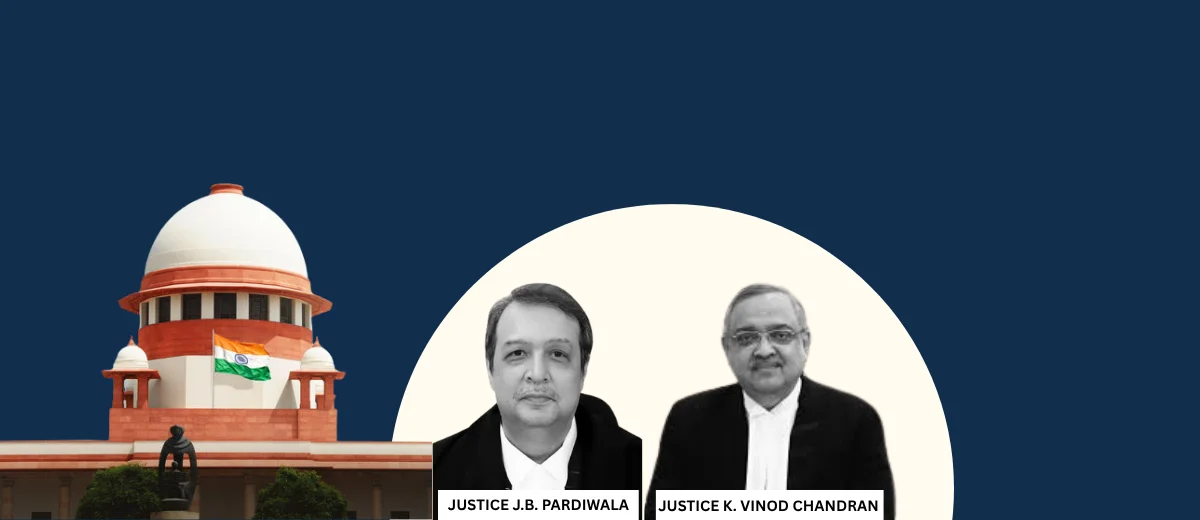
Coram: Hon’ble Justice J.B. Pardiwala, Hon’ble Justice K. Vinod Chandran
Relevant Statutes and Provisions: Sections 147, 148, 149, 307, 323, 325, 506 of the Indian Penal Code, 1860 (IPC), Section 216 of the Code of Criminal Procedure, 1973 (CrPC).
(The Hon’ble Supreme Court dismissed the Special Leave Petition, refusing to add Section 307 IPC, holding that the grievous nature of injury is not an essential precondition for attempt to murder.)
The Hon’ble Supreme held that the nature of the hurt on which the courts laboured in the impugned orders, though relevant, cannot be the sole basis for a finding of attempt to murder. But the finding of the Sessions Court that there is no intention or knowledge alleged could be taken as a reason or justification for not bringing in Section 307.
FACTS
A dispute over waterlogging caused by the draining of rainwater led to an assault by armed accused persons on the petitioner, his brother and his uncle, in which the petitioner and his brother sustained multiple injuries. The injured were taken immediately to the Primary Health Centre, Sagga, Karnal, where the Medical Officer (PW6) examined them and, as regards the brother’s injuries, left their gravity to be stated by the treating surgeon.
An FIR was registered at Police Station Nissing, Karnal, under Sections 147, 148, 149, 323, 325 and 506 of the Indian Penal Code, 1860 (IPC) against six accused. The brother was treated by a neurosurgeon at a private hospital, who found a fracture of the right parietal bone with underlying haemorrhagic contusion. When this report was obtained during the investigation, the accused requested an examination by a Medical Board, which included the PW6, and the Board determined that the injuries were grievous but not life-threatening. Despite the availability of both medical opinions, Section 307 of the IPC was excluded from the chargesheet; furthermore, the victim raised no objection regarding this omission at the stage of taking cognizance. Charges were framed, and during the trial the Neurosurgeon, examined as PW5, deposed that the injury could, in his opinion, have been dangerous to life. After the prosecution witnesses were examined, the petitioner applied for alteration of charges to Section 307 IPC, which was opposed by the accused. The Judicial Magistrate First Class, Karnal, dismissed the application , holding that the Medical Board’s report prevailed. In revision, the petitioner contended before the Sessions Court that the FIR had first been registered under Section 307 and the section was deleted only after the Board’s opinion, but the Sessions Court dismissed the revision petition, and observed that the complainant failed to allege an intention to kill and that multiple injuries were also suffered by two of the accused. The High Court, while dismissing the revision petition, held that the opinion of the private neurosurgeon was rendered inconsequential in view of the opinion subsequently furnished by the Medical Board of the Government Medical College, Karnal. Aggrieved by the judgment of the High Court, the petitioner has preferred the instant Special Leave Petition before the Hon’ble Supreme Court.
ISSUES
- Whether the grievousness of the injury, or its potential to endanger life, is a necessary ingredient of Section 307 IPC.
- Whether the charge could be altered to Section 307 IPC at the stage of the trial at which the application was made.
CONTENTION OF THE PETITIONER
The injuries, caused by armed assailants, were dangerous to life, as the Neurosurgeon deposed. The FIR was originally registered under Section 307, and the section was deleted only after the Board examination sought by the accused. The courts below wrongly preferred the Board’s opinion over that of the treating Neurosurgeon, and the application to alter the charge should therefore have been allowed.
CONTENTION OF THE RESPONDENTS
The Medical Board opined that the injuries were grievous but not dangerous to life, therefore, Section 307 was not attracted. The first informant had also never alleged any intention to kill. Two of the accused had themselves been injured. Moreover, the application was filed very belatedly, only after the prosecution evidence had been recorded. Lastly, the order does not record the State’s stand.
JUDGMENT AND ANALYSIS
- Grievous injury or danger to life is not an ingredient of Section 307.
The statutory framework of Section 307 contains one limb governing criminal liability and another limb regulating the quantum of punishment. Culpability arises when an act is done with such intention or knowledge, and in such circumstances, that if death were caused the accused would be guilty of murder. Intention or knowledge alone attracts up to ten years and fine. If hurt is also caused, the punishment is life imprisonment or the lesser punishment. Hurt, simple or grievous, is therefore not a precondition of the offence and only enhances the punishment. The Court relied on Pasupuleti Siva Ramakrishna Rao v. State of A.P. (2014) 5 SCC 369 for this distinction between the two punishments. It relied on State of M.P. v. Kashiram (2009) 4 SCC 26 for the rule that intent coupled with some overt act is enough, without any injury capable of causing death or even simple hurt.
- Intention or knowledge is the determining question and is inferred from circumstances.
Chimanbhai Jagabhai Patel v. State of Gujarat (2009) 11 SCC 273 sets out the ingredients: (i) an overt act; (ii) intention or knowledge to cause an injury likely to cause death, or one that would in the ordinary course of nature lead to death, or an act so imminently dangerous that death would in all probability result; and (iii) no excuse for running the risk. None of these depends on the gravity of the injury. State of M.P. v. Saleem (2005) 5 SCC 554 holds that no injury capable of causing death is needed, and that a simple injury does not negate intention, which is discerned from the surrounding circumstances. State of M.P. v. Kanha (2019) 3 SCC 605 and Jage Ram v. State of Haryana (2015) 11 SCC 366 add that the absence of a fatal injury does not dislodge Section 307. The nature of the injury and the weapon used can support an inference of intent and knowledge, so they are relevant evidence but not the test.
- Delay was decisive, but the trial court’s power to alter the charge remains
The trial had substantially proceeded when the prayer was made. Both medical certificates were available at the chargesheet stage, and the injured, who were conscious of their injuries and of how the acts were committed, did not complain at cognizance. No case of intention or knowledge attracting Section 307 was raised at the initial stage, at cognizance or while evidence was led, and the investigation did not detect one either. The late application could not be entertained, and its rejection was justified. The trial court may still alter the charge at any time during the trial if sound and justifiable cause emerges from the evidence.
The Supreme Court dismissed the Special Leave Petition and rejected the prayer to add Section 307 IPC. It held that neither grievous hurt nor danger to life is essential for an attempt to murder, because the offence turns on intention or knowledge. The courts below were therefore wrong to treat the Medical Board’s opinion as decisive. The Court still upheld the refusal because the application came late in the trial, after both medical opinions were on record, with no earlier allegation of intention or knowledge. The trial court may still alter the charge if the evidence later gives sound and justifiable cause.




 > Mon - Sat, 9:00 AM – 7:30 PM