Case Name: CHANNAPPA (D) THR. LRS. V. PARVATEWWA (D) THR. LRS.
Petition Number: CIVIL APPEAL OF 2026 ARISING OUT OF SLP (C) NO. 8536 OF 2024
Neutral Citation: 2026 INSC 343
Date of Judgement: 09.04.2026
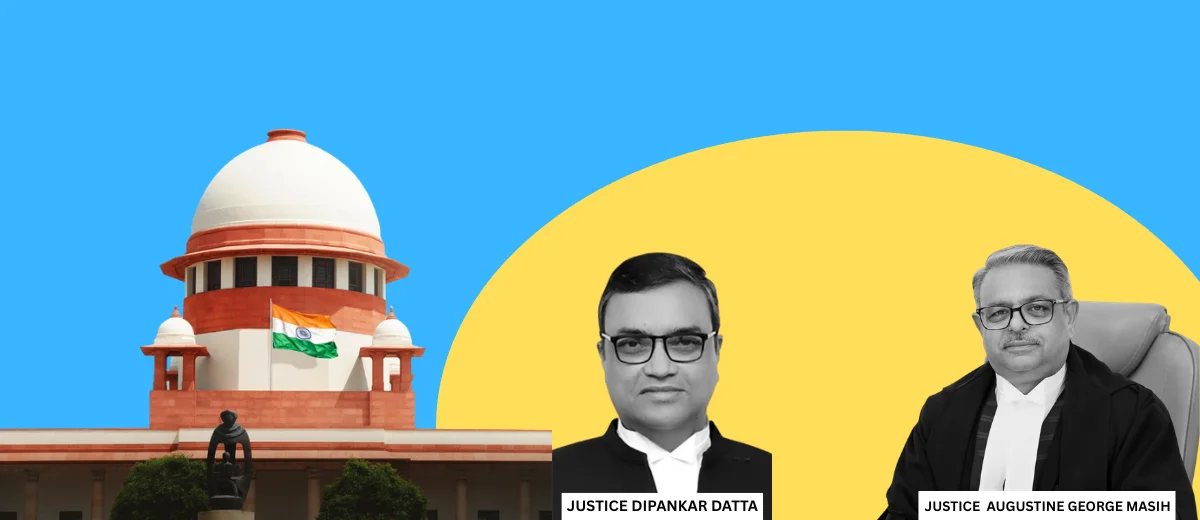
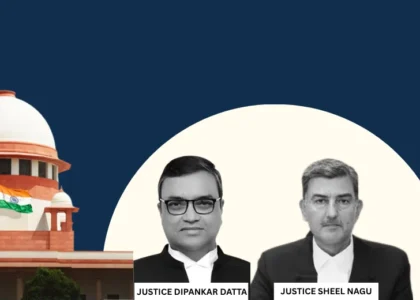
Coram: HON’BLE MR. JUSTICE DIPANKAR DATTA AND HON’BLE MR. JUSTICE AUGUSTINE GEORGE MASIH.
INTRODUCTION
In this case, the respondent filed a subsequent suit for declaration of title over property, the ownership of which is disputed in the primary suit seeking injunction against appellant’s interference with peaceful possession of the property. A Division Bench of Justice Dipankar Dutta and Justice Augustine George Masih setting aside the judgement of the Karnataka High Court, held that a subsequent suit claiming declaration of title is barred by Constructive Res Judicata if it was omitted in the earlier suit, where the title of ownership of the property itself was in dispute.
FACTS AND PROCEDURAL HISTORY
The Appellant was adopted by the Respondent in 1961, shortly after the death of the Respondent’s husband. In 2002, the Respondent instituted a suit in Trial Court seeking to declare that the adoption deed was null and void, and not binding along with a suit of injunction simpliciter (hereafter Suit I), which was dismissed by the Court in 2006. Aggrieved, the Respondent appealed before the First Appellate Court under Section 96. While this appeal was pending, the Respondent filed a fresh Original Suit before the Principal Civil Judge (hereafter Suit II), alleging illegal dispossession of the property by the Appellant and sought for declaration of title of ownership along with possession.
Challenging the Original Suit, the Appellant filed two Interlocutory Applications before the Trial Court, one seeking to stay the suit and the other questioning its maintainability. Both were dismissed by the Trial Court. Aggrieved, the Appellant filed a Writ petition before the High Court which was also dismissed. The Appellant preferred Second Appeal which was allowed by the Court, affirming dismissal of Suit I. The Respondent died during the pendency of Suit II. The Trial Court dismissed Suit on the ground of Res Judicata and Constructive Res Judicata. The Legal Representative preferred an Appeal before the Appellate Court for Suit II, which held that suit was not barred by limitation, but dismissed the suit on grounds of Res Judicata, Constructive Res Judicata and Order II Rule 2 CPC. The Appellant passed away during the Second Appeal. The High Court allowed the Regular Second Appeal of the Respondent and set aside the judgements and decrees on the grounds of Res Judicata and ruled in favour of the Respondent.
ISSUES
- Whether Suit I, Suit II and the subsequent appellate proceedings are barred by Res Judicata or Constructive Res Judicata under Section 11 CPC or by the provisions of Order II Rule 2?
- Whether the High Court exercising its jurisdiction under Section 100 of CPC, was justified interfering with the concurrent findings of the lower courts and decreeing Suit II?
SUBMISSIONS OF THE PARTIES
The Appellant contended that while instituting Suit I and the subsequent appellate proceedings, the Respondent was fully aware of the Appellant’s contention of claiming ownership over the property. Having been aware, the Respondent ought to have claimed declaration of title along with other reliefs in Suit I itself as they all were based on the same cause of action.
The Respondent contended that the Suits were based on two distinct causes of action. One was with regard to the validity of the adoption deed and the other was with regard to the illegal dispossession of the Respondent. Thus, it was argued that it was neither barred by Res Judicata nor Order II Rule 2 CPC.
JUDGEMENT AND ANALYSIS
The Supreme Court emphasized the Doctrine under Order II Rule 2 of CPC that all reliefs arising from the same cause of action should be claimed in a single proceeding. If the plaintiff omits one relief in the primary suit, then they are barred from instituting a subsequent suit with regard to the omitted relief. Given the foundational fact of entitlement of property existed at the time of the primary suit, the Court highlighted that the cause of action and the subject matter in both Suits I & II are substantially the same. It was pointed out that despite the Respondent being aware that the Appellant rejected her claim of ownership, she chose to file an Injunction Simpliciter without a relief for declaration of title.
The Court further clarified that the fundamental principle of Order II Rule 2 of CPC is that a person cannot be vexed for the same cause of action twice by re-litigating in a subsequent suit. This is done to prevent harassment of the defendant. The Court stated that the principle of Constructive Res Judicata is also relevant in the context, that a matter ought to have been a ground of attack in the primary proceedings is presumed to be in direct and substantial issue with the proceedings. It was observed, relying on previous decisions, that Res Judicata not only applies to issues already decided, but extends to issues that ought to have been raised earlier.
With regard to the second issue, the Court clarified that the jurisdiction of the High Court is confined to substantial questions of law and not findings of fact concurrently recorded by lower courts, unless they are perverse or have no evidence. Assessing the factual matrix without any misapplication of law exceeds the limits of jurisdiction under Section 100 CPC.
Thus, the Court allowed the Appeal of the Respondent and set aside the judgment of the High Court.
CONCLUSION
The Supreme Court thus reiterated that a defendant cannot be harassed for the same cause of action twice on the basis of the principle of Constructive Res Judicata under Section 11 CPC and Order II Rule 2, that all substantially related reliefs should be claimed from the same cause of action and proceeding, to avoid multiplicity of suits.


 > Mon - Sat, 9:00 AM – 7:30 PM