Case Name: SIVAKUMAR VS. STATE REP. BY THE INSPECTOR OF POLICE (with connected case)
Petition Number: CRIMINAL APPEAL No. 1807 OF 2019
Neutral Citation: 2026 INSC 318
Date of Judgement: 06.04.2026
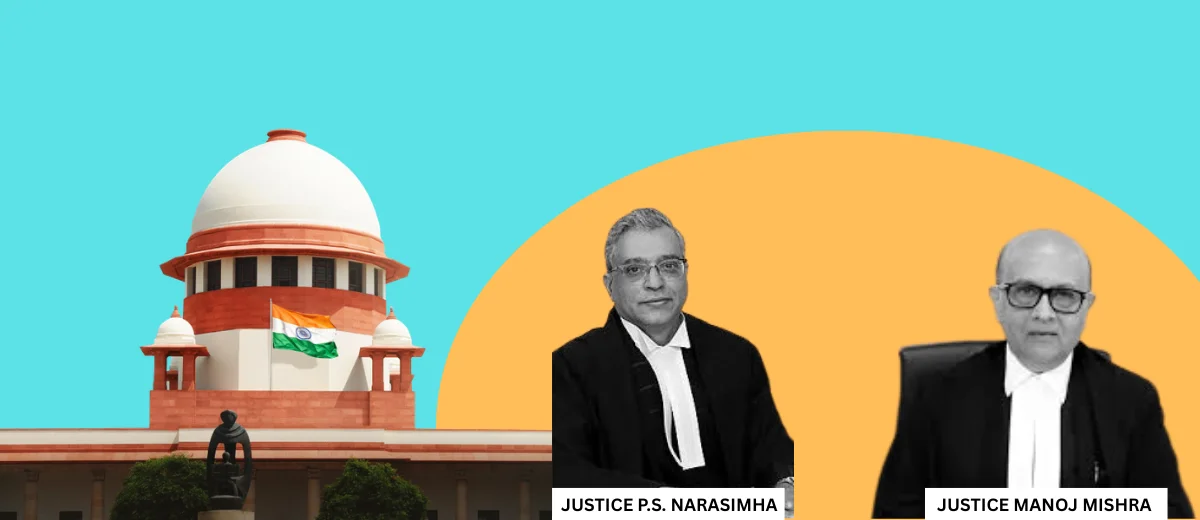
Coram: HON’BLE MR JUSTICE PAMIDIGHANTAM SRI NARASIMHA & HON’BLE MR JUSTICE MANOJ MISRA
INTRODUCTION
The appeal was filed by two accused challenging a common judgment of the Madras High Court. The High Court had enhanced their sentences, convicting both under Section 294(b) of the IPC for using obscene language, convicting A-1 under Section 304 Part II read with Section 34 IPC, and altering A-2’s conviction to Section 304 Part II IPC for a fatal assault during a boundary dispute. The Supreme Court examined the legal threshold for “obscenity” concerning verbal abuses, the requirements for establishing “common intention” in a sudden melee, and the proportionality of sentencing in sudden, unpremeditated familial quarrels.
FACTS
The deceased and the accused were neighbours and close relatives who shared a disputed common boundary. The deceased insisted on fencing the disputed property despite objections from the accused. A heated argument ensued. In the heat of the moment, A-1 picked up an Aruval (an agricultural tool) and aimed a blow at the deceased. The deceased’s brother (PW-4) intervened, and the blow struck him instead. A-1 then struck another blow on PW-4’s toe. During this melee, A-2 struck a hard, solitary blow on the deceased’s head using a log, causing him to fall unconscious. The deceased later succumbed to a depressed fracture of the skull and internal blood clots. Cause of death, as per the opinion of the doctor, was grievous injury on head and brain.
The Trial Court acquitted two female co-accused but convicted A-1 under Section 324 IPC and A-2 under Section 325 IPC. The victim’s widow filed an appeal challenging the acquittal of the two female co-accused on all charges, as well as the acquittal of Accused Nos. 1 and 2 in respect of certain offences. The High Court affirmed the acquittal of Accused Nos. 3 and 4. However, it reversed the acquittal of Accused Nos. 1 and 2 for the offence punishable under Section 294(b) of the Indian Penal Code and convicted them for the said offence. A-1 was additionally convicted under Section 304 Part II read with Section 34 IPC, and A-2’s conviction was escalated to Section 304 Part II IPC.
ISSUES
- Whether the mere utterance of a vulgar or abusive word (like “bastard”) constitutes an “obscene act” punishable under Section 294(b) of the IPC?
- Whether A-1 could be saddled with the liability of culpable homicide under Section 304 Part II read with Section 34 IPC, without evidence of a shared intent or exhortation to kill the deceased?
- Whether the single fatal blow by A-2 using a wooden log during a sudden quarrel justified a conviction for culpable homicide rather than grievous hurt?
ARGUMENTS OF THE PARTIES
The Appellants argued that there was no evidence to justify a conviction for obscenity under Section 294(b). A-2 argued that the assault occurred in the heat of the moment, the weapon was picked up on the spot, and the fatal head injury was accidental from a single blow; thus, he had no intention or knowledge to cause death. A-1 argued that he could not be convicted with the aid of Section 34 IPC because there was no evidence that he shared a common intention with A-2 to cause fatal injuries to the deceased.
The Respondent (State) argued that using the word “bastard” was sufficiently abusive to attract Section 294(b) IPC. The State further contended that A-2 was rightly convicted for culpable homicide due to the severity of the blow. Since A-1 initiated the attack, he shared a common intention with A-2, justifying his conviction under Section 304 Part II read with Section 34 IPC.
JUDGEMENT AND ANALYSIS
The Hon’ble Supreme Court partly allowed the appeals, setting aside several of the High Court’s enhanced convictions. Regarding Section 294(b) IPC, the Court quashed the convictions. Relying on precedents like Apoorva Arora v. State (Govt. of NCT of Delhi) & Anr., the Court clarified that vulgarity or profanity does not per se amount to obscenity. To be legally “obscene,” the material or words must appeal to a “prurient interest” (arousing sexual or lustful thoughts). The mere use of an abusive expletive like “bastard” during a heated argument may evoke disgust, but does not meet the legal threshold for obscenity. Moreover, such words are commonly used in the modern era, and hence, the conviction of the appellants for the offence punishable under Section 294(b) IPC was not upheld.
Regarding A-1’s liability under Section 34 IPC, the Court set aside his conviction for culpable homicide. The Court noted that A-1 assaulted PW-4, not the deceased. There was no evidence that A-1 exhorted A-2 to strike the deceased or that they shared a pre-planned intention to cause fatal harm. However, A-1’s conviction under Section 324 IPC for injuring PW-4 was affirmed, with his sentence reduced to the time already served.
Regarding A-2, the Court upheld the High Court’s conviction under Section 304 Part II IPC. The Court observed that A-2 uttered words indicating a desire to “finish off” the deceased and struck a forceful blow with a log that fractured the skull. This established the requisite “knowledge” that his act was likely to cause death. However, noting that the incident was a sudden quarrel between relatives, the weapon was not pre-arranged but picked up from the spot, and only a solitary blow was struck, the Court found the 5-year sentence too harsh and reduced it to 3 years’ Rigorous Imprisonment.
CONCLUSION
The Supreme Court concluded that criminal liability must be strictly assessed based on the specific intent and actions of each accused during a sudden melee. The Court held that the mere use of vulgar or abusive profanities in heated, modern-day conversations does not constitute an “obscene act” under Section 294(b) of the IPC. Furthermore, the Court held that common intention cannot be mechanically presumed without explicit evidence of shared intent or exhortation. By reducing the sentence of the primary assailant, the Court reaffirmed that while a single, severe blow with knowledge of its fatal likelihood constitutes culpable homicide, the sentence must be proportionately balanced against mitigating factors like the sudden, unpremeditated nature of a familial dispute.