Case Title:
INDRAVADAN N. ADHVARYU PIPALA FALI MODHVADA v. LAXMINARAYAN DEV TRUST
Citation:
Civil Appeal No. 7549 of 2011
Date:
29 January 2026
Hon’ble Supreme Court Bench:
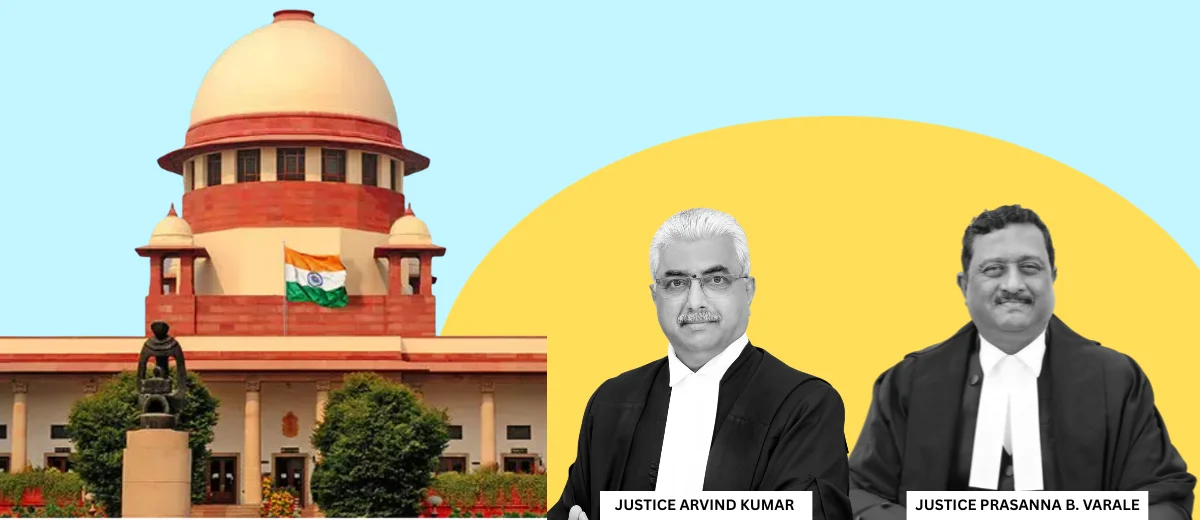
Justice Aravind Kumar & Justice Prasanna B. Varale
Introduction
The Hon’ble Supreme Court, in Indravadan N. Adhvaryu Pipala Fali Modhvada v. Laxminarayan Dev Trust, examined whether a religious temple trust falls within the definition of an “industry” under Section 2(j) of the Industrial Disputes Act, 1947. The appeal arose from concurrent findings of the Labour Court and the Gujarat High Court, which had held that a temple trust, being a religious and charitable institution, does not qualify as an industry and therefore is not subject to industrial adjudication. While affirming this settled legal position, the Court also addressed the equities involved in the abrupt termination of a long-serving employee, ultimately granting monetary compensation in place of reinstatement.
Background of the Case
The appellant was appointed as an Accountant in 1977 by the respondent, Laxminarayan Dev Trust, a religious and charitable institution managing a temple. He rendered continuous and uninterrupted service for nearly twelve years. On 1 November 1999, the appellant’s services were allegedly terminated orally, without issuance of any charge-sheet, domestic inquiry, or disciplinary proceedings.
The appellant’s repeated representations seeking reinstatement went unanswered. During conciliation proceedings before the Labour Conciliation Officer, the Trust issued a communication directing the appellant to report for duty at a transferred post in Vadtal, a far-off location, failing which termination proceedings would follow. The dispute eventually culminated in a labour reference.
By an award dated 3 December 2009, the Labour Court rejected the reference, holding that the respondent Trust, being a temple and charitable institution, did not fall within the ambit of “industry” under Section 2(j) of the Industrial Disputes Act, as it neither carried on manufacturing activity nor operated with a profit motive. The appellant’s challenge to this award was dismissed by a Single Judge of the Gujarat High Court and subsequently by a Division Bench in intra-court appeal, leading to the present appeal before the Supreme Court.
Court Ruling and Legal Reasoning
The Hon’ble Supreme Court declined to interfere with the concurrent findings of the Labour Court and the High Court. The Bench reiterated settled jurisprudence that religious and charitable institutions which do not engage in systematic commercial or profit-oriented activities cannot be brought within the “four corners” of the definition of an “industry” under Section 2(j) of the Industrial Disputes Act merely because they employ staff.
The Court held that the respondent Trust was essentially a temple trust and, therefore, outside the purview of industrial adjudication. Consequently, the appellant was not entitled to statutory labour law remedies such as reinstatement.
However, the Court took note of the appellant’s twelve years of continuous, uninterrupted, and blemish-free service, as well as the fact that his termination was effected without any inquiry and was followed by a transfer to a distant location. Acknowledging these circumstances, the Court held that the ends of justice would be met by awarding lump-sum monetary compensation.
Without entering into the merits of the termination, the Court directed the respondent Trust to pay a sum of ₹12,00,000 (Rupees Twelve Lakhs) to the appellant in full and final settlement of all claims. The Court further directed that the amount be paid within four weeks, failing which it would carry interest at the rate of 9% per annum. The Court clarified that the amount would be recoverable through execution proceedings or by filing an application under Section 33(C)(2) of the Industrial Disputes Act before the Labour Court.
Conclusion
The Hon’ble Supreme Court reaffirmed the legal position that a temple trust does not constitute an “industry” under the Industrial Disputes Act, 1947, and accordingly upheld the rejection of the appellant’s claim for reinstatement. At the same time, the Court exercised its equitable jurisdiction to grant lump-sum compensation, recognising the hardship caused by the abrupt termination of a long-serving employee without due process. The judgment reflects a careful balance between strict statutory interpretation and the need to prevent manifest injustice, underscoring the Court’s commitment to fairness even in cases where formal labour law protections are inapplicable.