
Case name: UNION OF INDIA & ORS V. COL AMARDEEP SINGH
Petition No: W.P.(C) 2531/2024
Citation: 2026 DHC 5204
Date of Judgment: 01.07.2026
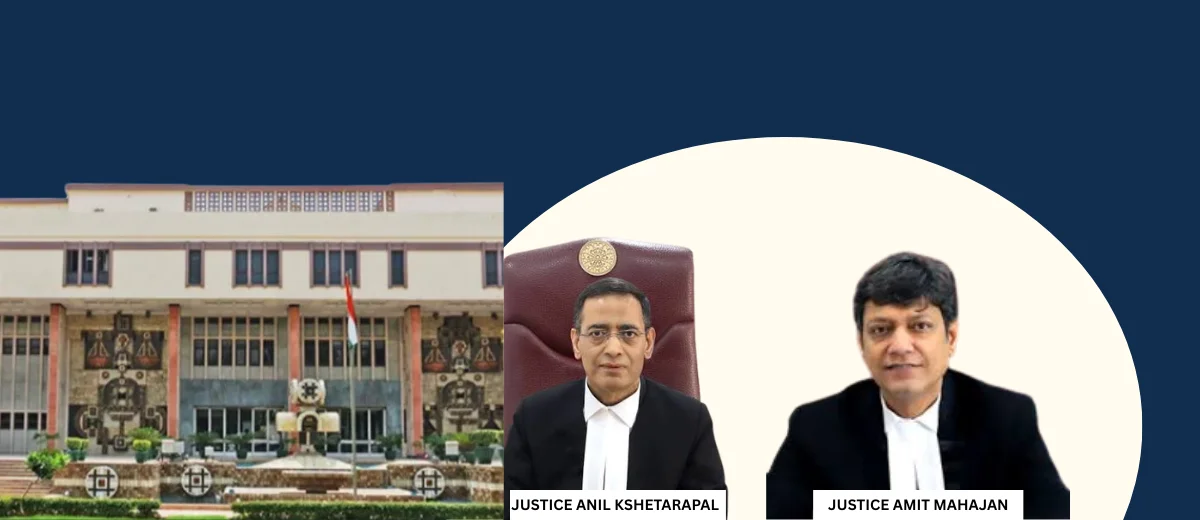
Coram: Hon’ble Justice Anil Kshetarapal and Hon’ble Justice Amit Mahajan
Relevant Statutes and Provisions: Article 309 of Indian Constitution, Survey of India (Group A) Service Rules, 1989, Defence Service Regulations, 1987
INTRODUCTION
This case addresses a critical conflict between civil administrative equivalence and statutory military promotion frameworks. The Division Bench adjudicated on whether an Army Officer permanently seconded to a civil organization holds an automatic, enforceable right to corresponding substantive military ranks based solely on their civil promotion. The Bench focused on Defence Service Regulations,1987 (DSR,1987) stating that in order to satisfy promotion criteria, an overall assessment including strict adherence to promotable medical standards is mandatory. Mere administrative parity within a civil framework cannot override independent military frameworks. The court also emphasized that when a Tribunal’s order is based on the assumption that civil promotion carries automatic entitlement to military rank, it overlooks critical regulatory distinctions and undermines military administration.
FACTS
Col. Amardeep Singh was originally an Army Officer who was permanently seconded to the Survey of India, under the Survey of India (Group A) Service Rules, 1989, certain civil posts are considered equal to military ranks, like Director is equated with Brigadier and Additional Survey General with Major General. After being promoted to the civil post of Additional Surveyor General, the respondent claimed that he was entitled to the military ranks, the Army refused claiming that he was in a S1H1A1P1E(hereinafter referred to as ‘SHAPE-2’) medical category and did not satisfy the Army’s promotion requirements. The Armed Forces Tribunal (AFT) allowed his claim and directed the Army to grant him those ranks. The Union of India challenged the AFTs order before Delhi High Court.
ISSUE
Whether the promotion to an equivalent civil post in the Survey of India automatically entitles an officer to the corresponding military rank despite not fulfilling the Army Promotion standards and medical requirements?
ARGUMENTS OF THE PARTIES
The respondent claims that the Service Rules, 1989 create an equivalence between civil posts and military ranks, once he became Additional Surveyor General and completed the required service, the corresponding military rank should follow and SHAPE-2 medical category is not an absolute bar to promotion. The Union of India argued that equivalence of posts does not mean automatic promotion in the Army. Army promotions require compliance with promotion policies, selection criteria and medical fitness standards. Granting higher ranks would disturb the Army’s promotion hierarchy and seniority structure.
JUDGMENT AND ANALYSIS
The court first explained that while exercising jurisdiction under Article 226 of the Constitution, it does not sit as an appellate authority over decisions of the Armed Forces Tribunal. It held that courts should interfere only when the Tribunal has misinterpreted the law or decision is arbitrary or it violates the statutory provisions. The court rejected respondent’s argument and held that the 1989 Survey of India rules only create equivalence of status between certain civil posts and military ranks to facilitate organizational parity, coordination between civil and defence streams and administrative functioning, but it does not create an independent channel for military promotion. The court distinguished between administrative equivalence which means equal status, protocol, pay equivalence and organizational coordination and substantive military rank which means command authority, military responsibilities, seniority, future promotions and a place within Army Hierarchy. Therefore, they cannot be equivalent.
The court also emphasized that promotion in the army is governed by Defence Service Regulations, MS Branch Promotion Policies, Army Regulations, medical standards etc, these require overall merit, assessment, the respondent here bypass this framework. The respondent here was placed in the SHAPE-2 medical category, the court held that SHAPE-2 does not automatically disqualify an officer neither does it create an automatic right to promotion, instead, it emphasized that army authorities must evaluate whether officer satisfies promotability standards or whether he can discharge responsibilities attached to higher rank. Thus, medical fitness is directly connected to combat readiness, operational efficiency and civil courts should not dilute these standards.
The respondent argued that since Service Rules, 1989 were statutory rules framed under Article 309, they override Army policies, the court rejected this and adopted the principle of harmonious construction where it explains that the two set of rules govern different subjects, 1989 Service rules regulate service within the Survey Of India and Army Regulations regulate military promotions, accordingly, the 1989 rules never intended to abolish Army promotion standards. The court also considered practical consequences, it noted that if the respondent were granted Major General Rank merely because of his civil appointment, he would effectively jump ahead of senior officers which would disturb the structure of military promotions.
The respondent relied on the Supreme Court judgment in Union of India v. Brigadier Javed Iqbal (2022) 17 SCC 450, wherein it was held that SHAPE-2 was not to be used as an absolute bar for promotion where governing rules otherwise permitted promotion. In the present case, the dispute was whether the respondent had any entitlement to substantive military rank at all, not merely whether SHAPE-2 prevented promotion. Thus, this case did not support the respondent’s claim. The court noted that Defence Stream Officers in Survey of India occupy supernumerary posts which exist outside the regular army cadre, therefore serving in supernumerary posts equivalent to Major General does not automatically place an officer within the Army’s regular promotion channel.
CONCLUSION
The court concluded that the Armed Forces Tribunal committed a legal error by assuming that civil promotion automatically resulted in military promotion. According to the Court, equivalence of posts ensures only administrative parity, substantive military rank is governed exclusively by Army promotion rules and medical fitness, selection criteria remain mandatory. The High Court set aside the Tribunal’s order and held that holding an equivalent civil appointment and completing qualifying service does not create an enforceable legal right to the substantive military ranks of Brigadier or Major General.





 > Mon - Sat, 9:00 AM – 7:30 PM