
Case Name: AAA Vs LINDA SEMA & ORS
Petition No.: SLP Criminal No. 4772 of 2024
Neutral Citation: 2026 INSC 675
Date of Judgement: 09.07.2026
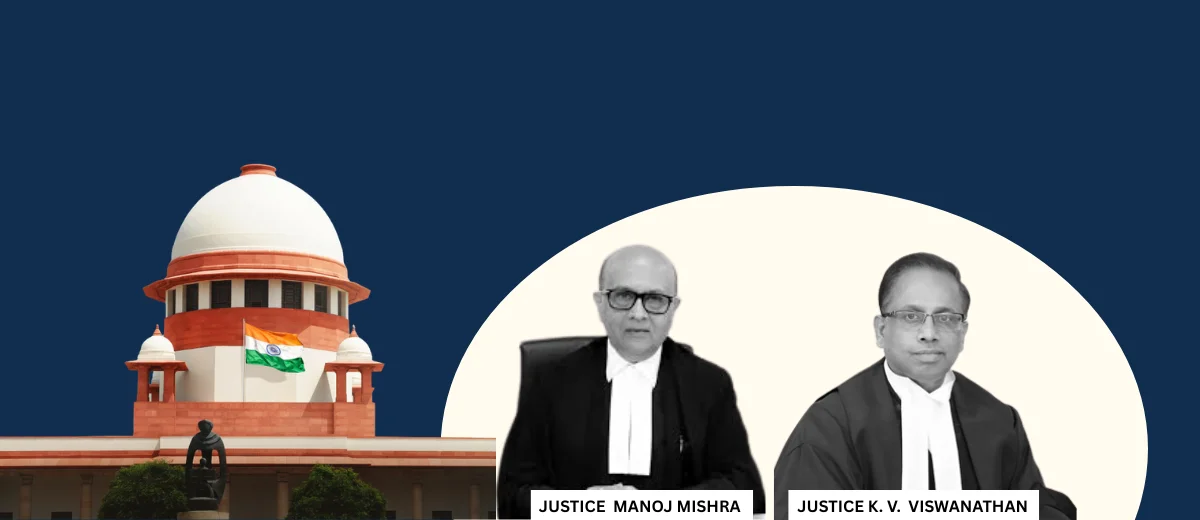
Coram: Hon’ble Mr. Justice Manoj Misra and Hon’ble Mr. Justice K.V. Vishwanathan
Relevant Statutes & Provisions: Section 6,19,27,42A,43,44,45,21 of POCSO Act 2012, S376AB, 120B of IPC, S164 of CrPC, Rule 4 of POCSO Rules 2012.
INTRODUCTION
This case concerns the liability of school authorities under the Protection of Children from Sexual Offence Act, 2012 (POCSO Act) for allegedly failing to report and concealing information regarding the sexual assault of a minor student. The Supreme Court was called upon to determine whether the materials collected during investigation disclosed a prima facie case against the Principal, teachers, and other school staff who, despite being informed of the incident chose not to report it to the police and instead suppressed the matter. The case also examines the scope of mandatory reporting obligation under Section 19 and Section 21 of the POCSO Act and the principles governing discharge of accused persons at the stage of framing of charges.
FACTS
The appellant, a mother of an eight year old minor victim filed an FIR alleging that a senior juvenile boy had sexually assaulted her daughter in the classroom in November 2019. The victim had immediately reported the incident to her elder sister and the school’s head girl who then informed the Headmistress. The school authorities conducted an informal verification and decided not to report the matter to the police or the child’s parents, allegedly instructing students to remain silent. Following an investigation, the police filed a charge sheet indicting the juvenile for sexual assault and the school staff for failing to report the offence, conspiring to suppress the information and causing disappearance of evidence. The Trial Court and High Court discharged the school officials on grounds that a medical examination showed no definitive signs of sexual assault and the staff lacked knowledge of the crime. Thereafter, the appellant approached before the Supreme Court, aggrieved by the decision of the Courts below.
ISSUES
Whether the materials forming part of the police report if taken at their face value have sufficient probative value to create a grave suspicion that the accused to be charged has committed that offence.
JUDGEMENT AND ANALYSIS
The Supreme Court examined the issues and held that the expression “knowledge that such an offence has been committed” under Section 19(1) of the POCSO Act is not confined to direct eyewitness knowledge. Knowledge also includes awareness arising from the information received from the victim herself. The court observed that the purpose of the POCSO Act is to ensure quick reporting and protection of children and therefore a narrow interpretation of knowledge would defeat the purpose of the legislation. When a child directly reports sexual abuse, the recipient acquires sufficient knowledge to report the matter to police. The Court relied on SR. Tessy Jose v. State of Kerala (2018) 18 SCC 292 , State of Maharashtra v. Dr. Maroti (2023) 4 SCC 298 , and Just Rights for Children Alliance v. S. Harish 2024 SCC Online SC 2611 to emphasize that the Act imposes a mandatory reporting obligation and does not require a person to independently investigate the truth of the allegation before reporting it.
The Court observed that the primary objective of the POCSO Act is to protect children from sexual assault, sexual harassment, and pornography while safeguarding their welfare and best interests. In examining the statutory framework, the Court noted that Section 42A gives the Act overriding effect, Section 43 promotes public awareness, Section 44 provides for monitoring its implementation, and Section 45 empowers the Central Government to frame rules. Referring to the POCSO Rules, 2012 particularly Rule 4, the Court highlighted the duties of the Special Juvenile Police Unit or local police to ensure the care, protection, and medical examination of the child upon receiving information under Section 19. Reading Section 19 together with the Rules, the Court held that the provision covers information regarding an offence that has been committed, attempted, or is likely to be committed, thereby implying that any person receiving such information from a child victim acquires knowledge of the offence and is under a legal obligation to act in accordance with the Act.
The Court emphasized that Linda Sema, the Headmistress of the School could not avoid liability by claiming that she first wanted to verify the allegation. It observed that instead of reporting the matter as required by Section 19(1), she undertook her own inquiry by examining the victim, questioning the juvenile and deciding the situation herself. The POCSO Act does not contemplate such a preliminary investigation by school authorities. Investigation must follow reporting, allowing private verification before reporting would risk loss of evidence and undermine the act. Consequently, the Court concluded that the materials collected during investigation created a suspicion that Linda Sema had failed to discharge her duty despite having knowledge of the offence. Therefore, there was sufficient material to frame charges against her under Section 21 of POCSO Act and Section 176 IPC.
The Court also noted that the prosecution materials did not show that these individuals had received direct and credible information from the victim regarding the assault. Their knowledge was derivative and based on discussions within the school administration. In the absence of direct information or awareness of the offence, criminal liability under Section 21 of the POCSO Act could not be fastened upon them. The Court further held that there was no substantial material indicating a criminal conspiracy under Section 120B IPC or any deliberate act causing disappearance of evidence under Section 201 IPC. At best, the materials suggested that the school authorities collectively took an incorrect decision not to report the matter after reviewing the available information.
CONCLUSION
The Supreme Court partly allowed the appeal. It set aside the discharge of Linda Sema and directed that she face trial for offences under Section 21 read with Section 19(1) of the POCSO Act and Section 176 IPC. However, it upheld the discharge of the other teachers and school officials, finding insufficient material to proceed against them for offences under Sections 176, 201, and 120B IPC or Section 21(2) of the POCSO Act.




 > Mon - Sat, 9:00 AM – 7:30 PM