
Case Name: NAGREEKA INDCON PRODUCTS PVT. LTD. V. CARGOCARE LOGISTICS (INDIA) PVT. LTD.
Petition Number: CIVIL APPEAL ARISING OUT OF SPECIAL LEAVE PETITION (CIVIL) NO.19026 OF 2023
Neutral Citation: 2026 INSC 384
Date of Judgement: 17.04.2026
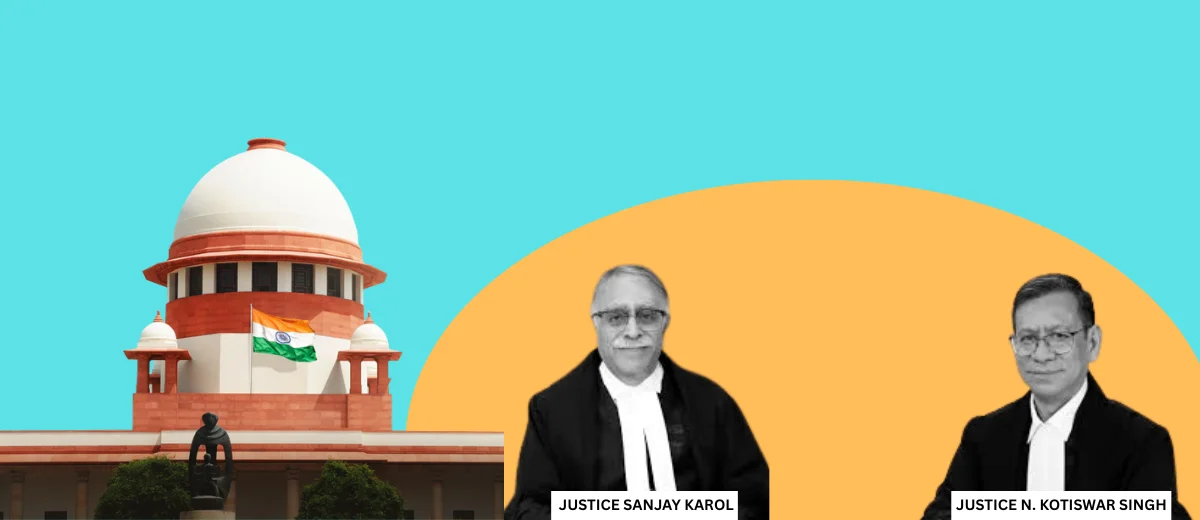
Coram: HON’BLE MR. JUSTICE SANJAY KAROL AND HON’BLE MR. JUSTICE N. KOTISWAR SINGH
INTRODUCTION
The present case involved a conundrum of whether Clause 25 of the Bill of Lading constituted an Actual Arbitration Clause and the fundamental interpretation of the word ‘Can’ with regard to Arbitration. The Supreme Court examined whether there existed an actual agreement for Arbitration between parties and if so, whether it was binding or not, and on where and how the word ‘Can’ be employed in law.
FACTS AND PROCEDURAL HISTORY
The Appellant was an aluminium foil manufacturing company who entered into a contract with the Respondent, for delivering six consignments of containers to American Alupack Industries (AAI), out of which four were delivered successfully. The dispute started from the fifth container. When the Respondent delivered the consignment to AAI and produced the Original Bill of Lading at the time of delivery, AAI did not pay the required amount which resulted in loss for the Appellant. However, the respondent denied liability for the financial loss. Clause 25 of the Bill of Lading contained an Arbitration Clause, which reads as “…any difference of opinion or dispute thereunder can be settled by arbitration in India.”
ISSUES
- Does the word ‘can’ necessitate arbitration or keep it open to parties to choose other dispute resolution mechanisms?
- Whether Clause 25 actually constitutes an Arbitration Clause?
SUBMISSIONS BY THE PARTIES
The appellant argued that Section 7 of the Arbitration and Conciliation Act, 1996 does not provide any specific form for an Arbitration Agreement. Furthermore, it was stated that the inclusion of such a clause in the bill reflects the intent of the parties to settle the dispute via Arbitration, that it should be approached pragmatically so that parties don’t take undue advantage of the clause. The Appellant contended that with regard to the existence of the clause, a prima facie view should be taken.
The respondents argued that Clause 25 did not constitute a valid arbitration clause as it did not amount to a definitive agreement between parties. Referring to the decisions in K.K. Modi v. K.N. Modi 1998 (3) SCC 573 and Bihar State Mineral Development Corporation v. Encon Builders (I) (P) Ltd 2003 (7) SCC 418 the respondent further contended that the present case did not meet the essentials of a valid arbitration agreement laid down in these decisions. It was also argued that using the word ‘can’ does not constitute a binding arbitration agreement.
JUDGEMENT AND ANALYSIS
The Supreme Court emphasised that arbitration becomes the dispute mechanism if it is the method chosen by mutual intention and agreement of both the parties. The Court dived deep into the interpretation of the word ‘Can’ which essentially means that it is possible for someone to do something or something to happen and that in legal parlance, the words used conventionally are ‘may’ and ‘shall’. The word ‘Can’ therefore indicates mere possibility. In the context of the present case, the Court noted that the word ‘can’ indicated it is open to the choice of the parties. When the word ‘shall’ is employed, the mandatory intention is clear, the Court observed. However in the present case, the Court stated that the mere usage of the word ‘can’ without describing the procedure of arbitration reflects a form of choice and is found to be incomplete with regard to appointment of arbitrators for the process.
At the instance of one party insisting on arbitration and the other not believing the clause to be an actual arbitration clause, the Court noted that there was no mutual agreement between the parties for arbitration being the chosen medium. Being vaguely worded, the Court held that it is not compulsory for the parties to undergo the method they haven’t chosen. The word only conveys a mere possibility and not an obligation to perform. The Court quoted Jagdish Chander v. Ramesh Chander 2007 (5) SCC 719,
“But mere use of the word “arbitration” or “arbitrator” in a clause will not make it an arbitration agreement, if it requires or contemplates a further or fresh consent of the parties for reference to arbitration. For example, use of words such as “parties can, if they so desire, refer their disputes to arbitration” or “in the event of any dispute, the parties may also agree to refer the same to arbitration”. Hence, Clause 25 was not found to constitute a valid arbitration agreement.
CONCLUSION
The Supreme Court thus concluded that the mere possibility of referring a dispute to arbitration cannot be said to be a binding arbitration agreement and noted that while the dispute is open to be settled by arbitration, the arbitration agreement will come into existence only when both the parties agree to it.



 > Mon - Sat, 9:00 AM – 7:30 PM