Case Name: V.K. JOHN VERSUS S. MUKANCHAND BOTHRA AND HUF (DIED) REPRESENTED BY LRS. & ORS.
Petition Number: Special Leave Petition (Civil) No. 16162/2023
Neutral Citation: 2026 INSC 393
Date of Judgement: 20.04.2026
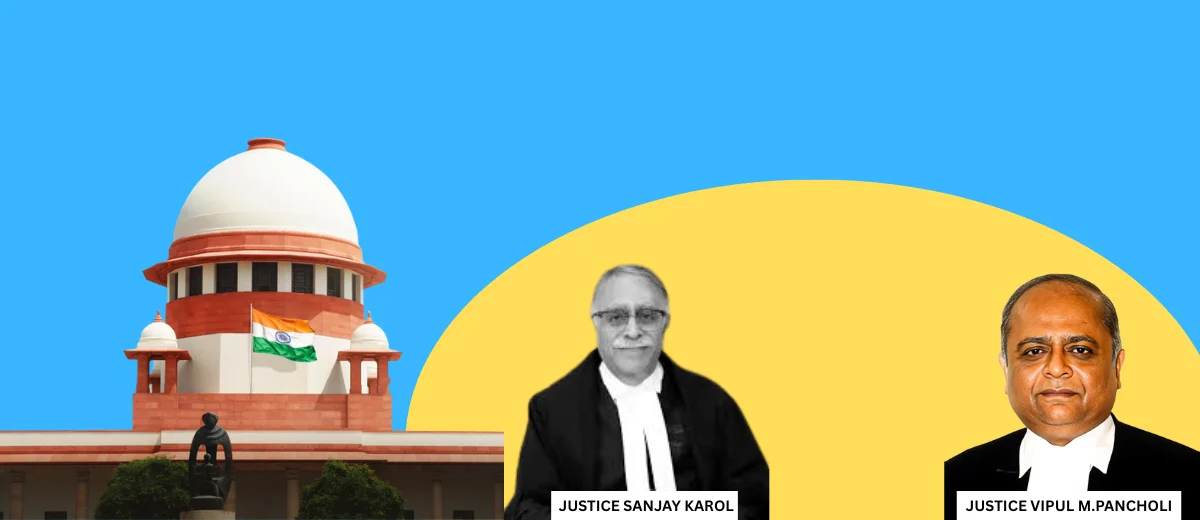
Coram: HON’BLE MR JUSTICE SANJAY KAROL & HON’BLE MR JUSTICE VIPUL M. PANCHOLI
INTRODUCTION
The present appeal before the Supreme Court arose from a judgment of the Madras High Court, which dismissed a Civil Revision Petition filed by the appellant against an arbitral award. The core legal question addressed by the Supreme Court was whether a person claiming to be the legal representative of a deceased party to an arbitration agreement can challenge the arbitral award under Article 227 of the Constitution/Section 115 of the Code of Civil Procedure (CPC), or if their exclusive remedy lies under Section 34 of the Arbitration and Conciliation Act, 1996.
FACTS
In 2007, the appellant’s paternal uncle entered into a ‘Deed of Agreement for Sale’ with Respondent No. 1 for the sale of a subject property. Shortly after, he passed away. In 2011, Respondent No. 1 initiated arbitration proceedings against Respondent No. 2, alleging him to be the legal representative of the deceased uncle. The Sole Arbitrator passed an award directing Respondent No. 2 to execute the sale deed, which subsequently led to the filing of an execution petition.
The appellant discovered these proceedings in 2012. He contended that Respondent No. 2 was falsely shown as the legal heir and that he had a substantial claim over the property, having even secured a preliminary decree for a 1/3rd share in a separate partition suit. Asserting that he was never made a party to the arbitration proceedings, the appellant challenged the arbitral award by filing a Civil Revision Petition before the Madras High Court. The High Court dismissed the petition, ruling that the appropriate statutory remedy for someone claiming to be a legal representative lies under the Arbitration Act, not via constitutional or revisionary powers.
ISSUE
Whether the appropriate remedy for legal heirs/representatives aggrieved by an arbitral award is a petition to set aside the award under Section 34 of the Arbitration & Conciliation Act, 1996, or a revision petition under Article 227 of the Constitution of India / Section 115 of the CPC?
ARGUMENTS OF THE PARTIES
The Appellant argued that since he was never made a party to the arbitration proceedings, and the arbitrator failed to inquire into the true legal heirs of the deceased, he could not file a petition under Section 34 of the Arbitration Act. Therefore, he claimed that a revision petition under Article 227 of the Constitution was his only available recourse. The Respondents argued that because the appellant’s specific case is that he is the sole surviving legal heir of the deceased, he effectively steps into the shoes of the deceased party, making Section 34 of the Arbitration Act his proper and exclusive statutory remedy.
JUDGEMENT AND ANALYSIS
The Supreme Court dismissed the appeal and upheld the High Court’s view, ruling that the appropriate relief for a legal representative challenging an arbitral award is under Section 34 of the Arbitration Act.
The Court’s analysis was founded on the principle that the Arbitration Act is a self-contained, complete code. Relying on Bhaven Construction v. Executive Engineer, Sardar Sarovar Narmada Nigam Limited and Anr (2022) 1 SCC 75, the Court reiterated that judicial interference beyond the procedures established under the Act must be exercised in “exceptional rarity.” Expanding on this, the Court emphasized that Section 34(1) of the Act uses the word “only,” which explicitly mandates that recourse against an arbitral award can be made exclusively through an application under this provision, thereby barring alternative remedies such as revision petitions under Article 227 of the Constitution or Section 115 of the CPC.
The Court examined the statutory scheme, specifically:
- Section 2(1)(g): Defines a “legal representative” as a person who in law represents the estate of a deceased person.
- Section 34: Enumerates the exclusive statutory grounds and mechanism through which a Court may set aside an arbitral award upon an application made by a “party.”
- Section 35: Extends the finality and binding nature of an arbitral award not just to the parties, but also to “persons claiming under them.”
- Section 40: Expressly states that an arbitration agreement is not discharged by the death of a party and remains enforceable by or against their legal representatives.
Harmonizing these provisions, the Court reasoned that the Arbitration Act envisions the continuity of proceedings. Upon the death of a party, the legal representative naturally ‘steps into the shoes of the deceased’. The Court emphasized a logical corollary: if an arbitral award is enforceable against the legal representatives of a deceased party, the statutory right to challenge that award under Section 34 must naturally flow to those same legal representatives. Denying them this right would defeat the object of the Act and leave them unfairly remediless while holding them liable to fulfill the award.
CONCLUSION
The Supreme Court concluded that denying a legal representative the right to challenge an award under Section 34 would defeat the very object of the Arbitration Act as a complete dispute resolution code. It would create an absurd scenario where legal heirs are liable to fulfil an award but are left remediless under the statute to challenge it. The Court held that the appropriate remedy for a legal representative aggrieved by an arbitral award is strictly under Section 34 of the Arbitration Act, thereby affirming the dismissal of the appellant’s Civil Revision Petition while granting him the liberty to file a Section 34 petition with the limitation period commencing from the date of this judgment.


 > Mon - Sat, 9:00 AM – 7:30 PM