

Case Name: RAHUL GUPTA V. STATION HOUSE OFFICER AND ORS.
Petition Number: SPECIAL LEAVE PETITION (CRL.) NO. 13755 OF 2025
Neutral Citation: 2026 INSC 374
Date of Judgement: 16.04.2026
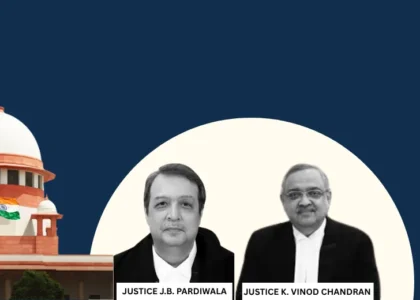
Coram: HON’BLE MR. JUSTICE SANJAY KUMAR AND HON’BLE MR. JUSTICE K. VINOD CHANDRAN
INTRODUCTION
In a peculiar case, after numerous desperate failed attempts in lower courts, the petitioner approached the Supreme Court to implicate his wife in an act of ‘giving dowry’ via registration of F.I.R. against her. The Supreme Court confronted the fundamental question of interpretation of what essentially constitutes the ‘Act of Giving Dowry’ under the Dowry Prohibition Act and how it is exempted in the statute as well. The case is also an important precedent on the Registration of Second FIR on the same set of circumstances.
FACTS AND PROCEDURAL HISTORY
The wife, who has been living separately since 2021, lodged an F.I.R. against the petitioner who is the husband in 2022, alleging harassment of dowry. As per her statement under Section 161 Cr. P.C., she stated that discussions about dowry as well as its payment were done before the marriage. Subsequently, chargesheet was filed after investigation against the petitioner and his parents under Section 498A IPC and Section 3 of the Dowry Prohibition Act. What followed was a trail of desperate attempts by the husband for Registration of F.I.R. against the wife for the alleged offence of ‘giving dowry’ under Section 3 including a last attempt before the High Court, wherein the petition was dismissed. The petitioner approached the Supreme Court as the last resort.
ISSUES
- In the absence of Independent Evidence, whether the complaint and statements of the aggrieved party and family members are sufficient for prosecution of the offence of ‘Giving Dowry’ under Section 3 of the Dowry Prohibition Act?
2. When can a second FIR be registered on same or similar offences?
SUBMISSIONS BY THE PARTIES
The Petitioner contended that he and his family did not take dowry, however the wife having filed the complaint and recorded statements along with her family members, constituted the ‘Act of Giving Dowry’ under Section 3 of the Dowry Prohibition Act. The Respondent-wife in response, contended that dowry was discussed and paid before their marriage itself, which was corroborated by similar statements given by family members.
JUDGEMENT AND ANALYSIS
The Supreme Court clarified in the present case that Section 3 of the Dowry Prohibition Act with no independent evidence produced by the petitioner and laying the foundation of the claim on the complaint and statements of the wife and her family members, cannot be invoked to prosecute the wife. The Court further added that Section 7(3) of the Dowry Prohibition Act was overlooked upon, in the precedents cited by the petitioner to support his contentions, which specifically states that a party aggrieved by the offence of dowry shall not be subject to prosecution under the Dowry Prohibition Act as it defeats the very objective of the Act; that statements made by the Aggrieved Party cannot be used for prosecution against them.
The Court also clarified on the Registration of Second FIRs on the same offence and set of circumstances, but such that the incidents mentioned do not fall within the scope of the first F.I.R, that the incidents are separate. The judgement also clarifies that orders of a Magistrate in a criminal case cannot be reviewed under Section 114 of the CPC. Accordingly, the Court dismissed the petition.
CONCLUSION
The present case is an important precedent on the interpretation of Section 3 of the Dowry Prohibition Act and how Section 7(3) should not be overlooked, highlighting the plight and helplessness of women who file complaints of having been compelled to give dowry during marriage. The Court emphasizes this by quoting the submission of the Amicus Curiae, that “…the givers of dowry, i.e., the parents, should not be equated with those who take the dowry, as the givers are victims rather than criminals, as parents are compelled to give dowry and they do not do so out of their free will.”



 > Mon - Sat, 9:00 AM – 7:30 PM