
Case Name: VPS HEALTHCARE PRIVATE LIMITED AND ANOTHER V. PRABHAT KUMAR SRIVASTAVA AND ANOTHER
Petition Number: CIVIL APPEAL ARISING OUT OF SPECIAL LEAVE PETITION (CIVIL) NO. 23869 OF 2023
Neutral Citation: 2026 INSC 361
Date of Judgement: 13.04.2026
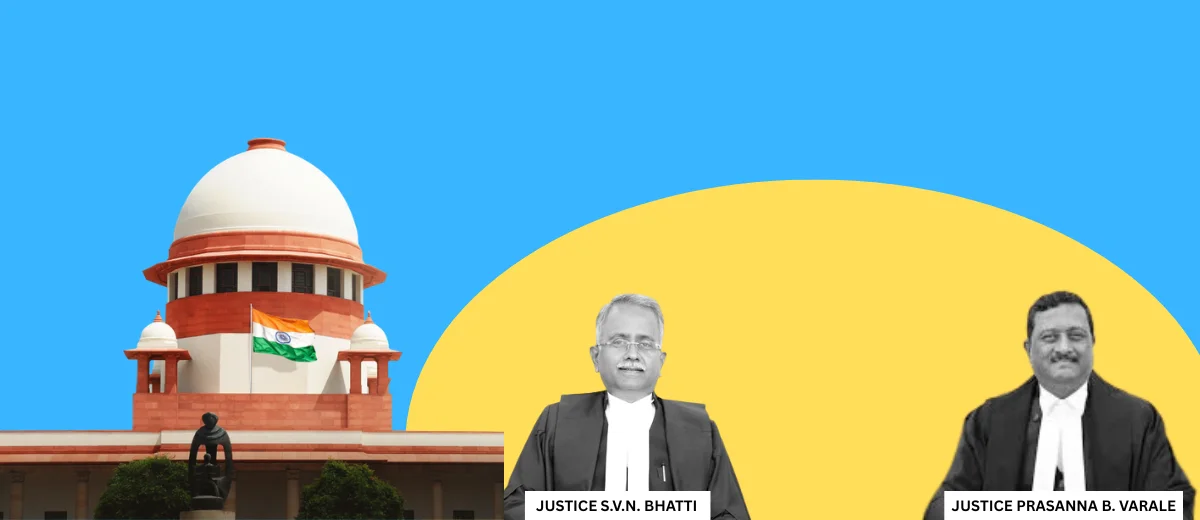
Coram: HON’BLE MR. JUSTICE S.V.N. BHATTI AND HON’BLE MR. JUSTICE PRASANNA B. VARALE
INTRODUCTION
In the present case, the Supreme Court examined the enforceability of a Consent Award in a dispute of arbitration. The Court focused on whether the obligation of the Promoters to discharge their liability as per the Singapore International Arbitration Centre (SIAC) Consent Award was contingent on the appeal filed before the Singapore Court of Appeal.
FACTS AND PROCEDURAL HISTORY
The dispute involved a series of agreements and transactions between 3 companies: VPS Healthcare and Medeor Hospitals Limited (formerly Rockland Hospitals) being the Appellants and the Promoters being the Respondent. There is a third party, Ernst Young and LLP (EY), involved in the initial agreement of acquisition. In 2015, Rockland Hospitals and EY entered into a Professional Service Agreement to attract investors. In 2016, VPS acquired 100% equity of Rockland Hospitals vide Share Purchase Agreement with Promoters of Rockland Hospitals and the latter was renamed as Medeor Hospitals. Disputes arose thereafter between EY and Medeor on the Professional Service Agreement and also between VPS and the Promoters. To resolve the disputes, the Appellant and Respondent entered into a Deed of Compromise in 2019 for which SIAC gave the Consent Award. In the terms of the compromise, as per Paragraph 32(a) of the Consent Award, the Respondents undertook to discharge all liabilities related to the dispute to indemnify the Appellants within 30 days once the Court of Appeal confirms and ensure that no liability is recovered from the Appellants. It read: “:..The Respondents will ensure that no liability in regard to the said litigation is recovered from the First and Second Claimants by the Forum. (the fourth limb) The Respondents will keep the First Claimant indemnified of the same and ensure that in case any liability is confirmed by the Highest Court of Appeal, the same will be discharged by the Respondents within a period of 30 days.” (the fifth limb).
In 2021, the Arbitral Tribunal granted Rs. 10 Crore along with interest to EY against the Appellants. The Appellants approached the High Court which granted a stay, but subject to a deposit of Rs. 15 Crore and stated that there was an ambiguity in Paragraph 32(a) regarding liability of the Promoters. Although the Appellants deposited the amount, they appealed to the Hon’ble Supreme Court to recover the amount by enforcing the Consent Award.
ISSUE
Whether the Promoters’ obligation to indemnify and defend the Appellants as per the Consent Award was enforceable immediately or contingent on the outcome of appeal before the Singapore Court of Appeal?
Whether Paragraph 32(a) constitutes a Contract of Indemnity?
SUBMISSIONS OF THE PARTIES
The Appellants contended that Paragraph 32(a) of the Consent Award created an immediate obligation on the Promoters to ensure no liability, regardless of whether it is interim or final and that it is not dependent on any Court of Appeal at any stage of litigation. The Respondents contended that their liability to actually pay arises only 30 days after the Highest Court of Appeal has confirmed it and that any interim orders by the Court other than the Highest Court of Appeal has not been transformed into confirmed liabilities that they have to satisfy.
JUDGEMENT AND ANALYSIS
The Supreme Court noted that the Deed of Compromise was signed and the Consent Award was granted while the claim of EY against the Appellant (VPS) was pending, which meant that the Promoters had agreed to indemnify the Appellants during the pendency to settle the proceedings. The Court recognised Paragraph 32(a) to contain an indemnity component, but held it to be an absolute obligation as it is an immunity provided to the Appellants, undertaken by the Respondents. It was clarified that the limb of 30 days is for an extreme scenario but is not the primary trigger for the Respondent Promoters.
The Court explained that the High Court erroneously read the fifth limb of Paragraph 32(a) in isolation, that the word ‘said litigation’ in the fourth limb means proceedings at every stage and not only before the Highest Court. The word ‘forum’ was contractually defined as “means any Court, Court of Appeal, Authority, Tribunal, Statutory Authority, Ministry, Judicial, Quasi-Judicial Authority, Adjudicatory, Investigation Officer, etc., by whatsoever name called.”
The Court added that exact words must be given paramount importance in commercial contracts and courts are strictly prohibited from adding, deleting or substituting words and found the ‘purposive interpretation’ of the High Court flawed. It was also clarified that a Consent Award is not different from a Consent Decree. The fundamental question with regard to a Consent Award is whether the decree has been satisfied or not or has it been nullified.
The Court emphasised that the core issue was the starting point of the Contract of Indemnity under Paragraph 32(a) of the clause, that it already began when the Appellants deposited 15 Crore as per the direction of the High Court, which was to be compensated by the Respondent as per the clause where the Promoters agreed that no liability shall be recovered from the Appellant. By using the word ‘ensure’ in the clause, the Hon’ble Supreme Court held that the obligation rests on the Promoters to insulate liabilities of any pending disputes for the Appellants. Accordingly, the Court allowed the Appeal.
CONCLUSION
The Supreme Court thus concluded that plain reading of specific clauses results in immediate obligations and are not subject to the outcome of Appeals, and there is no need to wait for appellate confirmation to enforce such liabilities.



 > Mon - Sat, 9:00 AM – 7:30 PM