
Case Name: HOME CARE RETAIL MARTS PVT. LTD. V. HARESH N. SANGHAVI
Petition Number: CIVIL APPEALS ARISING OUT OF SLP (C) NO. 29972/2015, SLP (C) NO. 26876/2014 AND NO. 11139/2020.
Neutral Citation: 2026 INSC 415
Date of Judgement: 24.04.2026
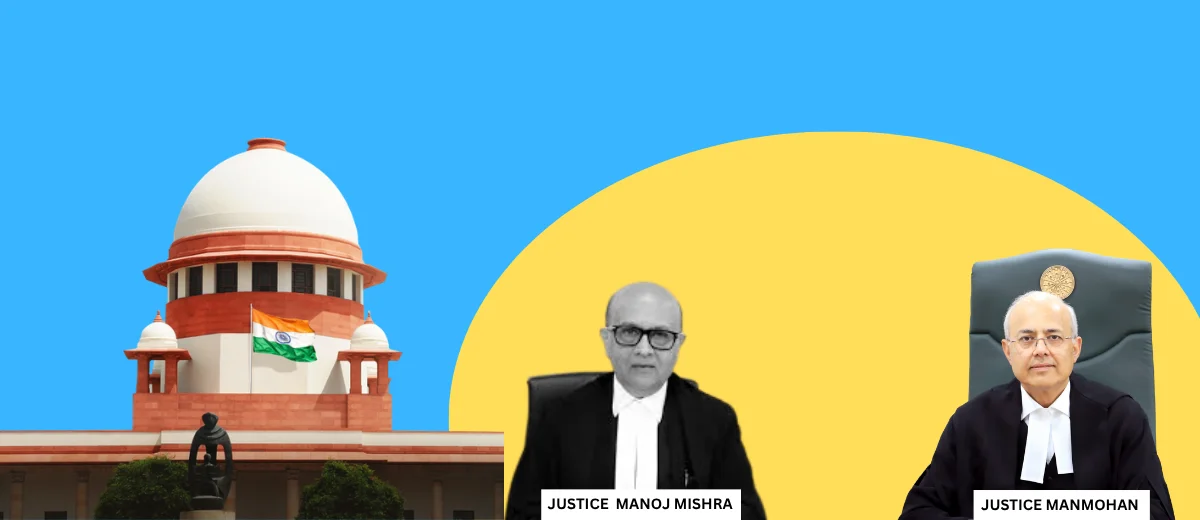
Coram: HON’BLE MR. JUSTICE MANOJ MISRA AND HON’BLE MR. JUSTICE MANMOHAN
INTRODUCTION
The above case is a significant judgement wherein the Supreme Court overruled the judgements of several High Courts across India, settling conflicting views involving a substantial question of law, examining the scope of challenging an Award in Arbitration under Section 9 of the Arbitration and Conciliation Act, 1996 (hereinafter called ‘the Act’) by an unsuccessful party, who has lost in the proceedings, post-award declaration and before enforcement of the award.
FACTS AND PROCEDURAL HISTORY
Different High Courts had conflicting views on Section 9 of the Arbitration and Conciliation Act, 2026 on whether an unsuccessful party could challenge an Award of Arbitration after it had been declared and before it was enforced. The Bombay High Court, Delhi High Court, Madras High Court and Karnataka High Court were of a restrictive view that a party who has lost the arbitration proceedings cannot maintain a petition challenging the award under Section 9 of the Act. These Courts reasoned that since Section 34 of the Act already exists to set aside or uphold the Award, the interim measures granted under Section 9 are limited to ‘protecting the fruits of the proceedings’ and that the findings of the arbitral tribunal cannot be reversed. These Courts concluded that there is no remedy for an unsuccessful party who cannot claim relief under Section 9. On the other hand, the Telangana High Court, Gujarat High Court and the Punjab and Haryana High Court held a different view that an unsuccessful party’s petition under Section 9 of the Act is maintainable.
ISSUE
Whether the petition of a party who has lost the arbitration proceedings seeking interim relief post award declaration and before enforcement, under Section 9 of the Arbitration and Conciliation Act, 1996 is maintainable before law?
SUBMISSIONS OF THE PARTIES
The Counsels for the Petitioner contended that the judgement of the Bombay High Court in Dirk India Pvt. Ltd. v. Maharashtra State Electricity Generation Co. Ltd., 2013 SCC OnLine Bom 481 was erroneous as it did not consider that if under Section 34, a decision gets set aside by the Court, then the rights of the lost party are revived, enabling them to start fresh arbitration and protect their contractual rights anew. They further added that this interpretation leaves absolutely no remedy for the lost party. It was further argued that if Section 43 of the Act allows to restart a dispute and initiate fresh arbitration and Section 34 allows setting aside an award, excluding the time of the earlier proceedings, then the party should also be entitled for an interim relief on the subject matter of the dispute. The Counsels also specified that the Arbitration Conciliation (Amendment) Act, 2019 narrowed the legal remedy as it confined the jurisdiction of arbitral tribunals, not to grant interim reliefs post – award declaration. If the Court grants a stay order under Section 36, then the party is equally entitled to protection of their rights under Section 9 during the pendency of proceedings under Section 34.
The Counsel for the Respondent argued that although Section 9 can be invoked for interim measures, it cannot undermine the finality of an arbitral award. Once an award has been rendered, it was argued that the claims are adjudicated conclusively and hence, only a successful party can seek interim protection under Section 9 to seek protection to preserve the fruits of the award. The Counsel countered that an unsuccessful party who has nothing to preserve after having lost, therefore cannot maintain a petition under Section 9 of the Act. It was further contended that allowing relief under Section 9 would result in multiplicity of proceedings, misuse of the provision and affect the finality of decisions.
JUDGEMENT AND ANALYSIS
The Supreme Court clarified and explained that the term ‘party’ cannot be contextually modified depending on the outcome of the arbitral proceedings. Quoting from the judgement,
“…where the words of a statute are clear, plain, and unambiguous, the Court is bound to construe them in their natural, ordinary, and grammatical sense, giving effect to the legislative intent without resort to any interpretative embellishment.”
Plain Interpretation Is Sufficient: Quoting R. v. Oakes, [1959] 2 Q.B. 350, the Court explained that when the literal reading produces an intelligible result, the words do not have to be changed according to the intention of the Parliament. In the present case, the Court observed that the word ‘party’ mentioned in Section 9 is defined in Section 2, but does not draw any distinction between ‘successful’ and ‘unsuccessful’ party. The literal interpretation of Section 9 in the present case conveys plainly that any party is entitled to the right to claim interim relief during the proceedings, before or after the award is delivered and before its enforcement.
Meaning Of The Term ‘A Party’ Is Not Contextual: Since the statute does not prescribe any qualification for award holders post award relief, the Court found it to be a narrow interpretation when ‘a party’ means all parties before the award is delivered and only the successful party after the award is delivered. Hence, the Court found the High Court Judgements depriving the parties of a right conferred by the Act itself. Changing the meaning of the term would amount to judicial amendment which is beyond the jurisdiction of the Court, the Court emphasised.
Section 9 Protects Subject Matter Of The Dispute: If the ultimate outcome may favour the parties, in that probability, the access to Section 9 cannot be denied on the basis of ‘winning’ or ‘losing’. The Court noted in Paragraph 41 of the Judgement: “...this Court is of the considered view that the object and purpose of Section 9 of the Act is to ensure that parties retain the right to approach the Court for interim measures until the judicial process has reached its culmination.”
Intention Of The Legislature Is To Secure Rights Of Parties: The Court further explained that unlike the provision in the United Nations Commission on International Trade Law (UNCITRAL) Model Law, which forbids parties from requesting interim relief of protection in an arbitration agreement, the legislature consciously introduced a post-award stage because it did not intend to restrict the rights of the parties seeking interim relief. Paragraph 39 of the judgement reads, “From the foregoing, it is evident that the Indian Parliament has consciously conferred an additional right upon parties to seek interim measures after the arbitral award has been rendered but prior to its enforcement. This departure from Article 9 of the UNCITRAL Model law, by introducing a post-award stage during which interim relief may be sought, demonstrates that the legislature deliberately expanded the scope of Section 9 of the Act.”
Assumptions Under Section 34 And 37 Erroneous: The Court rejected the assumptions made under Sections 34 and 37 that ‘it is to preserve the fruit of the award’ citing the Constitutional Bench Judgement in Gayatri Balasamy v. ISG Novasoft Technologies Limited, 2025 SCC Online SC 986 that Courts exercising jurisdiction can modify the award by setting aside the invalid portion or by correcting typographical or clerical errors and that the Hon’ble Supreme Court can do so under Article 142 of the Constitution.
Threshold for Grant of Interim Relief Under Section 9 Remains High: Lastly, the Court cautioned that while the ambit of Section 9 covers the rights of unsuccessful parties and that rights of the parties shall not be curtailed on mere apprehension, the threshold to invoke the provision shall remain high. The Court observed in Paragraph 60, “…In rare and compelling cases, permitting the unsuccessful party to invoke Section 9 of the Act would prevent irreparable prejudice and preserve the efficacy of the challenge proceedings.”
CONCLUSION
Therefore, the Supreme Court concluded that the impugned judgements of the High Courts are overruled and that an unsuccessful party is also included in ‘party’ mentioned in Section 9 of the Act. The Court ended the analysis on a cautionary note that lower courts should deal with such disputes with care and circumspection when a Section 9 application is filed by an unsuccessful party in arbitration.


 > Mon - Sat, 9:00 AM – 7:30 PM