
Case Name: NILESH C. OJHA VERSUS HIGH COURT OF JUDICATURE AT BOMBAY THROUGH SECRETARY & ORS.
Petition Number: CRIMINAL APPEAL NOS. 5673-5674 OF 2025
Neutral Citation: 2026 INSC 390
Date of Judgement: 20.04.2026
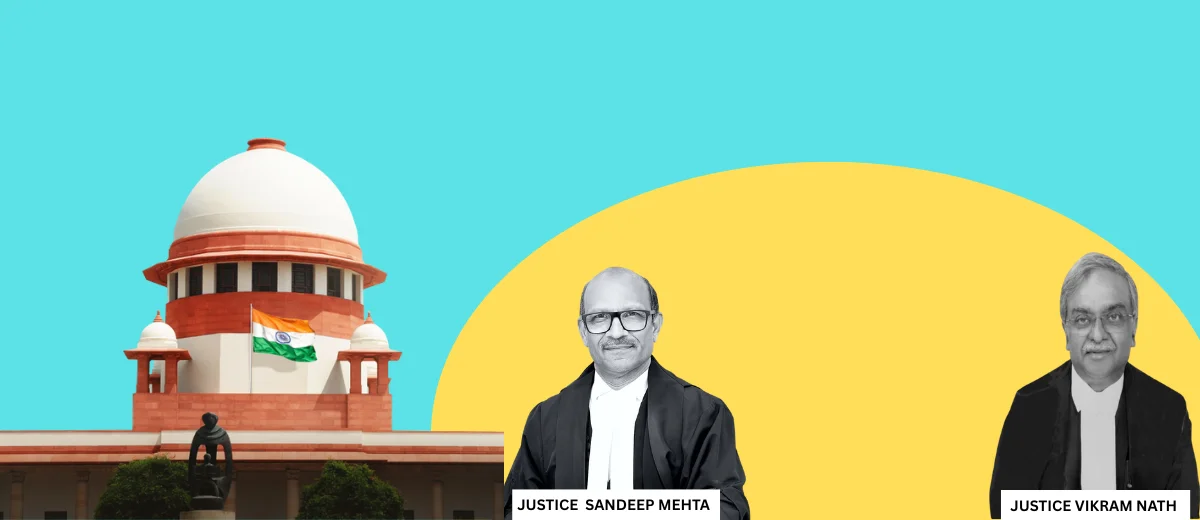
Coram: HON’BLE MR JUSTICE SANDEEP MEHTA & HON’BLE MR JUSTICE VIKRAM NATH
INTRODUCTION
The appeal was filed by an advocate challenging the orders of a Full Bench of the Bombay High Court. The High Court had initiated suo motu criminal contempt proceedings against him, rejected his application to implead a sitting High Court Judge as a respondent, initiated a fresh contempt petition based on scandalous pleadings, and dismissed his applications seeking the recusal of the Chief Justice and disqualification of the Bench. The Supreme Court examined the boundaries of professional conduct for advocates, the distinction between legitimate legal defence and scandalising the court, and whether an advocate can ventilate grievances regarding pending judicial matters through a public press conference.
FACTS
The appellant-contemnor had instituted a criminal writ petition on behalf of a client, which was listed before a Division Bench that included a specific judge (“Justice X”). On the evening before the hearing, the appellant held a press conference, casting aspersions on Justice X, alleging she was disqualified from hearing the case because her sister was an accused in the client’s FIR and was associated with a political party. Justice X brought this to the attention of the Chief Justice, who took suo motu cognisance and constituted a five-Judge Bench to adjudicate the criminal contempt.
During the proceedings, the appellant filed an application seeking to implead Justice X as a party-respondent. The High Court dismissed this application, ruling that a judge furnishing information is neither a complainant nor a necessary party. Furthermore, noting that the appellant had made additional scandalous imputations in that very application, the High Court directed the registration of a second suo motu criminal contempt petition against him. The High Court also held the appellant and 15 associating advocates liable for professional misconduct, issuing them a strong advisory. The appellant subsequently filed an application seeking recall of the earlier order, requesting the recusal of the Chief Justice, and seeking the disqualification of the five-Judge Bench on the ground of an alleged conflict of interest. The High Court dismissed this application as a frivolous, misconceived and sheer abuse of process of the Court. The appellant then appealed both orders before the Supreme Court.
ISSUES
- Whether the High Court exceeded its contempt jurisdiction by initiating proceedings and passing adverse orders against an advocate for publicly airing grievances and filing applications against a sitting judge?
- Whether the High Court has the jurisdiction to record findings of professional misconduct against advocates, or if such power vests exclusively with the Bar Council?
ARGUMENTS OF THE PARTIES
The Appellant argued that the High Court’s orders reflected an impermissible and excessive exercise of contempt jurisdiction. Relying on precedents like P.N. Duda v. P. Shiv Shankar (1988) 3 SCC 167 and In re: C.S. Karnan (2017) 7 SCC 1, he contended that imputations against a judge are not ipso facto impermissible if founded on demonstrable truth, made bona fide and in public interest, does not automatically constitute contempt. Furthermore, he argued that the High Court lacked the statutory jurisdiction to record findings of “professional misconduct” against the 16 advocates, as that power is exclusively vested with the State Bar Council and the Bar Council of India under the Advocates Act, 1961.
The Respondent argued that the orders under challenge did not suffer from any illegality, perversity, or procedural irregularity. The High Court contended that taking cognisance of the reckless public allegations and scandalous pleadings was essential to protect the institution, ensure the proper administration of justice, and maintain the majesty of the Court.
JUDGEMENT AND ANALYSIS
The Hon’ble Supreme Court dismissed the appeals and declined to interdict the ongoing contempt proceedings before the High Court. The Court anchored its analysis on the foundational and non-derogable principle of judicial independence, emphasising that “The judiciary even without the sword or the purse, remains the guardian of the Constitution and its sole strength lies not in any capacity to command or compel, but in public confidence and trust”. The Court drew a sharp, non-negotiable distinction between the legitimate right of a litigant to question the legal correctness of a judicial order before a higher forum, and the impermissible act of personalising a grievance by attributing improper motives to a sitting Judge.
The Supreme Court heavily criticised the appellant’s conduct. It is observed that an advocate, as an officer of the court, bears a heightened ethical obligation to conduct himself with restraint, sobriety and fidelity to the ethical standards governing the profession. The Court ruled that taking a pending judicial controversy into the public domain via a press conference, with the intent to sensationalise proceedings or scandalise the institution or its constitutional component, i.e., the Judges, is wholly inconsistent with the discipline expected of an advocate. Grievances against a judge must be ventilated strictly through established legal remedies and appropriate judicial forums, not through public commentary intended to erode public faith. An advocate, more than any other stakeholder in the justice delivery system, bears a heightened duty to uphold the dignity of the institution and to act with due restraint in matters concerning the administration of justice. Public confidence in the judiciary is the bedrock of the rule of law, and any attempt to scandalise or sensationalise judicial proceedings strikes at that very foundation.
Addressing the appellant’s specific allegations, the Court found that they were prima facie not confined to identifying legal errors but extended to imputing motives without a demonstrable foundation. Concluding that such unchecked allegations possess an inherent tendency to erode public confidence in the administration of justice, the Supreme Court held that no case for interference with the High Court’s interim orders was made out.
CONCLUSION
The Supreme Court concluded that while judicial accountability and scrutiny are integral to a democracy, reckless and personalised public attacks against a sitting judge undermine the very edifice of judicial independence. The Court held that advocates bear a strict ethical duty to pursue grievances through proper legal channels rather than public press conferences. Consequently, the Court dismissed the appeals, leaving all issues, including the limits of professional misconduct jurisdiction and the merits of the contempt charges, to be expeditiously and independently adjudicated by the High Court in accordance with the law.


 > Mon - Sat, 9:00 AM – 7:30 PM