Case Name: KISHAN CHAND (DEAD) THROUGH LRS V. GAUTAM GAUR HITKARAK SABHA, KOTA AND OTHERS
Petition Number: CIVIL APPEAL NO. 1245 OF 2011
Neutral Citation: 2026 INSC 448
Date of Judgment: 09.04.2026
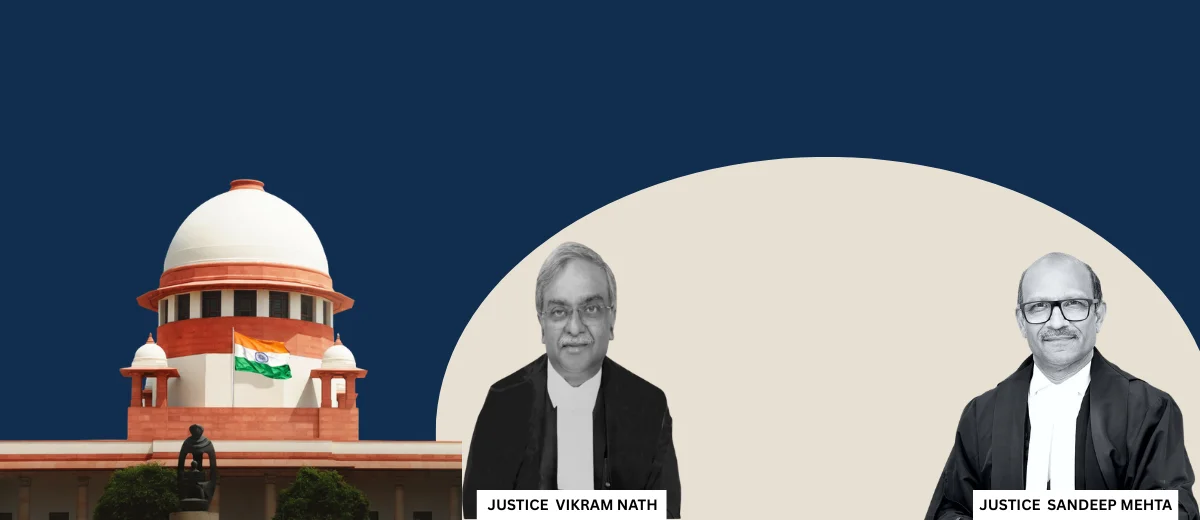
Coram: HON’BLE MR. JUSTICE VIKRAM NATH & HON’BLE MR. JUSTICE SANDEEP MEHTA
Relevant Provisions: Section 101 of Indian Evidence Act, Section 102 of Indian Evidence Act and Section 110 of Indian Evidence Act.
INTRODUCTION
The dispute at hand in this case was around the question whether mere supervisory role over temple management and appointment of priests confer title over the temple on the managerial authority. The court held in the negative and emphasised that merely reflective management arrangements concerning the temple did not constitute title documents. It held that the burden squarely lies upon the plaintiff to prove ownership on the strength of his own case and not on the weakness of the defendant’s defence.
FACTS
The appellant filed the present appeal to challenge Rajasthan High Court’s affirmation of a trial court decree granting injunction and possession to the respondents. The respondents, a registered society and its members, instituted a suit claiming ownership and management rights over the ancient temple “Moorti Swarup Shri Govardhan Nath Ji” at Kota. They asserted that caretakers or pujaris were appointed by the society, and that the appellant had been appointed as caretaker in 1951 after his predecessor relinquished the role. The respondents alleged that in 1976 the appellant wrongfully claimed ownership over the temple and its properties, prompting the suit for possession and injunction. The appellant denied the society’s title, claiming the temple was private property inherited through successive adoptions and a will executed in his favour. The Trial Court decreed the suit in favour of the respondents, directing restoration of possession. The High Court dismissed the appellant’s appeal and affirmed the decree prompting the present appeal.
ISSUE
Whether mere supervisory role over temple management and appointment of priests confer title over the temple?
JUDGMENT AND ANALYSIS
The Supreme Court at the outset observed that the approach adopted by the Trial Court and the High Court suffered from fundamental infirmities as both courts focused primarily on discrediting the appellant’s claim instead of examining whether the plaintiffs had independently established title over the suit property. The Court reiterated the settled principle and observed that the burden squarely lies upon the plaintiff to prove ownership on the strength of his own case and not on the weakness of the defendant’s defence. The court placed reliance on Union of India v. Vasavi Co-op. Housing Society Ltd., [ (2014) 2 SCC 269] wherein it was held that a plaintiff seeking declaration of title must affirmatively establish a clear and cogent title.
Applying these principles, the Court found that the respondent-plaintiffs had failed to produce any document evidencing ownership of the temple property. No deed of dedication, endowment, or legally admissible evidence demonstrating vesting of title in favour of the society was placed on record. The Court clarified that mere supervisory control over temple affairs or participation in the appointment of pujaris could not, by itself, confer proprietary rights over immovable property.
The Court further held that the documents relied upon by the courts below, including those recording the appointment of Gordhan Ji and the appellant as pujaris, merely reflected management arrangements concerning the temple and did not constitute title documents. The court emphasised upon the legal distinction between management of a religious institution and ownership of its properties, and observed that the two concepts could not be conflated.
The Supreme Court further observed that even if the appellant-defendant had failed to conclusively establish his own title, such failure would not automatically strengthen the plaintiffs’ case. Since the plaintiffs had failed to discharge the burden cast upon them under Sections 101, 102, and 110 of the Indian Evidence Act, 1872, the suit could not succeed. The courts below, therefore, misdirected themselves in law by shifting the focus from proof of title to the alleged deficiencies in the defendant’s case. Accordingly, the Supreme Court set aside the judgment of the High Court.
CONCLUSION
The judgment reaffirms that title over temple property cannot be inferred merely from supervisory control or appointment of pujaris. The Supreme Court emphasised that plaintiffs in title suits must independently establish ownership through cogent evidence, failing which the suit cannot succeed regardless of weaknesses in the defence.


 > Mon - Sat, 9:00 AM – 7:30 PM