Case Name: PARVATHI NAIRTHI (DEAD) AND ORS v. LAXMI NAIRTHY (DEAD) THROUGH LRS. AND ORS.
Petition No.: SLP (CIVIL) NO. 12822 OF 2013
Neutral Citation: 2026 INSC 521
Date of Judgement: 21st May, 2026
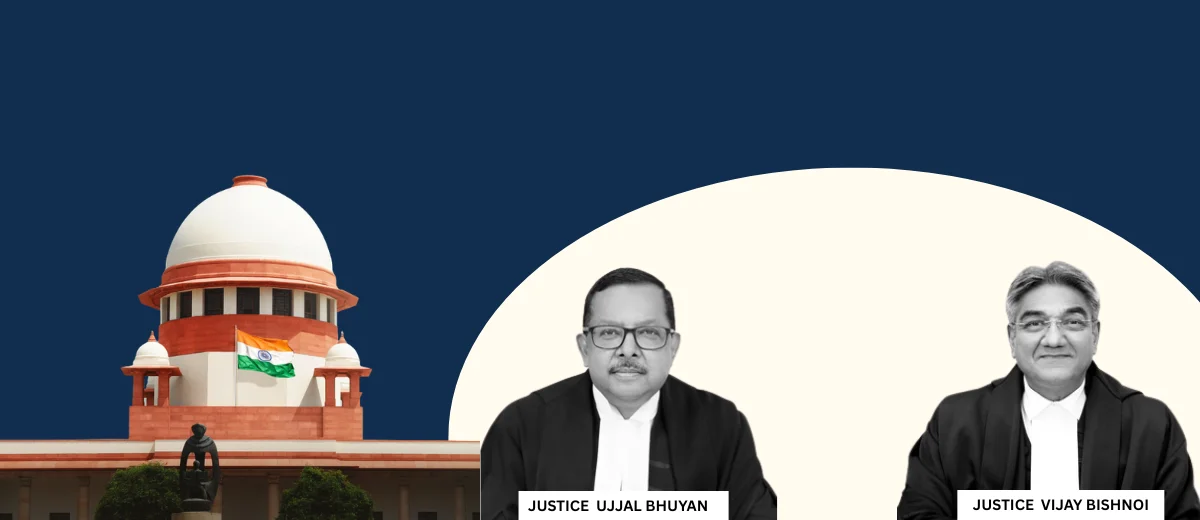
Coram: Honourable Mr Justice Ujjal Bhuyan & Honourable Mr Justice Bijay Bishnoi
Relevant Provisions: Section 63 of the Indian Succession Act, 1925; Section 68 of the Indian Evidence Act, 1872; Order XLI Rule 31 CPC; Order XIX CPC
INTRODUCTION
The Supreme Court, in the present case, held that mere exclusion of natural heirs from inheritance cannot by itself constitute a suspicious circumstance sufficient to invalidate a Will. The Court observed that the very object of executing a Will is to alter the ordinary line of succession, and a testator possesses complete testamentary freedom to distribute his property according to his wishes. The Court further stated that non-registration of a Will does not affect its validity, and mutation entries in revenue records do not confer title. The judgment consolidates the jurisprudence on suspicious circumstances surrounding testamentary documents, the evidentiary requirements for proving a Will, and the scope of appellate interference with concurrent findings of fact.
FACTS
The dispute pertained to agricultural and ancestral properties. The deceased had two sisters and two brothers. Following the death of his elder sister, he had taken responsibility for her daughters and performed their marriages. During his lifetime, he had executed powers of attorney in favour of his brother-in-law for the management of certain properties. Subsequently, he executed a Will bequeathing the suit properties in favour of his younger sister, and revoked the earlier powers of attorney. Thereafter, he passed away.
After his death, his wife initiated mutation proceedings before the Tehsildar seeking transfer of the properties in her favour. Mutation entries were eventually made in favour of the wife. However, the younger sister instituted a civil suit seeking a declaration of ownership under the Will, possession of certain properties, mesne profits, and an injunction against interference by the deceased’s wife and children.
The Trial Court entered judgment in favour of the plaintiff and upheld the Will. The First Appellate Court affirmed the findings, and the High Court dismissed the second appeal. The matter thereafter reached the Supreme Court.
ISSUES
1. Whether the Will had been validly executed and proved in accordance with the law?
- Whether the exclusion of the wife and children of the testator constituted a suspicious circumstance sufficient to invalidate the Will?
- Whether non-registration of the Will affected its genuineness or validity?
- Whether affidavits allegedly denying execution of the Will by attesting witnesses could invalidate the testamentary document?
ARGUMENTS OF THE PARTIES
The appellants contended that the Will was surrounded by suspicious circumstances. It was argued that the Will surfaced nearly seven years after its execution and six years after mutation entries had been made in favour of the wife and children. According to them, there was no explanation as to why only certain properties were bequeathed to the sister while the natural heirs were completely excluded. The appellants further argued that the respondent had failed to produce the Will before the Tehsildar during mutation proceedings. They also questioned the authenticity of the signatures on the Will and challenged the attesting witness’s testimony.
The respondents, on the other hand, submitted that the Will had been duly proved through one of the attesting witnesses in compliance with Section 68 of the Evidence Act. They argued that despite alleging forgery, the appellants neither sought handwriting examination nor produced expert evidence. The respondents pointed out that the Will expressly stated that the testator had already provided more than enough for his wife and children residing in Bombay. The respondents also contended that the affidavits relied upon by the appellants were procured suspiciously, even before the filing of the written statement, and were therefore inadmissible.
JUDGEMENT AND ANALYSIS
The Court undertook a detailed examination of the legal principles governing testamentary succession and proof of Wills. At the outset, the Court referred to Section 68 of the Indian Evidence Act and stated that a Will must be proved by examining at least one attesting witness capable of proving its execution. The Court relied upon the decision Shivakumar v. Sharanabasappa (2021) 11 SCC 277, which had held that, “The court has to consider two aspects: firstly, that the will is executed by the testator, and secondly, that it was the last will executed by him.” The Court distilled settled principles regarding execution, attestation, the burden of proof, suspicious circumstances, and the doctrine of judicial conscience.
The Court observed that the propounder of a Will is required to establish that the testator executed the Will voluntarily, in a sound disposing state of mind, and in compliance with Section 63 of the Succession Act. At the same time, allegations of fraud, coercion, fabrication, or undue influence must be specifically proved by the party alleging them. Suspicious circumstances cannot be based upon mere conjecture or “the fantasy of the doubting mind.” Applying these principles, the Court found that the Will had been duly proved through the testimony of one of the attesting witnesses, who deposed that the testator signed the Will in his presence and that both witnesses signed in the presence of the testator.
On the issue of delay, the Court rejected the appellants’ contention that the Will had surfaced belatedly. It accepted the concurrent findings that the respondent had already approached the Tehsildar in 1984 to assert her claim under the Will. The Court held that mutation entries are merely fiscal in nature and do not confer title. In this regard, reliance was placed on Balwant Singh v. Daulat Singh (1997) 7 SCC 137, wherein it was held that revenue entries are maintained primarily for the collection of land revenue and cannot determine ownership rights.
Rejecting the argument concerning the non-registration of the Will, the Court relied upon Ishwardeo Narain Singh v. Kamta Devi (1953) 1 SCC 295, and held that there is no statutory requirement mandating registration of a Will and that most Wills in India are unregistered. Therefore, no adverse inference could be drawn merely from non-registration.
A substantial portion of the judgment dealt with the doctrine of suspicious circumstances. The Court reaffirmed the principle laid down in Rabindra Nath Mukherjee v. Panchanan Banerjee (1995) 4 SCC 459 that exclusion of natural heirs does not by itself render a Will suspicious because the purpose of a Will is precisely to alter the ordinary course of succession. At the same time, the Court also referred to Ram Piari v. Bhagwant (1990) 3 SCC 364, where it was observed that the absence of reasons for the exclusion of natural heirs may cast suspicion in certain circumstances. However, the Court distinguished the present case on facts because the testator had expressly recorded in the Will that he had already adequately provided for his wife and children.
The Court further relied on Indu Bala Bose v. Manindra Chandra Bose (1982) 1 SCC 20 to explain that a circumstance becomes suspicious only when it deviates from normal human conduct in a manner that creates a legitimate doubt regarding its genuineness. After examining the overall tenor of the Will and surrounding circumstances, the Court concluded that exclusion of natural heirs in the present case did not constitute a suspicious circumstance sufficient to invalidate the testamentary disposition.
The Court finally considered the evidentiary value of affidavits allegedly filed by attesting witnesses denying execution of the Will and held that affidavits do not constitute substantive evidence under Section 3 of the Evidence Act unless supported by cross-examination in accordance with Order XIX CPC. The Court also found it suspicious that such affidavits were filed even before the institution of the written statement and without any notice from the Court. Consequently, the affidavits were held unreliable and incapable of displacing the proved execution of the Will.
CONCLUSION
Accordingly, the Supreme Court dismissed the appeal and upheld the concurrent findings of the Trial Court, the First Appellate Court, and the High Court, validating the Will. The Supreme Court clarified that exclusion of legal heirs, by itself, cannot invalidate a Will unless accompanied by genuine suspicious circumstances affecting due execution or voluntariness. The decision also established that unregistered Wills remain legally valid, that mutation entries do not determine title, and affidavits unsupported by cross-examination possess limited evidentiary value.


 > Mon - Sat, 9:00 AM – 7:30 PM