
Case Name: Didar Singh @ Dari v. State of Haryana (along with Ranjeet Singh @ Jeeta v. State of Haryana)
Petition No.: Criminal Appeal No. 1148 of 2013 with Criminal Appeal No. 786 of 2017
Neutral Citation: 2026 INSC 726
Date of Judgment: 14.07.2026
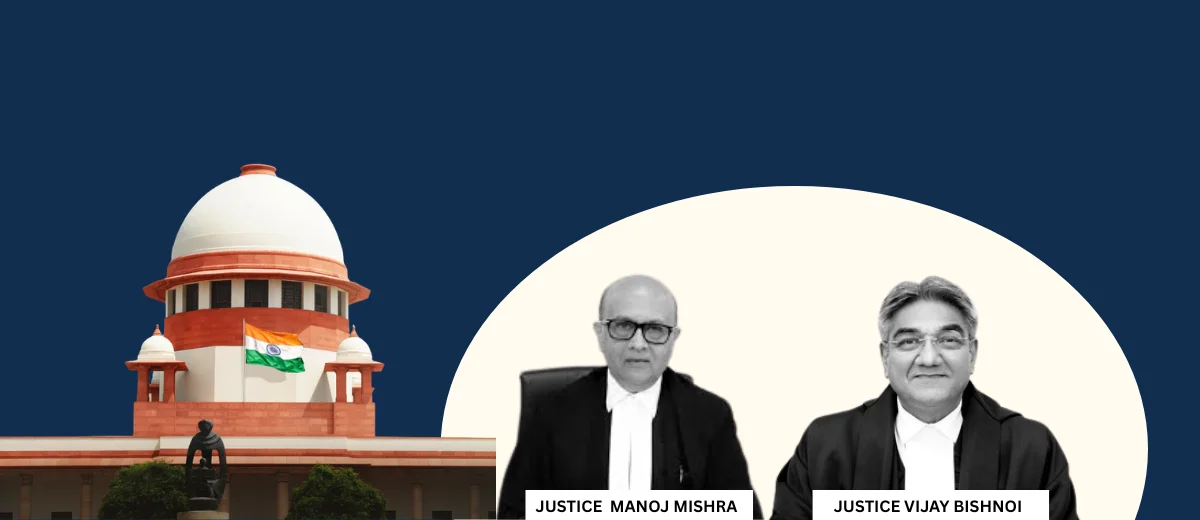
Coram: Hon’ble Mr. Justice Manoj Misra and Hon’ble Mr. Justice Vijay Bishnoi
Relevant Statutes & Provisions: Sections 302, 201 & 34 of the Indian Penal Code, 1860; Section 313 of the Code of Criminal Procedure, 1973; Section 106 of the Indian Evidence Act, 1872.
Introduction
Didar Singh @ Dari v. State of Haryana (along with Ranjeet Singh @ Jeeta v. State of Haryana) is a significant judgment of the Supreme Court dealing with the principles governing convictions based on circumstantial evidence. The case arose from the conviction of the appellants for murder under Sections 302 and 34 of the Indian Penal Code (IPC) by the Trial Court, which was affirmed by the High Court. The prosecution relied on the last seen theory, motive, recovery of articles, and disclosure statements to establish guilt. The Supreme Court closely examined whether these circumstances formed a complete and unbroken chain pointing only to the guilt of the accused. Finding serious inconsistencies and reasonable doubt in the prosecution case, the Court set aside the convictions and acquitted the appellants.
Facts
The appellants were convicted for the murder of the deceased under Sections 302 and 34 of the IPC. The prosecution alleged that the deceased was last seen leaving with the appellants on their motorcycle on the evening of 24th May 2004. The next morning, his body was found in a field with head injuries. The prosecution relied on the last seen theory after the recovery of the motorcycle and chappals, disclosure statements, and alleged motive to establish guilt. The Trial Court convicted the appellants, and the High Court affirmed the conviction. Aggrieved, the appellants approached the Supreme Court challenging the findings of the courts below.
Issues
- Whether the prosecution had proved the chain of circumstantial evidence beyond reasonable doubt to sustain the conviction of the appellants.
- Whether the last seen together circumstance, along with the alleged motive, recoveries and disclosure statements, was sufficient to establish the guilt of the appellants.
- Whether the prosecution had excluded every reasonable hypothesis consistent with the innocence of the appellants, thereby justifying their conviction for murder.
Arguments of the parties
The appellants argued that the prosecution failed to establish a complete chain of circumstantial evidence. They contended that the last seen together theory was unreliable due to the significant time gap between the deceased being last seen and the discovery of his body. They further submitted that the injuries could have resulted from a motorcycle accident and the alleged motive was not proved, and the disclosure statements and recoveries had no evidentiary value. They also argued that there was no recovery of the murder weapon or any scientific evidence linking them to the offence. Therefore, the conviction was unsustainable and they were entitled to the benefit of doubt.
The State contended that the prosecution had proved the guilt of the appellants through a complete chain of circumstantial evidence. It was also argued that the deceased was last seen alive with the appellants and was found dead the following morning. The recovery of the deceased’s chappals near the motorcycle and the appellants’ failure to explain when they parted company with the deceased further strengthened the prosecution case. Accordingly, the State submitted the conviction recorded by the Trial Court and affirmed by the High Court should be upheld.
Judgment and Analysis
The Supreme Court examined whether the prosecution had proved a complete chain of circumstantial evidence against the appellants. Referring to Sharad Birdhichand Sarda v. State of Maharashtra, (1984) 4 SCC 116, the Court reiterated that in cases based entirely on circumstantial evidence, every incriminating circumstance must be fully established and must point only towards the guilt of the accused, and must form a complete chain that excludes every reasonable possibility of innocence. In the present case, the prosecution relied on five circumstances: homicidal death, the deceased being last seen with the accused, recovery of the deceased’s slippers near the motorcycle, disclosure statements leading to certain recoveries, and motive. After examining each circumstance separately, the Court found that none of them had been proved beyond reasonable doubt. As a result, the prosecution failed to satisfy the test laid down in Sharad Birdhichand Sarda.
While considering the medical evidence, the Court observed that although the deceased had suffered fatal head injuries, the post-mortem report did not conclusively establish that the death was homicidal. Referring to Modi’s Medical Jurisprudence and Toxicology, the Court noted that similar injuries could also occur in a motorcycle accident. The Court also examined the stomach contents, intestinal findings and the estimated time of death. Relying on Shivaji Sahabrao Bobade & Anr. v. State of Maharashtra, (1973) 2 SCC 793, it observed that the contents of the stomach cannot be treated as a precise indicator of the time of death, as digestion varies from person to person. Since the medical evidence did not rule out the possibility of an accidental death, the Court held that the prosecution had failed to conclusively establish homicidal death.
The Court next considered the last seen together circumstance. Relying on Boby v. State of Kerala, (2023) 15 SCC 760, Nizam v. State of Rajasthan, (2016) 1 SCC 550, State of Rajasthan v. Kashi Ram, (2006) 12 SCC 254, and Satpal v. State of Haryana, (2018) 6 SCC 610, the Court reiterated that the last seen theory is a weak piece of evidence unless the time gap between the deceased last being seen with the accused and the discovery of the body is so small that the possibility of any third person’s involvement is completely ruled out. In the present case, the prosecution failed to establish the exact time of death, there was a significant gap between the deceased leaving with the accused and the recovery of the body, and there were material inconsistencies in the evidence of the prosecution witnesses. Therefore, the Court held that the last seen circumstance was not proved beyond reasonable doubt and could not complete the chain of circumstances.
The Court further found that the other circumstances relied upon by the prosecution also failed to inspire confidence. The ownership of the Yamaha motorcycle was not proved beyond reasonable doubt, as there was no reliable evidence connecting the vehicle with the accused. Similarly, the disclosure statements did not have much evidentiary value because the place of occurrence had already been discovered, and the recovered Honda motorcycle neither contained bloodstains nor showed any signs that it had been used to transport the deceased’s body. The Court also held that the prosecution failed to prove the alleged motive. Although it was alleged that the accused suspected the deceased of leaking information about their illicit activities to the police, no independent evidence, previous incident, or threat was produced to support this allegation.
The Court observed that if such hostility had actually existed, the conduct of the deceased and the prosecution witnesses would have been different. Referring to State of Punjab v. Kewal Krishan, (2023) 13 SCC 695 and Md. Anowar Hussain v. State of Assam, (2022) 19 SCC 264, the Court reiterated that recoveries and disclosure statements must have a clear evidentiary connection with the offence before they can be relied upon. The Court, relying on Shivaji Chintappa Patil v. State of Maharashtra, (2021) 5 SCC 626, reiterated that suspicion, however grave, cannot substitute legal proof. Unless the prosecution proves every incriminating circumstance beyond reasonable doubt and establishes a complete chain of evidence, the accused is entitled to the benefit of doubt.
Conclusion
The Supreme Court, therefore, held that the prosecution failed to establish a complete and unbroken chain of circumstantial evidence. As the circumstances did not conclusively point towards the guilt of the appellants and even indicated a reasonable possibility of accidental death, the appellants were given the benefit of doubt. Accordingly, the appeals were allowed, the judgments of the Trial Court and the High Court were set aside, and the appellants were acquitted of all charges.





 > Mon - Sat, 9:00 AM – 7:30 PM