
Case Name: Rehana Khan v. Rizwan Siddiquee
Civil Appeal No.: 12256 of 2025
Neutral Citation: 2026 INSC 907
Date of Judgment: 21.08.2026
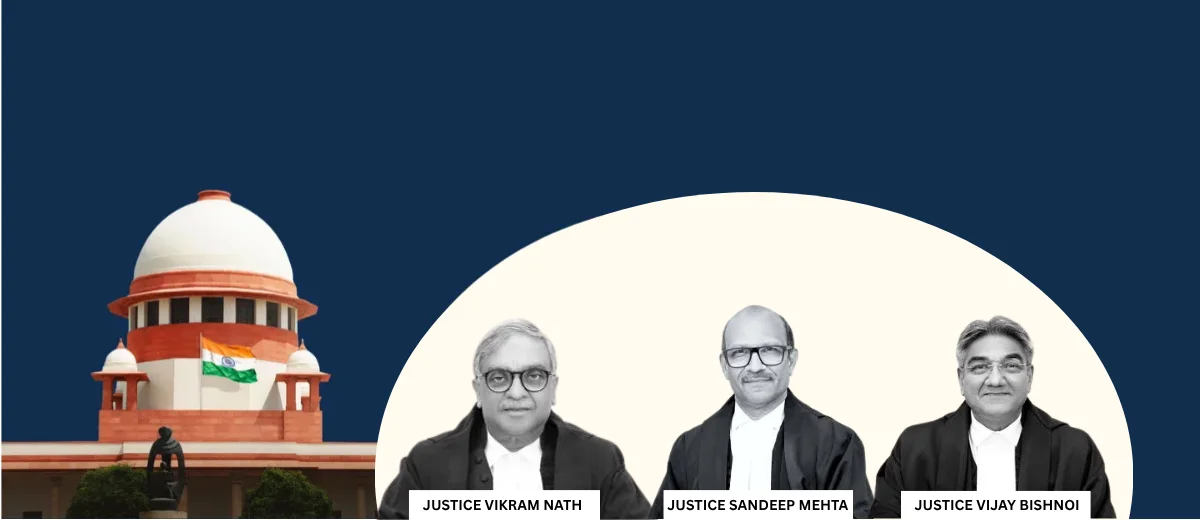
Coram: Hon’ble Mr. Justice Vikram Nath, Hon’ble Mr. Justice Sandeep Mehta and Hon’ble Mr. Justice Vijay Bishnoi
Relevant Statute and Provision: Section 35 of the Advocates Act, 1961.
(The judgment concerns whether an advocate’s duty of confidentiality and professional ethics continues even after the professional relationship with the client has ended, and whether disclosure of confidential client information to the media amounts to professional misconduct under Section 35 of the Advocates Act, 1961.)
In this judgment, the Court was called upon to determine whether an advocate’s duty of confidentiality towards a client continues even after the professional relationship has ended, and whether the disclosure of confidential client communications and related information to the media amounted to professional misconduct under Section 35 of the Advocates Act, 1961. While upholding the finding of professional misconduct, the Court reaffirmed that confidential information obtained during professional engagement cannot subsequently be used against the client.
FACTS
The Appellant, Rehana Khan, had engaged the Respondent, Rizwan Siddiquee, an advocate, as her counsel during 2013-2014. In the course of the professional engagement, she shared confidential information concerning her personal circumstances and allegations against a senior police officer. A legal notice was subsequently issued through the Respondent’s office to the said police official. On 24.07.2014, the Appellant lodged an FIR against the police official under Sections 376(2), 376C, 354 and 354D IPC, in which the Respondent was also named. Thereafter, on 05.08.2014, the Respondent gave interviews to television channels in which he discussed his relationship with the Appellant, information communicated to him by her, and conversations and messaging exchanges between them. The Appellant subsequently filed a complaint under Section 35 of the Advocates Act, 1961, alleging professional misconduct. The Bar Council of India’s Disciplinary Committee found the Respondent guilty of professional misconduct on three grounds, including unauthorised issuance of the legal notice, disclosure of confidential information, and derogatory public remarks. It ordered removal of his name from the roll for two years, imposed restrictions on his practice, and awarded monetary amounts.
ISSUES
- Whether the findings of professional misconduct against the Respondent under Section 35 of the Advocates Act, 1961, are sustainable, particularly in relation to the disclosure of confidential communications and information received from the Appellant during the professional relationship?
- Whether the Respondent was denied a reasonable opportunity of hearing in the disciplinary proceedings, and whether the alleged non-service of notice of the final hearing vitiated the order of the Disciplinary Committee?
- Whether the punishment imposed by the Disciplinary Committee of the Bar Council of India was inadequate so as to warrant enhancement, including permanent removal of the Respondent from the roll of advocates?
CONTENTIONS OF THE APPELLANT
- The Appellant contended that the Respondent, having been entrusted with confidential and sensitive information, breached the professional relationship of trust by disclosing such information publicly.
- It was argued that the Respondent had remained in contact with the opposing party during the period of his engagement, demonstrating collusion and bad faith.
- The Appellant submitted that the Respondent’s public statements and disclosures caused serious harm to her dignity, privacy, mental peace and reputation.
- She therefore sought permanent removal of the Respondent from the roll of advocates and compensation of ₹2 crore.
CONTENTIONS OF THE RESPONDENT
- The Respondent contended that he had been engaged only for the limited purpose of issuing a legal notice concerning alleged police harassment and that the draft of the notice had itself been supplied by the Appellant.
- He denied disclosing the Appellant’s confidential information or identity to the media and submitted that the Appellant herself had appeared before the media before his interview.
- He argued that his television appearance was merely an attempt to respond to public allegations made against him and that, by then, he was no longer representing the Appellant.
- The Respondent further challenged the disciplinary proceedings on the ground of violation of natural justice, alleging that the final hearing notice had not been served at his correct address and that the order was passed ex parte.
JUDGMENT ANALYSIS
- Advocate’s duty of confidentiality survives the termination of the professional relationship: The Supreme Court held that an advocate cannot use confidential information received from a client against that client, even after the professional relationship has ended. The Court expressly rejected the Respondent’s justification that he was entitled to speak publicly because the Appellant had subsequently become his adversary.
- Public disclosure of privileged communications constitutes professional misconduct: The Court held that an advocate who believes that he has been falsely accused has lawful remedies, including placing his version before the investigating agency or pursuing a defamation action. However, he cannot take his grievance to television and disclose privileged communications, play recorded conversations with his former client, or publicly attack the client. The finding of professional misconduct on this count was therefore held to be unassailable and sufficient to sustain the punishment imposed by the Disciplinary Committee.
- Natural justice argument rejected: The Court rejected the Respondent’s plea that he was denied a reasonable opportunity of hearing. It noted that he had entered appearance, filed a written statement, was represented by counsel and participated in the recording of evidence. The Court observed that a party who had participated throughout the proceedings could not subsequently claim that he was unaware of them.
- Appellant not entitled to enhancement: The Supreme Court also declined the Appellant’s request for enhancement of punishment. The Court found that she had not approached the Court with clean hands, as the record showed that she herself had participated in discussions concerning trapping the police official and had appeared before the media voluntarily. Further, the police official’s discharge had attained finality because she had not challenged it.
Therefore, the Hon’ble Supreme Court upheld the order of the Disciplinary Committee of the Bar Council of India. The appeals filed by both parties and the transferred case were dismissed. In view of the conduct of both parties, the Court imposed costs of ₹5,00,000 each, payable to the Supreme Court Legal Service Committee.




 > Mon - Sat, 9:00 AM – 7:30 PM