

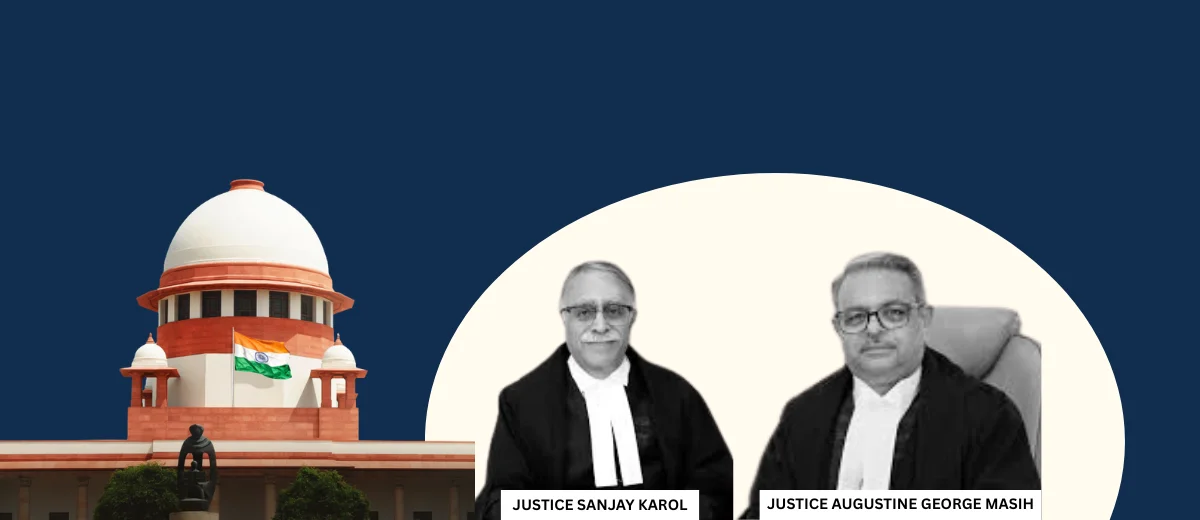
Case Name: Rutvij Bhagat Singh Wakhare v. The State of Maharashtra & Ors.
Petition No.: Writ Petition (Crl.) No. 127 of 2026
Neutral Citation: 2026 INSC 740
Date of Judgement: July 24, 2026
Coram: Hon’ble Mr. Justice Sanjay Karol and Hon’ble Mr. Justice Augustine George Masih
Relevant Statutes & Provisions: Article 19(1)(a), Article 21, Article 32, and Article 226 of Indian Constitution, Sections 34, 35, 36, 37, 120-B, IPC, Sections 43, 66(C), and 66(D) of IT act.
INTRODUCTION
In Rutvij Bhagat Singh Wakhare v. The State of Maharashtra & Ors, the Supreme Court evaluated whether multiple FIRs registered across different states of the country involving cyber fraud could be clubbed into a single composite investigation under Article 32. Dismissing the petition, the Court held that despite a common bank account and similar modus operandi, distinct transactions involving separate victims constitute independent offences, thereby rejecting the plea for consolidation.
FACTS
The petitioner challenged four FIRs registered across Maharashtra, Karnataka, and Odisha under the Indian Penal Code and Information Technology Act for “digital arrest” cyber fraud, wherein victims were coerced into transferring money into his proprietary concern’s bank account. Denying involvement, the petitioner claimed he was working abroad on a merchant ship while his account was misused by third parties, and sought relief under Article 32 to either quash the FIRs or club them into a single, composite investigation to avoid multiple proceedings.
ISSUES
- Whether the subject FIRs should be quashed.
- Whether clubbing and consolidation of the subject FIRs can be done and a direction one composite investigation be carried out by a single investigating agency.
ARGUMENTS OF THE PARTIES
The petitioner argued that parallel FIRs across three States for similar cyber fraud offences cause multiplicity of proceedings and conflicting findings, seeking their quashing or clubbing into a single investigation. He denied involvement, claiming he was working abroad on a merchant ship while third parties misused his proprietary bank account, and cited his severe heart condition and diabetes as grounds for relief under Article 32. The respondents contended that each FIR involved distinct complainants, separate financial transactions, and independent offences, failing the “same transaction” test. They asserted that cyber fraud investigations are at a nascent stage requiring state-specific forensic and financial tracing, and warned that clubbing the cases would prejudice victims and impede effective investigation.
JUDGMENT AND ANALYSIS
The Supreme Court dismissed the writ petition under Article 32 of the Constitution, refusing both to quash the subject FIRs and to direct their clubbing into a single composite investigation. Writing for the Division Bench, Justice Sanjay Karol affirmed that while Article 32 empowers the Court to quash criminal proceedings, this extraordinary remedy must be exercised sparingly and with self-imposed judicial discipline. Grounding its approach in established precedents such as Romesh Thappar v. State of Madras 1950 SCC 436 , Union of India v. Paul Manickam (2003) 8 SCC 342 , Jagisha Arora v. State of U.P. (2019) 6 SCC 619 , and Sunil Kumar Rai v. State of Bihar (2024) 17 SCC 592 , the Court reiterated that an aggrieved party is ordinarily expected to approach the High Court under Article 226 or Section 482 CrPC first. The Bench also highlighted the distinct difference between the maintainability of an Article 32 petition and whether it ought to be entertained.
The Court noted that direct intervention under Article 32 is reserved for clear violations of fundamental rights or exigent circumstances. Because the petitioner only asserted lack of knowledge and account misuse without establishing an infringement of Part III rights, no exceptional grounds existed to bypass statutory CrPC remedies. Furthermore, regarding the prayer for clubbing, the Court applied T.T. Antony v. State of Kerala (2001) 6 SCC 181 to affirm that no successive FIRs could be filed in connection with the same or connected cognizable offence alleged to have been committed in the course of the same transaction. The Court also relied on Babubhai v. State of Gujarat (2010) 12 SCC 254 wherein it was held that the ‘test of sameness’ has to be applied to determine whether two FIRs relate to the same incident or form different parts of the same transaction. It held that if the answer is in the affirmative, the second FIR ought to be quashed.
Reiterating the five principles summarized in State of Rajasthan v. Surendra Singh Rathore 2025 SCC OnLine SC 358, the Court summarised the principles regarding the permissibility of the registration of a second FIR, it observed that a second FIR may be maintainable where the scope of two FIRs are different, even if they arise from the same set of circumstances and also when the incidents in question are distinct irrespective of whether the offences alleged are similar or different. Applying these principles, it held that the FIRs registered across Maharashtra, Karnataka, and Odisha constituted distinct transactions involving different victims. Consequently, the petition was dismissed, leaving the petitioner at liberty to pursue appropriate statutory remedies before the competent forums
The Court further discussed the meaning of what constitutes ‘same transaction’ or ‘distinct offence’ by relying on State (NCT of Delhi) v. Khimji Bhai Jadeja, 2026 SCC OnLine SC 19 wherein the Court laid down triple tests, though not to be applied cumulatively, to decide whether separate actions can be treated as part of the ‘same transaction’ – (i) unity of purpose and design; (ii) proximity of time and place; and (iii) continuity of action.
CONCLUSION
In this case, the Supreme Court reaffirmed that Article 32 cannot be used to bypass High Court remedies under Section 482 CrPC unless fundamental rights are directly violated. It ruled that in multi-state cyber frauds, a shared bank account or similar modus operandi does not satisfy the “test of sameness” leaving distinct crimes against separate victims to be investigated independently.



 > Mon - Sat, 9:00 AM – 7:30 PM