
Case Name: THE STATE OF KERALA VERSUS K.A. ABDUL RASHEED
Petition Number: Special Leave Petition (Crl.) No. 1808 of 2026
Neutral Citation: 2026 INSC 365
Date of Judgement: 15.04.2026
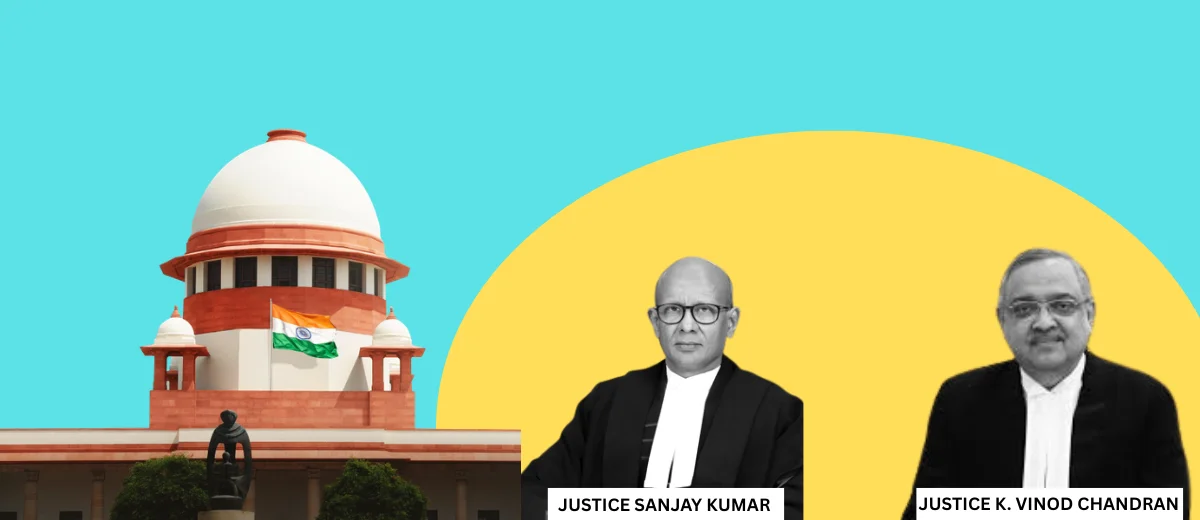
Coram: HON’BLE MR JUSTICE SANJAY KUMAR & HON’BLE MR JUSTICE K. VINOD CHANDRAN
INTRODUCTION
The appeal was filed by the State challenging a judgment of the High Court, which had acquitted the accused (a Taluk Supply Officer) of bribery charges under Sections 7 and 13(1)(d) read with 13(2) of the Prevention of Corruption Act, 1988 (PCA). The High Court had overturned the Trial Court’s conviction on the grounds that the complainant had turned hostile and prevaricated during the trial, allegedly failing to establish the foundational requirement of a “demand” for a bribe. The Supreme Court examined the evidentiary value of a hostile witness’s testimony and the establishment of demand and acceptance in corruption cases.
FACTS
The complainant was an Authorized Ration Dealer (ARD) whose weekly accounts and “Abstract” of ration cards needed to be verified and countersigned every three months by the Taluk Supply Officer (TSO), who is the accused in this case. The accused allegedly refused to countersign the Abstract and demanded a bribe of ₹500 to do so. Unwilling to pay the bribe, the complainant approached the Vigilance Department. An oral complaint was recorded by the Deputy Superintendent of Police in the presence of independent witnesses, including an Assistant Engineer. A trap was laid. The complainant and an independent witness entered the TSO’s cabin and handed over the phenolphthalein-powder-coated ₹500 note.
Upon receiving the pre-arranged signal, the trap team rushed in. The marked currency was recovered from the accused’s shirt pocket. Phenolphthalein tests on the accused’s left hand and shirt pocket turned pink, confirming contact with the bribe money. The Trial Court convicted the accused, imposing the statutory minimum sentence of two years. However, the High Court acquitted him, citing that the complainant had given evasive and inconsistent statements during cross-examination, and the independent witness who accompanied the complainant into the cabin was not examined, thereby creating a lacuna in proving the “demand.”
ISSUES
Whether the foundational ingredient of “demand” under the Prevention of Corruption Act can be considered proved when the primary complainant turns hostile and gives prevaricating statements during cross-examination?
ARGUMENT OF THE PARTIES
The Appellant (State) argued that although the complainant (PW1) made inconsistent statements during cross-examination, there was sufficient oral and corroborated evidence regarding the demand and acceptance. The State pointed out that the accused admitted to accepting the money, and the explanation he offered for it was a deliberate falsehood.
The Respondent (Accused) argued that the High Court’s acquittal fortified the presumption of innocence. Relying on precedents like Jayaraj B. v. State of Andhra Pradesh, 2014 KHC 4199, the defence contended that since the complainant denied every line of his Section 161 statement regarding the demand during cross-examination and stated in his deposition that the amount paid to the accused was with a request to deposit it with the bank as a fee for renewal of his license.
JUDGEMENT AND ANALYSIS
The Hon’ble Supreme Court allowed the appeal, set aside the High Court’s acquittal, and restored the Trial Court’s conviction and two-year sentence. The Court focused heavily on the legal principles surrounding hostile witnesses, explicitly referencing the Constitution Bench decision in Neeraj Dutta v. State (NCT of Delhi), (2023) 4 SCC 731 and Sat Paul v. Delhi Administration, (1976) 1 SCC 727. The Supreme Court reiterated that when a prosecution witness turns hostile or is cross-examined by the party calling him, his evidence is not automatically “washed off the record” in its entirety. The court must carefully scrutinise the testimony and accept the creditworthy portions that are corroborated by other evidence.
Applying this to the facts, the Court observed that while PW1 prevaricated during cross-examination, he explicitly affirmed during his chief-examination that he made the complaint detailing the ₹500 demand to the Vigilance Officer in the presence of the independent witness. Both of them fully corroborated that this complaint was made, recorded, and affirmed by the complainant. Thus, the initial demand was successfully established. Furthermore, the Supreme Court noted that the acceptance of the marked currency was not just proved by the trap proceedings but was actually admitted by the accused. The accused, however, provided contradictory and false explanations for receiving the money. The Court held that this false explanation regarding the admitted acceptance of the money served as an additional compelling circumstance pointing to his guilt.
CONCLUSION
The Supreme Court concluded that the High Court erred by mechanically discarding the entire evidence of the complainant just because he made inconsistent statements during cross-examination. The Court held that the creditworthy portions of a hostile witness’s testimony, when sufficiently corroborated by independent trap witnesses and official records, can validly establish the demand and acceptance of a bribe. Finding the accused’s guilt proved beyond a reasonable doubt, the Court restored the Trial Court’s conviction and the statutory minimum sentence of two years.


 > Mon - Sat, 9:00 AM – 7:30 PM