Case Name: YOGENDER CHANDOLA V. VISHESH RAVI & ORS.
Petition Number: EL.PET. 10/2020
Neutral Citation: 2026:DHC:3412-DB
Date of Judgment: 24th April, 2026
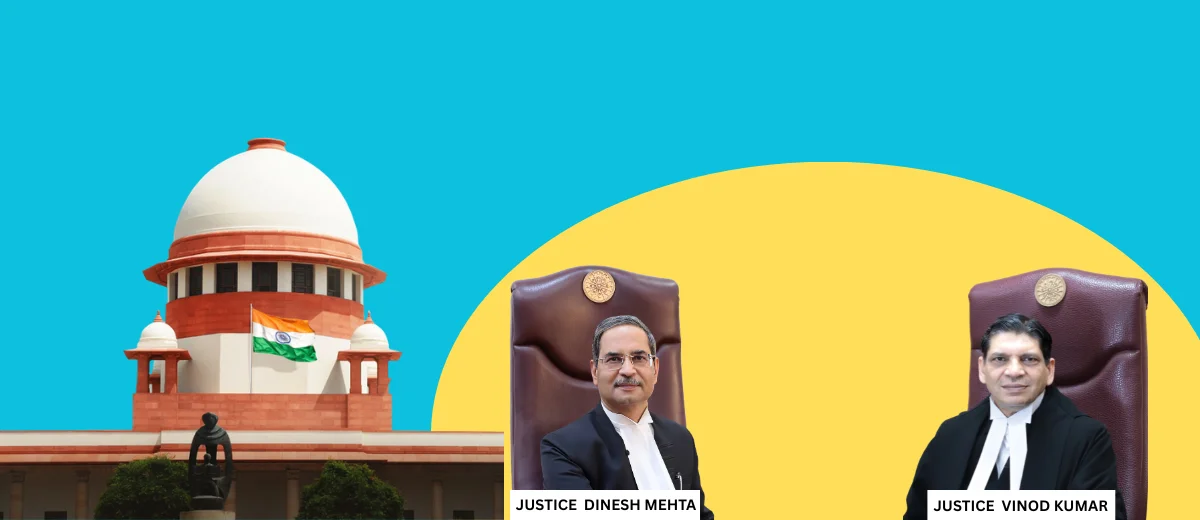
Coram: HON’BLE MR. JUSTICE DINESH MEHTA AND HON’BLE MR. JUSTICE VINOD KUMAR
INTRODUCTION
This matter arose from a reference made by a Single Judge while hearing the election petition. The petitioner challenged the election of the returned candidate from the Karol Bagh Assembly Constituency in the Delhi Legislative Assembly election of 2020. It was alleged by the petitioner that the returned candidate had furnished false information about his educational qualification in a nomination form (Form 26) and the affidavit and that this constituted “corrupt practice” under the Representation of the People Act, 1951 (RP Act). The case reached a Division Bench after the Single Judge referred a legal issue on whether false disclosure or non-disclosure of educational qualification in the Form 26 and nomination affidavit would attract Section 123 of the RP Act.
The Division Bench ultimately held that the petition had become infructuous because the assembly term had already ended and fresh elections had already been held in 2025.
FACTS AND PROCEDURAL HISTORY
The petitioner filed an election petition under Section 80 read with Section 100(1)(b) and 100(1)(d) of the Representation of People Act, 1951 (RP Act) seeking to declare the respondent’s (returned officer) election null and void. The allegation was that the respondent misrepresented his education that he had passed Class 10 from National Institute of Open Schooling (NIOS) in 2003, whereas the petitioner claimed that NIOS records showed that he had enrolled but had not appeared in the relevant examination. It was further pleaded by the Petitioner that this false declaration had been repeated in earlier elections in 2013 and 2015 which was intended to mislead voters and influence the election results. The grounds in this petition invoked “corrupt practices” as given under Section 123(4) of the RP Act and it was claimed that the false declaration materially affected the election result. During hearing of the matter, a question arose as to whether the petition was infructuous since the 2020 assembly term has ended and new elections were held in 2025. The Single Judge then referred the matter to a Larger Bench, to determine if false disclosure of educational qualification would attract Section 123 of the RP Act.
ISSUE
Whether false disclosure or non-disclosure regarding the candidate’s own educational qualification in a nomination form and the affidavit constitutes a “corrupt practice” under Section 123(4) of the Representation of the People Act, 1951 (RP Act) ?
SUBMISSIONS OF THE PARTIES
Petitioner’s Submission: The Petitioner submitted that the candidate knowingly made false disclosure about his educational qualification in order to influence voters and change the election result into his favour. The petitioner relied on the previous Delhi High Court ruling, Nand Ram Bagri v. Jai Kishan reported in 2013 SCC Online Del 1826, which suggested that such misinformation or false statements in nomination documents can amount to corrupt practices under Section 123 of the RP Act.
Respondent’s Submission: The respondent contended that Section 123(4) requires publication of a false statement about the personal character or conduct of another candidate, not the candidate himself. The respondent pleaded that the petition was framed under Section 123(4), not Section 123(4) and the court couldn’t rewrite a petition or supply a different statutory basis. Moreover, he relied on the judgment of Hon’ble the Supreme Court in the case of M.J Jacob v. A. Narayanan and Ors. (Civil Appeal 3611/2008) to emphasize that the election cannot be set aside, until the ingredients of Section 123(4) are found existing.
JUDGEMENT AND ANALYSIS
The Division Bench noted that the Petitioner’s pleading were confined to Section 123(4), which deals with publication and not on Section 123(2) which stipulates “an undue influence”. This mattered because the case of Nand Ram Bagri had involved arguments under both provisions, so it was not directly transferable to the present proceedings. The Court then broke down Section 123(4) into four ingredients: publication by a candidate, false or believed to be false publication, publication in relation to personal character/conduct of any candidate and an intent to prejudice that candidate’s election prospects. On this reading, the “candidate” whose prospects are prejudiced is the other candidate, not the person making the statement about himself. Therefore, a false statement about one’s own educational qualification doesn’t fit within Section 123(4).
The court also held that a nomination form (Form 26) and the affidavit declaration is not “publication” in the statutory sense and thus allegations as pleaded by the petitioner didn’t satisfy Section 123(4) ingredients. The Court distinguished Nand Ram Bagri from the present matter because that case involved a broader challenge that touched both Section 123(2) and 123(4) while in the present case, the petitioner framed the petition only under Section 123(4) so the court refused to import Section 123(2) into the case on its own. The court clarified the judgment rendered in Nand Ram Bagri to the extent it holds that wrong mentioning or incorrect statement given in the nomination form is corrupt practice within the meaning of Section 123(4) is not good law. The Bench further relied on Ajmera Shyam v. Smt. Kova Laksmi & Ors. reported in 2025 SCC OnLine SC 1723, noting that educational qualification disclosure should not be unreasonably stretched into a ground to invalidate an otherwise validly declared election over minor technical non-compliances.
The court concluded that even if the allegations were assumed to be true, they still would not amount to corrupt practice under Section 123(4) and since the legal foundation collapsed, the request for disqualification under Section 8A of the RP Act would also not arise. Finally, the assembly term had already ended and fresh elections had also been held in 2025, the petition was held liable to be treated as infructuous in practical terms as well.
CONCLUSION
Therefore, the judgment of this case narrows the scope and application of Section 123(4) by holding that false disclosure of one’s own educational qualification in nomination form (Form 26) or an affidavit is not, by itself, amounts to a corrupt practice under Section 123(4) of RP Act. The court also clarified that election petitions must be strictly and precisely pleaded and courts cannot expand them beyond the statutory language by purposive interpretation where the Act does not clearly permit it. In practical terms, the case strengthens the principle that election results should not be set aside on the basis of pleadings that do not fit squarely within the provisions of corrupt practice under the Representation of People Act, 1951 (RP Act).






 > Mon - Sat, 9:00 AM – 7:30 PM