

Case Name: J&K ECONOMIC RECONSTRUCTION AGENCY V. RASH BUILDERS INDIA PRIVATE LIMITED
Petition Number: DIARY NO. 44792 OF 2025
Neutral Citation: 2026 INSC 368
Date of Judgement: 15.04.2026
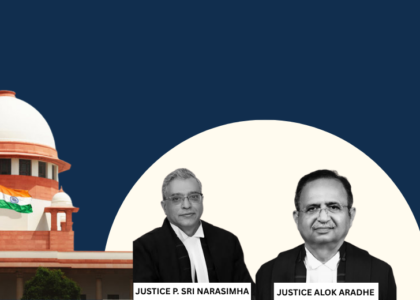
Coram: HON’BLE MR. JUSTICE PAMIDIGHANTAM SRI NARASIMHA AND HON’BLE MR. JUSTICE ALOK ARADHE
INTRODUCTION
In the present case, the Supreme Court examined and drew a clear legal distinction between the seat of arbitration and the venue of arbitration, which despite previous judgements, continued to create jurisdictional confusion in arbitration proceedings. In a Special Leave Petition filed before the Hon’ble Court, it also enumerated the legal consequences of jurisdictional errors.
FACTS AND PROCEDURAL HISTORY
The case arose from a dispute between the Appellant, Jammu and Kashmir Economic Reconstruction Agency (JKERA) and the Respondent, a Contractor wherein they entered into an agreement to execute four road infrastructural projects. The agreements were executed in 2008. When disputes arose regarding the Contract, the Respondent, based on the Arbitration Clause in their agreement, issued a notice to the Appellant. The Respondent thereafter filed four applications for appointment of Sole Arbitrator before the High Court, which was allowed. However, the appointment was challenged by the Appellant and the Sole Arbitrator was substituted. In 2016, the parties fixed Srinagar as the seat and New Delhi as the venue. The Arbitrator was substituted for the second time in 2021. In 2024, the arbitral award was delivered in New Delhi. The Appellant filed an application under Section 34 of the Jammu and Kashmir Arbitration and Conciliation Act, 1997 before the High Court, to set aside the award. However, the High Court returned the application, holding that since the arbitration proceedings had already been conducted and an award had been delivered, only New Delhi had jurisdiction. Aggrieved, the Appellant preferred appeal before the Supreme Court.
ISSUE
Whether New Delhi has exclusive jurisdiction over the arbitration proceedings despite an express agreement fixing Srinagar as the Seat of Arbitration?
SUBMISSIONS OF THE PARTIES
Learned Counsel for the Appellant submitted that the seat of arbitration was fixed by the arbitrator with the consent of both the parties and an alteration in the seat of arbitration could only be made by mutual agreement of both the parties. In instances where the seat and venue are different, the Counsel argued that the seat exercises supervisory jurisdiction and hence, only the Courts at Srinagar possessed jurisdiction. Learned Counsel for the Respondent contended that New Delhi was recorded as the place of arbitration in the arbitration award and that parties may alter the seat by mutual consent and hence, the appeal was liable to be dismissed.
JUDGEMENT AND ANALYSIS
The Supreme Court undertook a comprehensive view with reference to arbitral jurisprudence with the objective of clearing the clutter of jurisdictional errors and like in previous judgements, reiterated fundamental principles governing the Seat of Arbitration.
Quoting Bharat Aluminium Co. v. Kaiser Aluminium Technical Services Inc. (2012) 9 SCC 552, the Court explained that Arbitration depends on the place or seat chosen by both the parties, i.e. the legal place of Arbitration, which means the law governing the arbitration proceedings is the law of the Seat of Arbitration. It was observed that Section 20 of the Arbitration and Conciliation Act, 1996 encompasses choice of the parties to decide the seat of arbitration, while its sub-clause (3) permits to choose a place convenient to the parties. The Court underlined that Seat is the place of jurisdiction and Venue is merely for Convenience.
Relying on the ‘Close and Intimate Connection’ test evolved in English jurisprudence and referring to Enercon (India) Ltd. & Ors. v. Enercon GMBH & Anr.; (2014) 5 SCC 1 and Indus Mobile Distribution Pvt. Ltd. v. Datawind Innovations Pvt. Ltd. & Ors.; (2017) 7 SCC 678, the Court further explained that seat is the juridical home of arbitration, and that designation of a seat of arbitration in an agreement is equivalent to that of a Clause of Exclusive Jurisdiction.
Paragraph 15 reads as follows: “…once a seat is designated, it operates as the centre of gravity of the arbitration and vests exclusive jurisdiction in the courts of that place for all matters arising out of the arbitration, including challenges to the arbitral award. The designation of a seat, therefore, is not a matter of mere form, but carries with it significant legal consequences.”
The Court further explained that once the seat of arbitration has been designated in the agreement, regardless of whether the Cause of Action arose there or not, it operates as the Exclusive Jurisdiction. The Seat of Arbitration may also be a place which has no connection with the dispute.
The Court listed down the fundamental principles distinguishing the seat and venue of arbitration, which are summarised as follows:
- Seat of Arbitration is the juridical home or the legal place of arbitration, which identifies the Court having exclusive jurisdiction over the Arbitration matter.
- Once it is designated, it alone operates as an Exclusive Jurisdiction, including challenges to the Arbitration Award.
- Venue is only a geographical location fixed for convenience and does not alter the seat or change the jurisdiction.
- Even if proceedings are held or award is delivered elsewhere, the Seat of Arbitration remains fixed and cannot be amended unless by express agreement of the parties.
- Where it is not expressly designated, it can be determined by relying on the ‘Close and Intimate Connection’ test i.e. the place closely connected to the arbitration or in some cases, the venue and the seat can be the same, depending on the agreement and surrounding circumstances as well as the intention of the parties, express or implied.
Applying these principles to the present case, the Court noted that not only was there an express agreement, but the same was executed in the State of Jammu and Kashmir. The proceedings commenced in the said state and the corresponding High Court appointed the Arbitrator. This clearly draws the arbitration to Srinagar, the Court observed. Addressing the contention of the Respondent, the Court reiterated that the Seat of Arbitration is determined by the parties of the agreement alone and not by the recitals in the award. Unless the parties make an express agreement, it remains unalterable.
CONCLUSION
Therefore, the Court held that the High Court committed an error in not appreciating Srinagar as the designated seat of arbitration for mere reasons of convenience. The Supreme Court thus reaffirmed that party autonomy and legal certainty are the fundamental principles governing arbitration, and that seat and venue are distinct concepts. Accordingly, the Court allowed the appeal and quashed the impugned order of the High Court.





 > Mon - Sat, 9:00 AM – 7:30 PM