
Case Name: POORANMAL VS. THE STATE OF RAJASTHAN & ANR.
Petition Number: Criminal Appeal arising out of SLP (Crl.) No (s). 1977 of 2026
Citation: 2026 INSC 217
Date of Judgement: 10.03.2026
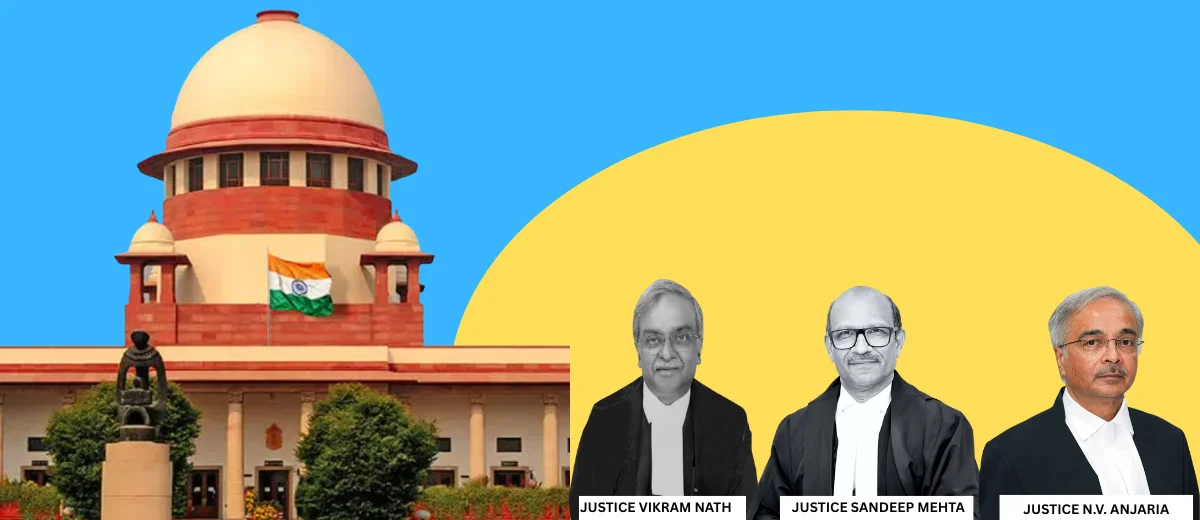
Coram: HON’BLE MR. JUSTICE VIKRAM NATH, HON’BLE MR. JUSTICE SANDEEP MEHTA & HON’BLE MR JUSTICE N.V. ANJARIA.
BACKGROUND:
The appellant and co-accused Ladu Lal were tried for the murder of Ladu Lal’s wife, Aruna. The Trial Court convicted both of them under Sections 302, 34 and 201 of the Indian Penal Code (IPC) and sentenced them to life imprisonment in 2012. The conviction was upheld by the Rajasthan High Court in 2018. Ladu Lal’s appeal to the Supreme Court was dismissed in 2022. Pooranmal could not file the appeal on time due to poverty and lack of access to legal assistance. Eventually, he approached the Supreme Court after 2749 days through legal aid which the Court condoned to hear the merits of his case.
FACTS:
On the night of March 2-3, 2010, Aruna was found dead in her home with some head injuries. Ladu Lal reported the crime and claimed that certain intruders had killed her and then fled the scene along with Rs. 4 lakh. Police grew suspicious of him with time and after a disclosure statement by Ladu Lal, Pooranmal was arrested. The case was based entirely on circumstantial evidence which consisted of:
- Call Detail Records showing frequent communication between the appellant and the co-accused around the time of the incident.
- Recovery of a blood-stained shirt allegedly belonging to Pooranmal.
- Recovery of Rs. 46,000 in cash.
ISSUES:
- Whether the circumstantial evidence proved his guilt beyond reasonable doubt?
- Whether the recovery of the shirt and cash can be considered as reliable evidence against him?
- Whether call detail records can be admitted without the mandatory certificate required under Section 65B of the Indian Evidence Act (IEA), 1872/ Section 63 of the Bharatiya Sakshya Adhiniyam (BSA), 2023?
ARGUMENTS OF THE PARTIES:
The appellant argued that the case is based on circumstantial evidence and that no credible evidence connects him to the crime. The call detail records are inadmissible as the mandatory certificate was not produced by the prosecution. The recovery of the blood-stained shirt and money was fabricated and had no clear nexus to the crime.
The respondents argued that since the co-accused’s appeal was already dismissed, Pooranmal’s appeal should be too. They claimed that the blood stain on the shirt matched the victim’s blood group and the appellant had no reasonable justification regarding its possession. The accused also failed to offer any explanation regarding his frequent contact with the co-accused.
The respondents also contended that the call detail records were proved by the nodal officers of the service providers and hence, non-production of the certificate under Section 65B should not be treated as fatal to the prosecution’s case.
JUDGEMENT AND ANALYSIS:
The Supreme Court set aside the conviction and acquitted the appellant. It was stated that in circumstantial cases, the evidence must exclude every hypothesis of innocence. The Court found a major discrepancy in the movement of samples to the FSL. Malkhana registers showed samples were sent and returned with defects but the reasons were never stated. This breach in the chain of custody made the FSL report unreliable.
The Court reaffirmed that a certificate under Section 65B of IEA is a mandatory condition for the admissibility of electronic records. Oral testimony of telecom officers cannot be considered a substitution for the same. Since no certificate was produced, the call detail records were entirely inadmissible.
The Court noted that the Investigating Officer could not explain why Rs. 46,145 was found in court when only Rs. 46,000 was allegedly seized. Additionally, it was highly improbable that an accused would hide a blood-stained shirt for days instead of destroying it.
CONCLUSION:
This judgement clarifies that electronic evidence cannot be admitted without a valid certificate as mentioned under Section 65B of IEA/Section 63 of BSA. Oral testimony of experts or officials cannot act as a substitution for the same. This decision strengthened the evidentiary safeguards regarding electronic evidence in criminal cases in order to protect the rights of the accused persons.
Contributed by:- Krishti Chakraborty (5th Year)
AMITY LAW SCHOOL, NOIDA


 > Mon - Sat, 9:00 AM – 7:30 PM