
Case Name: M/S A.K.G. CONSTRUCTION AND DEVELOPERS PVT. LTD VERSUS STATE OF JHARKHAND & ORS.
Petition Number: SPECIAL LEAVE PETITION (CIVIL) NO. 23858 OF 2025
Neutral Citation: 2026 INSC 312
Date of Judgement: 02.04.2026
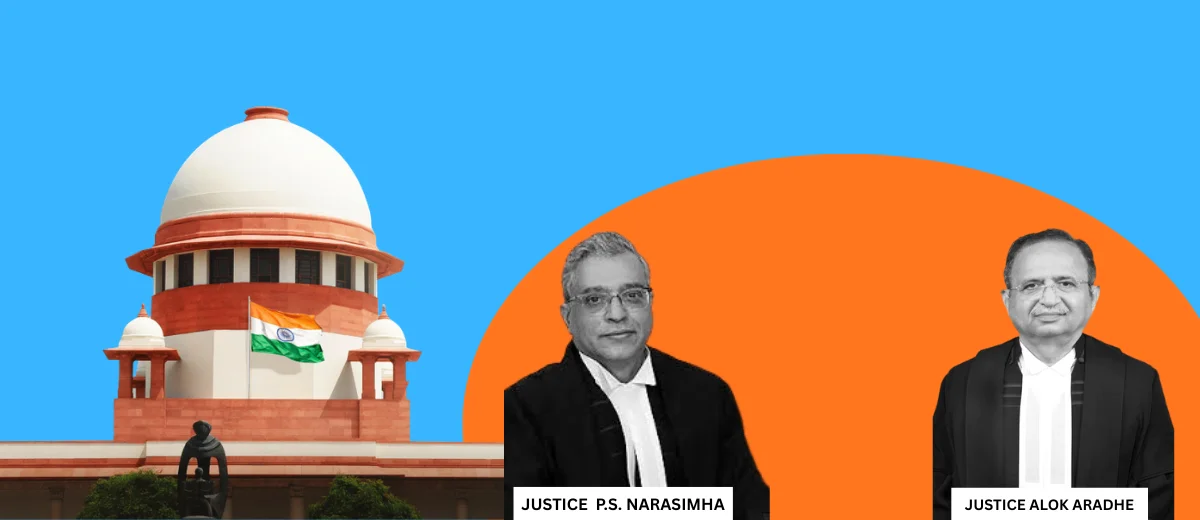
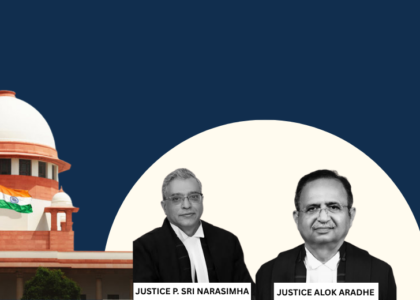
Coram: HON’BLE MR JUSTICE PAMIDIGHANTAM SRI NARASIMHA & HON’BLE MR JUSTICE ALOK ARADHE
INTRODUCTION
The appeal was filed by a construction contractor challenging a High Court order that affirmed the State Government’s decision to terminate its contract and blacklist it for a period of five years. The Supreme Court examined the distinct standards of legality, rationality, and proportionality that apply to administrative actions involving contract termination versus those involving blacklisting. The Court determined whether a general show-cause notice for negligence and poor quality work could serve as a legally valid foundation for imposing the severe and stigmatic penalty of blacklisting.
FACTS
The appellant, a registered contractor with the Drinking Water and Sanitation Department of Jharkhand, was awarded a contract in 2023 for the construction of an Elevated Service Reservoir (ESR). On June 1, 2024, the top dome of the under-construction reservoir collapsed. Although the appellant attributed the collapse to an unexpected cyclone and offered to rebuild it at its own expense, the Department issued a show-cause notice, inquiring why no action should not be taken for negligence and poor work quality.
Following the notice, multi-level enquiries were conducted, including inputs from premier engineering institutes (IITs), which concurrently indicated negligence on the part of the appellant. Consequently, the Chief Engineer issued a common order terminating the contract and blacklisting the appellant for a period of five years under the Contractor Registration Rules, 2012. This order also directed the stoppage of all other works being executed by the appellant and the confiscation of security deposits. The Appellate Authority and the High Court subsequently dismissed the appellant’s appeals and writ petitions, holding that the appellant’s own offer to reconstruct the dome inferred an admission of negligence and that proper opportunity was given.
ISSUES
- Whether the termination of the contract was valid despite the appellant’s claim of lacking a sufficient opportunity to be heard during the committee inquiries?
- Whether a general show-cause notice regarding negligence is sufficient to impose an order of blacklisting, or if a specific, unambiguous notice proposing blacklisting is mandatory under the principles of natural justice?
SUBMISSIONS BY THE PARTIES
The Appellant argued that both the termination and the blacklisting were illegal and arbitrary. They contended that the multiple committee reports were prepared without granting them an opportunity to be heard. Furthermore, they asserted that the decision to blacklist was excessively harsh and arbitrary, as it effectively terminated all of their other subsisting contracts with the Department without a specific show-cause notice warning them of such a drastic penalty.
The Respondent argued that Clause 59 of the General Conditions of Contract (GCC), which deals with termination, does not mandate a prior notice. Regarding the blacklisting, they relied on Rule 10 of the Contractor Registration Rules, 2012. They submitted that the show-cause notice issued on June 4, 2024, specifically fulfilled this requirement because it explicitly asked the contractor “why action should not be taken against you as per rules,” making the combined order of termination and blacklisting entirely legal and valid.
JUDGEMENT AND ANALYSIS
The Hon’ble Supreme Court delivered a split decision regarding the two administrative actions: it upheld the termination but set aside the blacklisting order.
Regarding the termination, the Court found the decision unimpeachable. The clear, corroborated findings of negligence by multiple technical institutes justified the termination. Furthermore, the Court noted that the appellant had been given sufficient opportunity to defend itself during the common hearing, before the Appellate Authority, and before the High Court, thereby satisfying the requirements of due process for contract termination.
However, regarding the blacklisting, the Court held that the order suffered from patent infirmities. The Court emphasized that the contractual conditions governing termination and those that relate to blacklisting are distinct and will be exercised independently. A decision of blacklisting is not automatic and certainly not a logical consequence of a decision of termination. The blacklisting order involves civil consequences; it casts a slur and bars the contractor from future business.
Relying on established precedents like Erusian Equipment & Chemicals Ltd. and UMC Technologies Pvt Ltd, the Court reiterated that natural justice mandates a specific, clear, and unambiguous show-cause notice spelling out the intention to blacklist. The June 4, 2024 notice merely asked for clarification regarding negligence and did not explicitly propose blacklisting. Therefore, the decision of blacklisting of the appellant was deemed to be illegal, arbitrary and unreasonable. To prevent further unnecessary litigation, the Court moulded the relief, directing that the blacklisting order would cease to operate immediately rather than remanding the matter for a fresh notice.
CONCLUSION
This judgment establishes that the administrative powers of contract termination and blacklisting carry differing gravities and must be exercised independently with distinct levels of scrutiny. While a contract may be terminated based on proven negligence, the severe penalty of blacklisting cannot be imposed mechanistically as a byproduct of that termination. It strictly reaffirms that a vague or general show-cause notice is legally insufficient for blacklisting; authorities must issue a specific, unambiguous notice proposing blacklisting to ensure strict adherence to the principles of natural justice.



 > Mon - Sat, 9:00 AM – 7:30 PM