
CASE: M/S CHOPRA HOTELS PRIVATE LIMITED v. HARBINDER SINGH SEKHON & ORS.
PETITION NUMBER: ARISING OUT OF SLP (C) NO(S). 9321-9322 OF 2026
CITATION: 2026 INSC 335
DATE OF JUDGEMENT: 08.04.2026
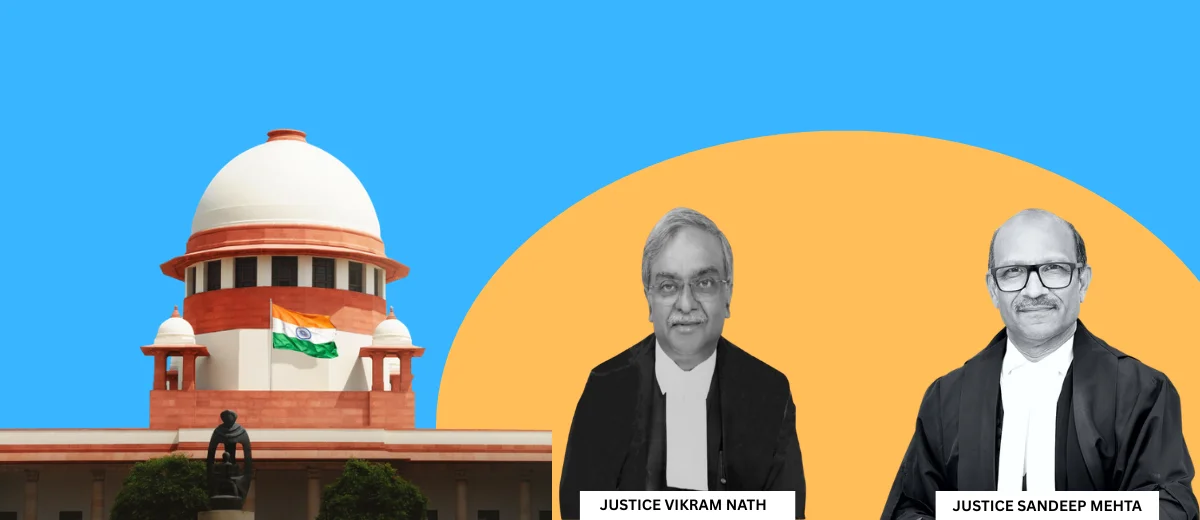
HON’BLE JUDGE/ CORUM: HON’BLE JUSTICE VIKRAM NATH AND HON’BLE JUSTICE SANDEEP MEHTA
INTRODUCTION
Justice Vikram Nath and Justice Sandeep Mehta, on April 8, 2026, decided on the sanctity of procedural fairness and the right to be heard in a case emerging from a complex web of municipal regulations, building violations, and shifting state policies. The dispute questioned whether a party whose property rights were directly jeopardised by a court’s interim order could be denied participation in those proceedings simply because they were not an original party to the litigation. The Court, through its judgment, gave a critical reminder that while technicalities often govern legal processes, they must never be used to shut out individuals whose interests are demonstrably affected by judicial action.
FACTUAL MATRIX
The dispute took place in Jalandhar, where the appellant owned a property that they had transitioned from residential to commercial use in 2006. By 2011, the Municipal Corporation of Jalandhar had approved plans for a hotel on the site. However, when the appellant applied for a completion certificate in 2024, a discrepancy regarding the front setback, i.e. the distance between the building and the road, stalled the process. The appellant argued this was a result of a surveyor’s error, noting that the plot was recorded as a rectangle in the sanctioned plans rather than a trapezium.
A potential resolution appeared on December 15, 2025, when the State of Punjab notified the Punjab Unified Building Rules, 2025. These new rules reduced the minimum front setback requirement for commercial buildings to 10%. Since the appellant’s building maintained a setback of 15.37%, it became compliant under the new regime. However, this relief was short-lived. The 2025 Rules were immediately challenged in the High Court of Punjab and Haryana via a writ petition, and on December 24, 2025, the High Court issued an interim order staying the implementation of any rules inconsistent with previous regulations and prohibiting the regularisation of existing violations.
PROCEDURAL HISTORY
The impact of the High Court’s stay was immediate and severe for the appellant. Municipal authorities cited the interim order to deny the appellant the benefits of the 2025 Rules, leading to the sealing of the hotel in early 2026, followed by a demolition order. The appellant challenged the demolition in a separate writ petition, but the High Court relegated them to statutory remedies under the Punjab Municipal Corporation Act, 1976.
The Appellant then moved two applications in the original writ petition that had stayed the 2025 Rules: one for impleadment, i.e. to become a party to the case and another for clarification of the stay order. On February 26, 2026, the High Court dismissed both, asserting that the appellant was not a necessary party and had no lis, i.e. legal dispute before that specific bench. Parallelly, the appellant’s statutory appeals and subsequent revisions were dismissed or tied to the outcome of other pending matters, leading to a situation where demolition commenced just thirty minutes after an adverse order was pronounced. The Supreme Court eventually stepped in, staying all proceedings and reserving judgment to determine the appellant’s right to intervene.
ISSUES OF THE CASE
The Supreme Court identified the core of the controversy as a procedural one.
- Whether the High Court was justified in holding that the appellant had no lis and was not entitled to be heard in the proceedings challenging the 2025 Rules?
- Whether a specific further course of action should be adopted in respect of the pending LPA No. 760 of 2026 and CR No. 2579 of 2026 to ensure they are adjudicated on their own merits?
JUDGEMENT ANALYSIS
The Hon’ble Court began by revisiting the established principles of impleadment. Drawing from the precedent of Mumbai International Airport Pvt. Ltd. v. Regency Convention Centre (2010) 7 SCC 417, the Court distinguished between a necessary party, i.e. without whom no order can be passed and a proper party, i.e. whose presence allows for a complete adjudication. The Court found the High Court’s view that the appellant had no lis to be unsustainable.
Further, the Bench noted that the interim order dated December 24, 2025, was not merely an abstract challenge to the rules; it was being actively used by authorities to deny the appellant’s specific property rights. The Supreme Court reasoned that:
- Direct Impact: When a person is directly and demonstrably affected by an interim order, they cannot be excluded from the proceedings simply because they were not an original party.
- Consistency: The High Court had previously allowed another entity to be impleaded in the same case, suggesting that the proceedings were not intended to be impervious to third parties.
- Procedural Justice: Denying the appellant an opportunity to be heard in the very forum where the prejudicial order originated was a failure of procedural fairness.
However, the Court declined to rule on the actual validity of the 2025 Rules or the specific compliance of the appellant’s building, stating that doing so would trench upon the jurisdiction of the High Court. Instead, it focused on setting the procedural exclusion right. The Court also addressed the logistical complex web of the multiple pending cases. It rejected the idea that the appellant’s independent remedies should be kept in abeyance until the parent writ was decided. It argued that making a party wait for the end of a broader challenge could make their specific legal remedies illusory in practical terms.
Further, the Court directed that LPA No. 760 of 2026 and CR No. 2579 of 2026 be heard together and adjudicated independently on their own merits. Rejecting indefinite delays, the Bench emphasized that independent remedies should not remain dormant merely because a broader challenge is pending. Consequently, a status quo was ordered to preserve the property until these specific matters are disposed of by the High Court.
CONCLUSION
Thus, the Court allowed the appeals and set aside the High Court’s dismissal. It ordered that the appellant be impleaded as a respondent in the parent writ petition and ensured that a party facing immediate civil consequences cannot be reduced to a mere spectator in litigation that directly impacts their property rights. By untangling this procedural knot, the Supreme Court reaffirmed that the right to be heard is not a technical privilege, but a fundamental cornerstone of the Indian judicial system.


 > Mon - Sat, 9:00 AM – 7:30 PM